
How Modi changed Odisha’s growth story
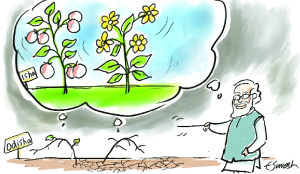
In Odisha, Modi’s impact is increasingly visible — in roads and railways, ports and airports, investment and tribal development. The larger question is whether this Centre-State partnership is doing more than building infrastructure: is it reshaping Odisha’s place in India’s economic landscape?
On September 17, Prime Minister Narendra Modi turned 76. Birthdays like this usually bring out tributes. I could write one easily enough. But I’d rather ask a simpler question. It’s the kind of question a state government owes its own people. Has this leadership actually changed how Odisha grows? I think it has. I want to walk you through ‘why’ and ‘how’.
This question isn’t abstract for me. For Odisha, a state long rich in mineral wealth but historically kept on the edge of national economic planning, the answer isn’t just rhetorical but measurable. You can see it in rail connectivity, in port capacity and in investment inflows. A policy architecture called Purvodaya now treats eastern India’s growth as central and not something of secondary importance.
From welfare list to growth strategy
The Prime Minister’s idea of Sabka Saath Sabka Vikas gets talked about mostly in political terms. The more useful test for me is administrative. Has it actually changed who gets access to the state? In Odisha’s case, it has. Our tribal communities make up 23 per cent of the state’s population. They used to be treated mainly as a welfare category. Now they sit at the centre of how we plan industry and infrastructure, including value addition in the mineral belt and coverage under Ayushman Bharat and PM Awas Yojana.
The point I want to make here is structural, not personal. When a government treats tribal-belt development as a core economic strategy rather than a mere side welfare programme, outcomes change at scale. That shift will possibly outlast me and every other Chief Minister.
What has the double-engine government built?
Since our government took office, closer coordination between Bhubaneswar and Delhi has produced things we can actually track. A rail programme built to connect all 30 districts of the state. Continued expansion of capacity at Paradip Port. There is a massive effort to build new roads, ports and airports. We are building connectivity across land, water and air. A real and sustained push to bring in global capital.
That last point isn’t theory for me right now. I got back from a three-day investment roadshow in the UAE, and our delegation across Abu Dhabi and Dubai proudly came away with proposals worth roughly `2.43 lakh crore. The potential is well close to nine lakh jobs, along with eight signed MoUs. The total investment proposals with us now are over `22.5 lakh crore. We are already witnessing investments worth over `3.11 lakh crore on the ground. Factories are being built, production being commissioned and jobs being created.
I must proudly say that Odisha can now walk into a room with sovereign wealth funds and be taken seriously. Not as a place you extract minerals from but as an investment destination in its own right. That is the change I keep trying to describe.
That is what Purvodaya actually means in practice. It isn’t a slogan about eastern India rising. But it’s about infrastructure spending and investor attention finally going to a region that spent decades exporting raw minerals and getting very little value addition back.
Our own state initiatives add to that, which is a reduced stamp duty for economically weaker sections under PMAY-U 2.0, along with new irrigation and water security projects. All of it is meant to keep that investment local, not let it pass through.
Security first
Growth needs peace before it can take root. Odisha’s security situation has genuinely changed. Districts that were Maoist strongholds for three decades, places like Malkangiri, Koraput and Kandhamal, have seen a real and sustained fall in Naxal activity. Growth corridors and security corridors have finally lined up. That didn’t happen consistently in earlier decades. I count it as one of the quieter but more important results of Centre-State coordination under this government.
Closing the gap
Odisha’s per capita income and human development indicators still trail several peer states. We are working to close them, not explain them away. One such instance is our Subhadra Yojana. This is one attempt to close income gaps for women. The scheme, along with the rest of the Purvodaya effort, is actually delivering measurable effects. The reports of several organisations, like IIM Sambalpur and SBI, are encouraging. Women are increasingly attracted to doing business.
Confident abroad, close to home
In the end, what strikes me most about the Prime Minister’s decade in office isn’t any one particular scheme. It’s the way he holds two things together that rarely sit comfortably in Indian politics. First, a foreign policy that is confident enough to negotiate as an equal at G20 forums. Second, a domestic style, Mann Ki Baat above all, built around direct connect with people in India’s smallest villages.
Odisha’s international profile used to be thin despite our coastline and our mineral wealth. That global confidence has had a real spillover effect now. International capital is now willing to look at eastern India for investments, and not just as a development liability.
With Modiji at the helm, we are confident of Odisha’s transformation in a few more years. Odisha is narrowing the gap. The coming years are going to be our years of destiny. Samruddha Odisha is in the offing.
I must proudly say that Odisha can now walk into a room with sovereign wealth funds and be taken seriously. Not as a place you extract minerals from but as an investment destination in its own right. That is the change I keep trying to describe
The writer is the Chief Minister of Odisha; Views presented are personal.