
High-tech weapons, made in India
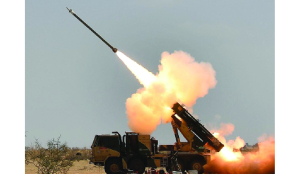
Made-in-India weapon systems looked impressive at Armenia’s Republic Day military parade on 28 May 2026. Armenia, emerging as one of reportedly eighty countries buying Indian-manufactured weapons, also highlights the growing global trust in “Make in India” military technology. The proudly weapon systems that Armenia purchased from India included the Pinaka Multi-Barrel Rocket Launchers for rapid, long-distance saturation strikes; two types of highly mobile 155 mm artillery guns; Akash medium-range surface-to-air missile systems designed to intercept aircraft, drones, and cruise missiles and Swathi Weapon Locating Radars with pinpoint accuracy. Armenia has recently emerged as India’s largest and primary export market for military weaponry.
Operation Sindoor, launched in May 2025, confirmed that India had made immense progress in providing indigenous, state-of-the-art weapon systems to its Armed Forces. India’s Defence Research and Development Organisation (DRDO) and some other Indian industrial companies demonstrated the capacity and capability to build the modern weapon systems covering strategic, air defence, air surveillance and integrated command and control sections for wide and effective air defence of the country. The key indigenous systems developed by DRDO, which played a decisive role during Op Sindoor, were:
- Surface-to-Air Missiles, which included the Akash Missile System, with over 96 per cent Indian content, along with medium-range missiles used for advanced area defense.
- Akashteer (meaning sky arrow) System, an automated air-defence control and reporting system which performed exceptionally well, integrating various sensors and communication frameworks into a single mobile network.
- Supersonic Cruise Missiles, produced by BRAHMOS and delivered pinpoint accuracy during strikes.
- Counter-Drone Technology included -man-portable counter-drone systems and the D4 Anti-Drone System, which were successfully utilised to jam and neutralise hostile unmanned aerial vehicles.
Former DRDO experts and top officials praised the performance of homegrown technologies, emphasising that the success in this conflict debunked prior criticisms of the organisation. Post Op Sindoor, unclassified productions by DRDO are:
India’s Sudarshan Chakra
An indigenous Iron Dome, a network-centric shield capable of neutralizing ballistic missiles up to 5,000 km in range. This is a major leap forward for Mission Sudarshan Chakra (Lord Vishnu’s constantly spinning celestial discus, which is a powerful symbol of divine protection), which is India’s ambitious initiative to build a multi-tiered, all-encompassing air and missile defence umbrella. The goal is to develop an indigenous capability with features akin to Israel’s Iron Dome and the US THAAD system, allowing India to counter everything from short-range rockets and drones to long-range ballistic threats.
Project Kusha
Under this project, DRDO has also been working on broader defense shields like the Long-Range Surface-to-Air Missile system to intercept threats at varying distances.
MIRV - AGNI V
MIRV (Multiple Independently Targetable Re-entry Vehicle) is an advanced ballistic missile technology that enables a single missile to carry and deliver multiple nuclear warheads against different targets. Integrated into the DRDO-developed Agni-V, it significantly enhances India’s strategic deterrence. The successful flight trials were conducted under Mission Divyastra. The MIRV-capable Agni-V, with an estimated range of 5,000-8,000 km, releases independent warheads after re-entering the atmosphere, enabling simultaneous strikes on multiple targets while complicating enemy missile defence systems.
SHESHNAAG 150
The Sheshnaag-150 (also known as Nagraja-meaning king of serpents) is an indigenous, AI-powered long-range swarm kamikaze drone developed by Bengaluru-based NewSpace Research and Technologies (NRT) to function as a low-cost, high-impact strike system. It features a range of over 1,000 km, carries a 25-40 kg warhead, has over five hours of endurance and operates in swarms to overwhelm the enemy’s defences. It is designed to operate in GPS-denied environments utilising advanced visual navigation systems. It can be launched from mobile platforms, such as a modified Toyota Hilux pickup truck. This drone aims to fill a niche for cost-effective, long-range, and high-precision strikes.
TARA
On May 7, 2026, DRDO and the Indian Air Force (IAF) successfully carried out the maiden flight trial of India’s first indigenous glide weapon system, TARA (Tactical Advanced Range Augmentation) designed to convert unguided warheads into precision-guided munitions (PGMs). Jointly developed by RCI (Research Centre Imarat) and other DRDO labs, the system, now in production with industry partners, demonstrated the ability to extend the range of a bomb to between 150 and 180 km when released from an altitude of 5 km, with a circular error probability (CEP) of three metres. The system deploys wings and tail units after release, using inertial navigation, GPS-assisted guidance and electro-optical seekers to achieve an accuracy of under five metres.
CADET Kamikaze drones
India is rapidly advancing its asymmetric and mobile warfare capabilities through the Carrier Air Defence Tracked (CADET) system, an advanced, mobile and armoured air defence platform developed by the Indian Army. It marks a shift from static territorial defence to mobile air defence for advancing mechanised forces. The kamikaze drones include the Peacekeeper Drone, with a range of 180 km, a speed of 450 km/h and a targeting accuracy (Circular Error Probable) of less than five metres. The CSIR-NAL Heavy Drone carries a 25 kg explosive payload, has an endurance of nine hours and a maximum range of 1,000 km. The drones are resistant to jamming and spoofing, using the indigenous NAViC satellite navigation system developed by the Indian Space Research Organisation (ISRO).
India’s exports of high-tech military weapon systems grew rapidly between 2022 and 2026, with total defence exports rising from Rs 686 crore in FY 2013-14 to a record Rs 38,424 crore in FY 2025-26, supplying over 80 countries.
Col Anil Bhat, VSM (Retd) is a strategic affairs analyst and former Defence Ministry and Indian Army spokesperson; Views presented are personal.