
Forty days of anger explodes on streets
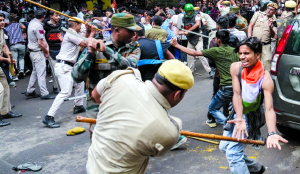
They came in the rain. They came from Uttar Pradesh, Haryana, Punjab, Bihar, Rajasthan, Maharashtra, Assam, and Madhya Pradesh. They came because a girl named Riya Thapa had died by suicide, because the NEET paper had leaked, and because nobody in Government had resigned. They gathered at Jantar Mantar from Sunday night, slept on the wet ground and on Monday morning, they tried to walk to the Parliament. The Delhi Police, which had imposed Section 163 of the Bharatiya Nagarik Suraksha Sanhita, which replaced the old Section 144 of the CrPC, across the New Delhi district, was waiting for them.
What followed was the one of the most charged days of political protest in the Capital in years.
The Cockroach Janata Party’s (CJP) Chalo Sansad march was met with batons charges near the Parliament Street, tear gas shells near the Shastri Bhawan and the Raisina Road, and mass detentions across central Delhi. Internet services were suspended in parts of the Capital. Several entry gates to the Parliament were shut.
Protesters attempting to reach Jantar Mantar from Mandi House Metro Station were assaulted by the police. By 4 pm, repeated tear gas shelling pushed protesters past a breaking point, and the demonstration turned violent. Stone-pelting began, and police vehicles were smashed near Rajiv Chowk. By evening, Jantar Mantar was completely empty, with protesters regrouped and gathered around Connaught Place and Rajiv Chowk. The CJP launched its sit-in at Jantar Mantar on June 6, over 40 days ago.
The demand throughout has been the resignation of Union Education Minister Dharmendra Pradhan over alleged irregularities in NEET-UG 2026. The Government did not engage until Monday, the day of the march, when CJP spokesperson Saurav Das and Ashutosh Ranka were called in to meet BJP president JP Nadda. Das posted from outside the meeting, “Our demands are clear. The youth have gathered in huge numbers.” After the meeting, he said Nadda had assured him he would speak internally, but that no commitments had been made.
The father of Riya Thapa, the NEET student who died by suicide, was present at Jantar Mantar and persuaded CJP founder Abhijeet Dipke, who had himself been on hunger strike, to end his fast and lead the march. Dipke, addressing supporters earlier in the day, said, “This Government is not satisfied with taking the lives of 20 NEET students. They are now baying for the blood of others.”
The CJP posted as the internet was cut in parts of the city: “You can shut down the internet, but how will you close the eyes and ears of the protesters who will see and report?” Delhi Police Additional CP Rajeev Ranjan appealed for calm: “Delhi Police appeals to all protesters to maintain peace, exercise restraint, and cooperate with the police.”