
Europe’s Two ‘Queens’ at War
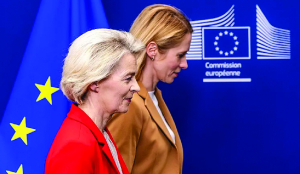
Israel’s decision to sever ties with EU foreign policy chief Kaja Kallas has exposed a deepening battle at the heart of the European Union– an escalating rivalry between Kallas and Ursula von der Leyen over who should steer Europe’s foreign policy in an increasingly volatile world. It is a contest between competing visions of European power
When Israel announced last Thursday that it was cutting “all contact” with Estonia-born EU foreign policy chief Kaja Kallas after accusing her of comparing Israel’s treatment of Palestinians with apartheid-era South Africa, the fallout created an immediate political crisis in Brussels. The obvious casualty was Kallas, the European Union’s High Representative for Foreign Affairs. But inside the EU’s power structure, some may have viewed the decision with quiet satisfaction. For Ursula von der Leyen, the powerful president of the European Commission and Kallas’s institutional superior, the controversy arrived at the height of their growing rivalry over who controls Europe’s foreign policy. A weakened Kallas would strengthen von der Leyen’s position in a battle that increasingly resembles a Cold War inside the EU itself.
This is not simply a clash between two ambitious women. It is a fight over what kind of power Europe wants to become. One side believes the European Union needs stronger central institutions, tighter coordination and a Commission powerful enough to act like a government. The other believes Europe’s influence depends on a strong diplomatic voice, clearer foreign policy and a tougher response to threats such as Russia. The rivalry between Kallas and von der Leyen is the latest battle in Europe’s unresolved argument over whether the EU should move towards something closer to a United States of Europe or remain a union of independent states. The irony is that both women want a stronger Europe. They simply disagree over who should control that strength.
Kallas entered Brussels in December 2024 with a reputation shaped by Estonia’s history, a country whose modern identity has been defined by Soviet occupation and fears of Russian expansion. As Estonian prime minister, she became one of Europe’s most outspoken critics of Moscow and one of Ukraine’s strongest supporters. Her critics argue that she has continued to act like a national leader rather than an EU official whose role requires balancing the interests of 27 governments. Her supporters argue that this is exactly what Europe needs, a clear voice at a time when Russia, China and geopolitical competition are becoming more aggressive.
Her ally Marko Mihkelson, chairman of Estonia’s parliament foreign affairs committee, captured this argument when he described representing EU foreign policy as almost “Mission Impossible”. His point was not that Kallas was without faults, but that the role itself is designed to create weakness. The High Representative is expected to speak for Europe abroad, yet real foreign policy decisions remain controlled by member states. One government can block action. The diplomat speaks, but national capitals decide. That contradiction sits at the centre of the dispute with von der Leyen. The European Union created the High Representative role after the Lisbon Treaty to give Europe a stronger international voice. But instead of creating a genuine foreign minister, it created a position caught between institutions. The High Representative serves as a vice-president of the European Commission while also leading the European External Action Service, the EU’s diplomatic body. The title suggests power. The reality is limited authority.
The result is predictable. Every major international crisis becomes a struggle over who leads.
The Commission under von der Leyen has steadily moved into areas once controlled mainly by traditional diplomacy. Russia’s invasion of Ukraine changed the nature of European foreign policy. Sanctions, defence production, energy security and industrial strategy became tools of geopolitical competition. China’s economic rise turned trade into a strategic weapon. The Commission argues that modern power is not just about diplomats and statements. It is about economic strength, technology and industrial capacity. Kallas’s supporters see this differently. They argue that von der Leyen’s expansion of Commission power has weakened the very diplomatic structure created to give Europe a single foreign policy voice. In their view, the Commission is gradually taking control of foreign policy without having the same democratic legitimacy or political accountability as national governments.
The dispute over the European External Action Service reflects this deeper struggle. Reports that the EEAS could be weakened or absorbed triggered concern among European diplomats. Kallas warned staff that the institution’s role was protected by EU treaties and that its structure remained unchanged. Her allies accused forces inside the EU system of attempting to reduce her influence and shift foreign policy authority towards the Commission. The roots of this conflict go back to the euro crisis, when another powerful woman faced a similar battle over the future of European power.
During the financial crisis, former German Chancellor Angela Merkel rejected the idea that Europe should respond by rapidly transferring more authority to Brussels. She stressed that under the Lisbon Treaty, “the member states are masters of the treaties”. The message was clear. Europe should integrate, but national governments must remain in control. It was a direct rejection of the federalist vision supported by figures such as Ursula von der Leyen, who had previously spoken about the idea of a “United States of Europe”. Merkel feared that transferring power during a crisis would create public anger and make citizens feel that decisions were being taken by distant institutions they could not control. Merkel and von der Leyen came from the same German conservative tradition, but their instincts were different. Merkel believed Europe advanced through compromise, caution and gradual integration. Von der Leyen believed Europe needed stronger institutions capable of acting quickly when faced with global threats. The Kallas dispute is the latest version of that unresolved disagreement. History shows that conflicts between powerful women often emerge when institutions create competing centres of authority. The relationship between Margaret Thatcher and Queen Elizabeth II remains one of the most discussed examples. Their tension was not simply personal. It reflected a clash between two forms of power. Thatcher represented electoral authority, political change and ideological conviction. A similar pattern appeared in American politics between Hillary Clinton and Nancy Pelosi. They were not direct enemies, but they represented different sources of influence. Pelosi controlled legislative power in Congress, while Clinton represented executive diplomacy and presidential politics. Their rivalry reflected a wider reality. Political systems often create overlapping authority, and those overlaps produce competition. The lesson is simple. Institutional rivalries are rarely caused only by personalities. They emerge when systems allow multiple figures to claim leadership. This is why the Kallas-von der Leyen relationship has become so politically sensitive. Von der Leyen’s Commission has increasingly presented itself as Europe’s geopolitical centre. Her supporters argue that the old separation between economics and foreign policy no longer exists. A Europe facing Russia, China and uncertainty from Washington needs a stronger institution capable of acting quickly.
Kallas’s supporters argue that Europe risks becoming a system where diplomacy serves Commission priorities rather than member states’ foreign policy interests. For them, the question is whether the EU will still have an independent foreign policy chief or whether that role will gradually become symbolic. However, this question will be decided by whether Europe’s institutions can adapt quickly enough to match a world that has become more competitive and dangerous.
History shows that conflicts between powerful women often emerge when institutions create competing centres of authority. The relationship between Margaret Thatcher and Queen Elizabeth II remains one of the most discussed examples
The writer is a columnist based in Colombo; Views presented are personal.