
EC divide raises questions over autonomy
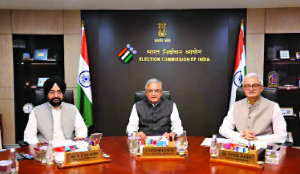
These are troubled times for the Election Commission of India (ECI). For decades, the body has been the standard-bearer of impartial polling, embracing new technology and earning international acclaim as a guide to other democracies on free and fair elections. That reputation now faces its sternest test.
According to an investigative report in The Indian Express on September 23, 2026, two of the three members of the Commission, Election Commissioners Sukhbir Singh Sandhu and Vivek Joshi, came close to open revolt against Chief Election Commissioner (CEC) Gyanesh Kumar, only to return to the same table and project normalcy. Their grievance was procedural. They recorded objections 14 times in 10 months to decisions and orders taken without their knowledge. The charge against the CEC is that he has sought to centralise the Commission's functioning, a direct affront to the democratic spirit of a collegiate body.
Controversy is not new to Nirvachan Sadan. The biggest turmoil before this came under T N Seshan, when the poll panel was converted from a solo-driven vehicle into a three-member body. Seshan went to court against the government's decision and made his fellow Election Commissioners, G V G Krishnamurthy and Manohar Singh Gill, parties to the case. Later, CEC N Gopalaswami wrote to the government seeking the removal of Election Commissioner Navin Chawla. The government of the day rejected the plea, and Chawla, who had close links with the Gandhi family, ultimately retired as CEC himself.
In nearly two decades of covering the ECI, I have watched professional and personal rivalries between commissioners play out, sometimes in the open. This is different. An Election Commissioner dissenting from the other two, or the reverse, is one thing. Here, the majority of the Commission says it was bypassed by a minority.
The law is clear. Section 18(2) of the Chief Election Commissioner and other Election Commissioners (Appointment, Conditions of Service and Term of Office) Act, 2023, says all business of the Commission shall, as far as possible, be transacted unanimously. Where the CEC and the Election Commissioners differ, the matter “shall be decided according to the opinion of the majority”. Even the procedure for transacting and allocating business can be regulated only by unanimous decision. The principle is older than the statute. In T N Seshan vs Union of India (1995), the Supreme Court stressed that Article 324 entrusts elections to the Commission, not to an individual.
The two Election Commissioners then wrote to the Cabinet Secretary about happenings in an autonomous constitutional body. The step is puzzling, though it conveys the gravity of the situation, since the proper authority was the President of India. The ECI has since said the letters concerned an officer on deputation and no policy matter.
At the heart of the row is the Special Intensive Revision (SIR) of the electoral rolls. A storm was already brewing around it. Former CEC S Y Qureshi has described the SIR in its present form as “illegal and unconstitutional”. Now it emerges that much of it was done without the knowledge of two of the three commissioners. As reported, Sandhu and Joshi objected repeatedly to procedural flaws and to being kept out of the loop on adding new voters and deleting names. They described the steps on new voters as “unauthorised, illegal”, warned against access to the voter database being centralised in Delhi while bypassing state officials, and flagged concerns over the integrity of the voter software. They also objected to IT department heads becoming super-heads on changes to the rolls while senior ECI officials were kept out. The full Commission did not meet between May and August 2026, which points to a deeper malady in the poll panel.
Did Kumar act on his own? Or is he part of a wider net, controlled from above, as Leader of Opposition in the Lok Sabha Rahul Gandhi alleges? Gandhi sees the report as vindication of his earlier charge that electoral manipulation helped the ruling dispensation win. At his press conference after the exposé, he tried to link the CEC to the top hierarchy of the Central government. Kumar can hardly feel comfortable after a former Kerala Chief Secretary claimed that Kumar, then a serving officer, had sounded him out about contesting the Lok Sabha election on a BJP ticket. Was he bidding on behalf of the saffron party bosses?
Surprisingly, the ruling BJP seems to have walked willingly into Gandhi's trap. The ECI's own rebuttal was guarded and deadpan, steering clear of the contentious issues. The BJP was more upfront, pressing its spokespersons into service “to defend the ECI”. That drew a sharp remark from columnist Tavleen Singh, no one's idea of a critic of the right, in an X post: “Is the BJP not embarrassed that their party spokesmen are speaking on behalf of the Election Commission? Is that not in itself a giveaway?”
In an official statement, the Commission played down the leaks, saying “differing views and observations are a normal part of deliberation”. It conceded that members held differing opinions but insisted these did not reflect its official position. On September 26, the three commissioners met together and promised that agendas would be circulated in advance and minutes recorded. That is an indirect admission of what was missing.
The government's role will come under scrutiny because Kumar is the first CEC appointed under the controversial 2023 Selection Act, which gave the executive a clear advantage on the selection panel by removing the Chief Justice of India. The exposé has revived the allegation that a centralised poll panel is being used to the government's advantage. Handled badly, it can have serious repercussions for the government, though it rises above party lines.
An institution whose only real currency is public trust cannot let that trust be settled through press notes and spokespersons. The way back lies in transparency: let the record of who decided what, and when, speak for itself.
The writer is a commentator on socio-political issues; Views presented are personal.