
Did you know?
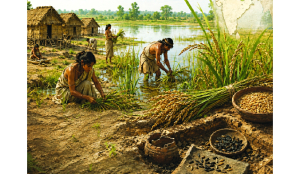
The lakeside settlement of Lahuradewa in Sant Kabir Nagar, Uttar Pradesh, has yielded some of South Asia’s earliest archaeological evidence for the use--and possibly cultivation--of rice. Excavations uncovered carbonised rice grains, husks and other plant remains from its earliest occupation levels, with evidence extending back to around the 7th millennium BCE. The excavators identified some remains as domesticated rice (Oryza sativa) and argued for an early farming tradition in the Middle Ganga Plain.
Lahuradewa is therefore central to an important debate about the history of rice. Its finds suggest that communities of the Ganga valley may have begun managing and cultivating local rice independently, pointing to an indigenous trajectory of rice agriculture in northern India rather than rice farming simply arriving there fully developed from East Asia.
It has also been suggested that locally managed or cultivated rice populations in northern India formed a proto-indica tradition, which much later interacted and hybridised with fully domesticated japonica rice arriving from East Asia. Whichever way we see it, the evidence from Lahuradewa does help to place the Middle Ganga valley as an important early centre in the long process through which wild rice became a cultivated crop.