
Cuisine of abundance, charity and continuity
Akshaya Tritiya is one of the most auspicious days in the Hindu calendar, celebrated as a symbol of prosperity, renewal and enduring abundance. Observed on Vaishakh Shukla Tritiya, the third lunar day of the bright fortnight of Vaishakh, Akshaya Tritiya this year fell on 19 April. It is associated with sacred beginnings, acts of charity, worship, annadaan and the invocation of lasting well-being. The word akshaya means “that which does not diminish,” reflecting the belief that virtuous actions performed on this day generate merit that endures and multiplies. While the festival is often associated with purity of purpose and the commencement of new ventures, its deeper message lies in the cultivation of gratitude, generosity and the responsibility to preserve and share abundance.
Arriving during the height of the Indian summer, when water becomes precious and fruits mature, Akshaya Tritiya also reflects the close alignment between seasonal cycles and cultural practice. The cultural background of Akshaya Tritiya is layered with sacred associations. In many Hindu homes, the day is connected with the worship of Lord Vishnu and Goddess Lakshmi, invoking preservation, auspiciousness and prosperity. It is also observed as Parashurama Jayanti in several traditions, while popular belief links the day with renewal and righteous beginnings. In Rajasthan and parts of western India, Akha Teej has long been considered auspicious for marriages and family celebrations.
In Maharashtra, it is counted among the highly auspicious muhurta days, when new work, purchases and household rites are undertaken with faith. In Odisha, the day carries a distinct agrarian and Jagannath tradition, as farmers mark Akhi Muthi Anukula, the ceremonial beginning of agricultural activity, while preparations for the Rath Yatra at Puri begin with chariot construction. In Jain tradition, Varshitap Parna is observed by those who break long austerities with sugarcane juice, recalling Rishabhanatha. Its culinary traditions embody this spirit through foods that are simple, nourishing and suitable for the climate, while also carrying the sanctity of offering and sharing.
The cuisine accordingly adapts to regional variations. Some households prepare elaborate naivedya, food offered to the deity, like cooling summer dishes or sweets while many mark the day through annadaan, the traditional Hindu sacred act of offering food to others. Since the festival falls in Vaishakh, the cuisine naturally leans towards mango, raw mango, curd, cucumber, coconut, soaked pulses, jaggery, ghee, rice, milk and light sattvic preparations. The purpose is not excess for its own sake. It is nourishment made auspicious, reminding the household that prosperity should spread rather than remain personal.
Maharashtra offers some of the most distinctive Akshaya Tritiya food associations, especially because the day falls in the season of mangoes and tender cashews. A festive meal may begin with Puran Poli, a soft flatbread filled with cooked chana dal and jaggery, flavoured with cardamom or nutmeg and served with ghee. The dal is cooked until tender, sweetened with jaggery and ground into a smooth filling, while the dough is rolled carefully around it. On Akshaya Tritiya, Puran Poli is not only a sweet dish but also as a symbol of plenty, because grain, pulse, jaggery and ghee come together in one generous preparation.
The same kitchen also gives us one of the best ways to make the savory section more specific to Akshaya Tritiya. Katachi Amti is prepared from the strained stock of the cooked chana dal used for the puran filling. Instead of wasting this nourishing liquid, it is transformed into a thin, spiced, tangy amti with goda masala, tamarind, jaggery, mustard, cumin, curry leaves, asafoetida and chilli. This dish carries the spirit of the festival in a subtle way. Akshaya does not mean endless consumption. It also means intelligent use, respect for ingredients and the ability to turn what remains into something complete. Katachi Amti balances the sweetness of Puran Poli, making the meal feel whole rather than heavy.
The Maharashtrian summer table then moves toward more seasonal savory dishes that are even more meaningful. Olya Kajuchi Bhaji, also known in some homes as fresh tender cashew curry, is especially valuable because tender cashews belong to the season and carry festive richness without excess. The cashews are cooked gently with coconut, cumin, green chilli, ginger, coriander and mild spices according to family custom. Ole Kajuchi Usal follows a similar seasonal logic, treating fresh cashews almost like a precious pulse. Raw mango creates another natural bridge between the festival and the climate in which it is observed. Kairichi Dal, also called Ambe Dal, is made with soaked chana dal, grated raw mango, coconut, green chilli, coriander and a light tempering. It is not a dal in the usual cooked sense, but a cooling, grainy, tangy preparation that refreshes the palate. Alongside it, Khamang Kakdi brings cucumber, peanut, coconut and mild seasoning into the meal. It is crisp, cooling and humble, yet festive enough for a thali.
Festive accompaniments reveal how Indian cuisine preserves labour across seasons. Kurdai, a sun-dried wheat preparation later fried or roasted until crisp, reflects the art of summer preservation, when households prepare papads, vadis and dried foods under the strong sun. Nachanicha Papad, made with ragi, brings a millet-based note to the thali. Gilkyachi Bhaji, made from sponge gourd and served in a crisp or lightly cooked form, brings another seasonal vegetable into the meal. These preparations may appear small, but they carry memory, planning and household economy.
The sweet side of the western Indian table is naturally brightened by mango.
Aamras is one of the most fitting dishes for Akshaya Tritiya because it belongs to the same hot season and carries a sense of golden abundance. Ripe mango pulp is extracted, lightly whisked and sometimes flavoured with cardamom or saffron, though many families prefer it plain so that the mango remains central. Shrikhand also fits the mood of the festival, especially in Gujarat and Maharashtra, where strained curd is sweetened and flavoured with saffron, cardamom or mango to make Amrakhand. Since curd cools the body and saffron-gold tones evoke auspiciousness, Shrikhand becomes both festive and seasonally wise. Sanjori, a lesser-known Maharashtrian festive sweet made with semolina, milk, ghee and sugar or jaggery, can also be included for special meals.
In North Indian homes, milk-based sweets are widely used. Kheer, made by slow-cooking rice in milk until it thickens, is one of the most familiar ways to express auspiciousness. On Akshaya Tritiya, it can be enriched with cardamom, saffron, almonds, cashews and raisins, then offered as prasad before being shared. Lapsi, made from broken wheat roasted in ghee and cooked with jaggery or sugar, is another meaningful dish because wheat represents grain, growth and household sustenance. In Rajasthan and Gujarat, where Akha Teej has strong cultural resonance, Lapsi can be framed as a dish of wholesome sweetness. Besan Laddoo or Atta Laddoo may also appear when families prepare sweets that can be distributed, stored and shared with guests.
South Indian traditions offer another way of making the cuisine more rooted in the day’s seasonal and devotional character.
Payasam is central to many temple and home offerings, whether made with rice, vermicelli, moong dal, chana dal or jaggery. Chana Dal Payasam and Moong Dal Payasam are especially useful in this preparation because pulses carry nourishment and strength, while jaggery and coconut bring sweetness without losing the sattvic character of the dish. The dal is lightly roasted or cooked until soft, then simmered with jaggery syrup, coconut milk or milk, and finished with cardamom, ghee-fried cashews and raisins.
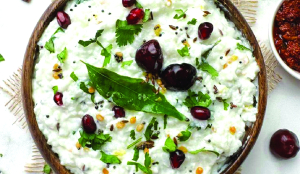
In Karnataka and parts of the South, Kosambari provides the savory counterpoint. Made with soaked moong dal, cucumber, coconut, green chilli, coriander and lemon, it is light, cooling and suitable for offering. Thayir Sadam, or curd rice, may seem simple, but on Akshaya Tritiya its relevance lies in the heat of the season. Rice cooled with curd, tempered gently with mustard, curry leaves and ginger, becomes food that soothes, settles and completes a summer meal.
Odisha gives Akshaya Tritiya a particularly powerful cultural dimension because the day is linked with the beginning of agricultural activity. Accordingly there isn’t one fixed menu but dishes shaped by the season and the festival’s agrarian character. Dalma, made with dal and vegetables cooked together with mild spices, is one of Odisha’s most representative sattvic dishes. It is nourishing, balanced and closely aligned with temple-style and household cooking. On a day that honours the beginning of cultivation, a dish combining pulses and vegetables feels deeply appropriate. Dahi Pakhala, rice soaked in water and curd, often enjoyed with salt, green chilli, roasted cumin, curry leaves or simple accompaniments, reflects the summer intelligence of eastern India. It cools the body and honours rice not as a luxury but as the foundation of life. If Saga Bhaja or Badi Chura appears alongside such a meal, the table becomes both humble and complete.
The beverage tradition of Akshaya Tritiya is just as important as the food because the festival belongs to the heat of Vaishakh, when offering water is itself an act of merit. Panakam, made with jaggery, water, dry ginger, cardamom and sometimes black pepper, is one of the most meaningful drinks to include because it is cooling, energising and devotional. Aam Panna, prepared from roasted or boiled raw mango, cumin, black salt and jaggery, protects the body against heat and celebrates the raw mango season. Chaas and Lassi bring curd into drinkable form, offering comfort after a festive meal. Sattu Sherbet, made with roasted gram flour, water, lemon, cumin and salt or jaggery, connects nourishment with summer practicality. Nimbu Pani, Bel Sherbet, Kokum Sharbat and tender coconut water can also be a part of cooling hospitality. In Jain communities
observing Varshitap Parna, sugarcane juice has a sacred role, reminding us that a beverage too can become a carrier of memory, austerity and grace.
What makes Akshaya Tritiya cuisine beautiful is this balance between offering and enjoyment. A family may begin with puja, offer Puran Poli, Kheer, Payasam, Aamras, Panchamrit or fruit, and then share the meal with relatives, neighbours or guests. In some homes, annadaan becomes the heart of the day, with food, water, fruit, buttermilk or sweets distributed to those in need. Buying gold may be one visible symbol of prosperity, but giving food reveals its deeper meaning. It teaches children that festivals are carefully shaped cultural moments in which the calendar, the kitchen, and the family come together to observe a moral and spiritual lesson that is in harmony with the seasonal cycle.
To carry Akshaya Tritiya forward, therefore, we must preserve not only its rituals but also the traditions of its cuisine and the wisdom that gives these practices its contemporary relevance. Recipes such as Puran Poli, Katachi Amti, Kairichi Dal, Aamras, Kosambari, Dalma, Dahi Pakhala, Payasam and Panakam should not remain only in the memories of elders or in fading notebooks. They should be cooked, explained, tasted and passed on. Children should know why raw mango appears in summer, why water is offered, why annadaan matters, why a festival of prosperity must also be a festival of sharing, and why food prepared with devotion becomes more than consumption. In protecting the cuisine of Akshaya Tritiya, we preserve a civilisational understanding that abundance is sacred only when it nourishes others. The call of this festival is therefore simple and urgent. Let us keep cooking these dishes, keep telling their stories, keep feeding with gratitude and keep teaching future generations that what is truly akshaya is not wealth kept for oneself, but culture, compassion and nourishment shared across time.