
Chasing the Vision of Dr APJ Abdul Kalam
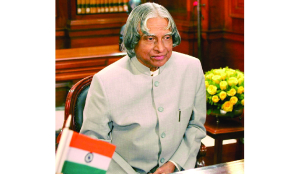
Dr APJ Abdul Kalam is that one eminent public figure of post-colonial India who inspired and catalysed the lives of millions of the youth across the nation. His entire life journey is a set of motivations from his modest childhood to the highest office in the Rashtrapati Bhawan. Dr Kalam’s endeavours in every walk of life, across science, education or public life, are great acts as powerful incentives for national progress. In one of his catalytic speeches in 2011 at IIT Hyderabad, he articulated the three visions: freedom, India’s development and its global stature. Regarding freedom, he noted that India got its first vision of independence in 1857 and later got freedom. He believed that we must protect it at all costs and reminded us, ‘If we are not free, no one will respect us’.
He was very cautious about freedom, which is far beyond the conventional political spectrum. He championed the cognitive freedom that is truly more important for intellectual autonomy and that draws the nation’s attention to reclaim its own heritage, honouring national heroes and preserving and cherishing its vast cultural treasures. India, after a long walk, led a great move for cognitive liberty, which evokes us to look back to our great civilisational history that constitutes great schools of philosophy, magnificent architectural milestones and many more ancestral achievements to cherish.
It’s truly correct that over the last several years, we have tangibly gone through these cultural shifts. For instance, the nation has replaced the colonial-era legal framework with the revised Bharatiya Nyaya Sanhita; we are scaling our traditional medical practices, revitalising the indigenous languages and making a structural change in the field of education for Bhartiyakaran of India’s education system and systematically moving away from the Macaulay model of education.
To memorialise the 75 years of India’s Independence, the Union Government of India took a great initiative by introducing a nationwide campaign, Azadi Ka Amrit Mahotsav, to commemorate our national heroes, their life journeys, and their contributions to India’s freedom movement. They are the real source of inspiration for our generation. Their history is very motivating and can inspire the idea of selfless service for the nation. The sacrifices they made for the country are unforgettable.
India’s freedom struggle was a pan-India movement. People across the country fought for their motherland with great spirit. The number of participants is truly innumerable. There were many freedom fighters who did not get much recognition, but their sacrifices are highly notable. Whatever they did, they did for the sake of the nation. Dr. Abdul Kalam always highlighted this kind of selfless service; he firmly believed in the philosophy that prompts everyone to ask, ‘What can I give?
The remaining two visions of Kalam Sahab are intrinsically linked, as he saw the vision for India’s development and its stature in the world. In point of fact, India has accomplished considerable achievements in diverse disciplines, and specifically the past decade and a half has marked a remarkable chapter for India’s growth and advancement. This growth has touched everything from science to finance. Some noteworthy achievements are the Mars orbiter mission (Mangalyaan), the Chandrayaan success, the Swadeshi Defence Network, and the unified payment interface (UPI). In the year 2023, the Prime Minister of India, Shri Narendra Modi, launched the Viksit Bharat@2027 initiative.
On this very occasion, he said that ‘in the life of any nation, history provides a time period when the nation can make exponential strides in its development journey; for India, this ‘Amritka’ is going on’. For India, this is the time, the right time (yahi samay hai sahi samay hai) and each and every moment should be utilised so every institution and every individual should move with a resolution that every effort and act will be for Viksit Bharat. Under his transformational leadership, India became the fastest-growing economy and was placed as the 4th largest global economy in 2025 by consistent structural reforms and other essential endeavours under the vision of Atmanirbhar Bharat. True national development, however, demands active civic participation. Once, Kalam Sahab said that why is media here so negative?
Why are we in India so embarrassed to recognise our own strengths, our achievements? We have so many amazing success stories, but we refuse to acknowledge it, why? We always say the government is inefficient. You say the laws are too old, you say and say, but what do you do about it?
While addressing the youth on national youth Day in Pune, he urged the young minds to take some pledge for the betterment of themselves and their nation that ‘I realise righteousness in the heart leads to the beauty in the character, beauty in the character brings harmony in the home, harmony in the home leads to order in the nation and order in the nation leads to peace in the world. So I like the lamp of knowledge in the nation and ensure that it remains lit forever. I realise, whatever works I do, if I do the best, I am contributing to realising the vision of developed India.’ In his autobiography, Wings of Fire, he shares the obstacles he faced and courageously overcame. While problems are a part of life, our courage, consistency, and passionate devotion to our vision will keep us fueled forever.
Really, we have a number of blame and excuses; moreover, we should ask ourselves what we can do for the betterment of our society and the development of our nation. Today, to honour his death anniversary, the nation must embrace his message and his inspirational directives. We must pivot from excuses to execution to lead an accountable, mission-driven life, as Kalam Sir himself defined his whole life and legacy in a singular defining declaration, ‘My mission is my nation.’
The writer is Assistant Professor, Zakir Husain College, University of Delhi; Views presented are personal.