
BRICS Summit: Where culture meets diplomacy
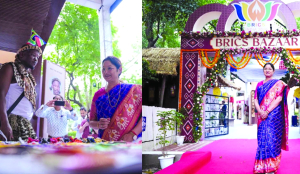
The ongoing BRICS summit here is not only about the leaders discussing serious issues specific to the region and global events, but also gives an opportunity to showcase the rich culture of the member countries through traditional crafts, performances and artistic expressions.
Zahra Pezeshkian, daughter of Iranian President Masoud Pezeshkian, and her husband Hassan Majidi visited the pavilion and interacted with the artisans and representatives showcasing Iran’s rich art, crafts and cultural heritage on Saturday. They explored pavilions from BRICS member and partner countries, including the Indian pavilion, witnessing the vibrant showcase of art, crafts and cultural heritage.
“Zahra Pezeshkian, daughter of the President of the Islamic Republic of Iran, visited the Pradhanmantri Sangrahalaya in New Delhi. She explored the museum showcasing the journeys, contributions and legacies of India’s Prime Ministers,” the Iranian Embassy in India posted on X.
After Zahra Pezeshkian visited the BRICS Bazaar, Union Minister for Women and Child Development Annpurna Devi posted on X, “It was a pleasure to welcome Ms. Zahra Pezeshkian, daughter of Iranian President Masoud Pezeshkian to the #BRICSBazaar at the National Crafts Museum, New Delhi.”
“Had the opportunity to show them around the Bazaar and share the rich traditions, art, crafts and cultural heritage showcased by BRICS member and partner nations,” the minister said.
Philippine First Lady Liza Araneta-Marcos, who is accompanying President Ferdinand R Marcos Jr., also explored the museum housed at the Teen Murti Bhawan complex, it is learnt.
From China’s Suzhou embroidery and Indonesia’s traditional weaving to Nigeria’s wood and calabash art, South Africa’s Zulu leather craft, Brazil’s clay art-one of the Americas’ oldest living traditions-and Belarus’s traditional willow weaving, the BRICS Bazaar at the National Crafts Museum & Hastkala Academy is bringing the cultural diversity of member nations to life.
The bazaar showcases the rich heritage of participating countries while creating a platform for cultural exchange and cooperation. It brings together over 40 artisans, designers and creative enterprises from 18 countries under one roof, will continue till September 15.
Lana Slastsion celebrated willow weaver from Molodechno, from Belarus leads the Verbachka folk crafts collective. According to a note on the website, she is recognised as a People’s Master of the Republic of Belarus.
“Willow weaving in Belarus is a traditional folk craft that creates useful and beautiful objects from flexible willow branches. It’s an ancient craft that predates weaving and the potter’s wheel. Craftsmen create durable baskets, furniture, decorative elements, and household utensils from the natural material, preserving ancient handcrafting techniques,” the note reads.
Cleziania Ribeiro de Lima Paiva, a ceramic artisan and sculptor from Goias, Brazil, has also been featured on the website.
“Brazilian clay art is one of the Americas’ oldest living traditions. Indigenous peoples shaped riverbank clays into pots and vessels; colonisation blended these techniques with Portuguese and African methods, creating a distinctly Brazilian craft passed down through generations,” reads another artist’s note.
“The material is the soul: argila (clay) dug by hand from riverbanks and hillsides, each deposit carrying its own colour - deep reds in Pernambuco, warm browns in Goias and Minas Gerais. The process is slow and meditative: harvest, knead, model entirely by hand (no molds or wheels), dry, fire in open bonfires, and finish with natural or industrial pigments,” it adds.
Another artist, Serik Rysbekov, a Kazakhstani artist-jeweller whose silver jewellery combines hot enamel, natural stones and traditional Kazakh influences with contemporary design, has also made it to the list.
Nadia Karimi, whose work focuses on preserving and developing the traditional art of Balochi embroidery, is also represented on the website as an Iranian artist. “The craft is deeply rooted in the identity and heritage of Balochi women, passed down lovingly from mothers to daughters through generations. Every intricate pattern and motif is meticulously hand-stitched using silk thread without the aid of machines, representing hours of devotion, patience, and cultural memory,” reads a note attached to her craft description on the website. The website does not list the number of artists participating at the stalls.