
BRICS adopts New Delhi Declaration as Modi seeks stronger Global South role
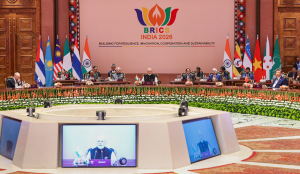
New Delhi, September 12: BRICS leaders adopted the New Delhi Declaration by consensus on Saturday as Prime Minister Narendra Modi called for a larger Global South role in international decision making.
The declaration was adopted at the end of the opening day of the two day summit hosted by India. Its acceptance followed negotiations aimed at bridging differences between Iran and the United Arab Emirates over the West Asia conflict.
BRICS takes decisions by consensus, allowing any member to block a joint declaration. Negotiators had reached an agreement after efforts to resolve the divisions.
Opening the summit, Modi said developing countries often face the consequences of global crises without having an adequate role in framing international decisions. He called for replacing what he described as a “pyramid of privilege” with a “platform of partnership”.
“The Global South stands in the front row of global crises but in the back row of decision making,” Modi said. He argued that the Global South must become a “rule shaper” rather than remain a “rule follower”.
Modi proposed a 10 point BRICS roadmap for reforming global governance. He said the roadmap should focus on representation, responsiveness and rule making, and should be finalised before the next summit.
The prime minister renewed India’s demand for reforms to the United Nations Security Council. He called for negotiations to be placed within a definite timeframe and linked to clear outcomes.
Modi also sought changes to voting rights, leadership positions and policy priorities at international financial institutions. Countries driving global economic growth should have a proportionate role in shaping economic governance, he said.
He called for equal participation in setting international rules for artificial intelligence, cyberspace, outer space, biotechnology and other critical technologies. These sectors would shape both future opportunities and the rules governing them, he said.
Modi also proposed a Seafarers’ Emergency Support Network connecting maritime authorities and diplomatic missions of BRICS countries. The proposed network would coordinate distress alerts, medical assistance, evacuations and communication with the families of sailors facing emergencies.
The proposal follows heightened risks to merchant shipping during the West Asia conflict and the disruption around the Strait of Hormuz. According to PTI, 10 Indian seafarers are among 16 Indians killed in the conflict since February.
Modi also called for a continuity and implementation mechanism to prevent initiatives from losing momentum when the BRICS presidency changes annually. He proposed a secure digital repository to track the nodal authority, timeframe and implementation status of decisions.
Russian President Vladimir Putin, Chinese President Xi Jinping, Iranian President Masoud Pezeshkian and South African President Cyril Ramaphosa were among the leaders attending the summit. Leaders from Indonesia, Malaysia, Egypt and the UAE were also present.
Concluding the day’s deliberations, Modi said institutions designed for an earlier era could not steer a changing world. He said the New Delhi Declaration gave direction to the grouping’s shared commitments, which now had to be translated into results.