
Bhagwat: Hindu cannot be exclusivist
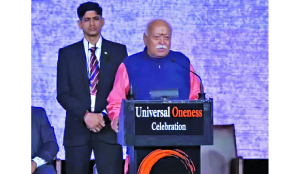
"The basis of this true belief, that my pain and pleasure lay in the pain and pleasure of the other is the reason for yearning for unity and its experience, harmony within humanity and feeling brotherhood. […] This knowledge is safely stored with Hindus. No one else has it. It is the duty of one who has a treasure, to protect it and make it easily available to others. To shy away from this duty would not be the cause of our ruin alone but also of the world. This is the purpose for which we organize ourselves to create a strong society. Thus, our organization is for the good of the world. […] People of the West are not aware of this science. Their senses are directed outwards and see outer world. They do not see inward, we see thus. Therefore, it is something worth doing for us to awaken Hindu society to such levels that it can teach the world, that has the inclination to see outward to see inward, this knowledge with firm resolve and confidence." These words would sound familiar to many who heard Dr Mohan Bhagwat ji's speech in the USA. However, they were spoken in 1954 in RSS meeting in Sindi by Shri Guruji. (M S Golwalkar: His Vision & Mission, Page 131) Dr Bhagwat presented this global vision of RSS to the world from New York.
The last stanzas of the 'Vishwa Prarthana' of Hindu Swayamsevak Sangh clearly state the global vision of Hindu thought: "Let our devotion to the cause be steadfast in organizing the people for the achievement of world peace and tranquility in the light of the universal Dharma.[…] In pursuit of the welfare of mankind, which indeed is the holy cause and inspired by the noble virtues of service and sacrifice, let my being O' Lord, be offered at your feet.
Though Sangh works only within Bharat, it is recognized as a force that changed the social and political landscape of Bharat. Heavy agenda-driven propaganda against RSS and Hindus hurts the Hindu community globally. RSS is dragged in to paint targets on Hindu organisations as is apparent from the reactions and responses from various politicians, academics and media during Mohan ji's visit. Having completed it 100 years of growth, consolidation and evolution from an organisation to a movement - it was time for RSS to present itself to global audience.
It is worth noting that religious heads of 30 countries, from 16 religions and 180 scholars came together for this event. They had a heart-to-heart conversation with Dr Bhagwat before the public event. Looking at this big outreach with 200+ organisations across USA, one may dare say that it was the first time after Swami Vivekananda's epoch-making speech in Chicago that a global vision about Hindu dharma and Bharat was presented before the world. USA was chosen as the stage, because whether we like it or not, narrative begins from USA and echoes around the world. Dr Bhagwat recalled Swami Vivekananda's words that every nation has a message, a mission and a destiny. Bharat's mission is the spread the word pluralism - see the divine unity in apparent diversity and celebrate diversity as an expression of unity in different forms, like nature. Hindu nation of Bharat stands as a living example of Spiritual Democracy where every faith, every religion has been respected and welcomed. In the same spirit, persecuted people of different religions and races were given refuge in Bharat. Even in recent times, it has gone and supported refugees of war, people suffering from Covid etc.
The message of global relevance of Hinduness was in tune with what Shri Guruji had said decades back. It was about One aatman/soul within all the human beings of whichever race, colour, religion they might be - Universal Oneness. The day chosen was Raksha Bandhan that celebrates the bond of brotherhood of the humanity, a pledge to protect each other. It is not just a festival of brother and sister, but of the society for the society sending out a message of social harmony. Prafulla Ketkar recalls that Hindus and Muslims tied rakhi to each other when they launched a successful agitation against 'Bang Bhang' division of Bengal on religious lines.
The RSS chief stressed the Hindu philosophy that material satisfaction cannot give lasting happiness. There is something else, the spiritual hunger which needs to be satiated. This can be through thought or action of helping other living beings. He talked about the difference between human beings and other living creatures who live just for consumption and pleasure. Animal does not think beyond present, human being thinks of life and afterlife. He explained that an animal does not know the reason of its life, human being searches to know the purpose since eons. Only human beings have vivek - intellect - that really differentiate them from animal kingdom. And this awareness must be put to good use. He reminded the audience about the integral view of human beings and the nature of Hindus and importance of human beings living in harmony with the society and nature; not just as consumers but as a part of this vast universe.
In keeping with the inclusive nature of Hindu dharma, he clearly stated that Hindu cannot be exclusivist like many other ideologies, hence cannot think of throwing out minorities when it talks about Hindu Rashtra. We should be clear that Hindu idea of nationhood is not that of nation state but of cultural spirit of Bharat, which is Hindu culture. This is the culture that binds us together for eons. This thought has been expressed at various times, from Shri Guruji's interview of 1971 to Balasaheb Deoras to Sudarshan ji. He presented the two diametrically opposite ideas that can make or break the world - 'Live and Let Live' or 'Only the people who follow a certain idea have a right to live. If they agree with us, we will protect them, or they have no place in the society'. And he reiterated the Hindu philosophy of 'Vasudhaiv Kutumbakam' as the only way for the world to survive, the thought that directs action of every conscious Hindu.
For the Indian diaspora, the message was what had been said much earlier by Shri Guruji to the swayamsevaks who came to meet him from overseas. You may take inspiration from your Janmabhoomi, your punyabhoomi, but your primary loyalty should be to your karmabhoomi and see what you can contribute to the society you adopted. Thus, it was a positive messaging from RSS to dispel all the negative propaganda by the western Left intellectuals, academia and media that could spread positivity. This speech of his, along with his speech in Toronto, Canada, will echo for a long time globally. If taken in right spirit, as enunciated in the joint declaration of the religious heads and scholars signed about Universal Oneness for world peace, this could be the beginning of leading non-state actors led push for peace.
Ratan Sharda is a well-known TV panelist and has authored several books. He has been a member of the RSS since his childhood days; Views presented are personal.