
Does God dwell in the temple?
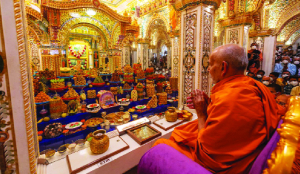
The mandir does not bring God closer to us; rather, it brings our wandering hearts closer to God. When our hearts are filled with devotion, the silent murti begins to speak, and the heart understands it all
How did this magnificent universe come into existence? Was it the result of an accident, or did it unfold according to an intelligent order? Is there a Creator behind this vast cosmos? And if God truly exists, is He merely an abstract, formless reality, or can He assume a personal and manifest form?
These questions have accompanied humanity for centuries. Philosophers have debated them, scientists have explored the mysteries of the universe, and rishis have sought their answers through direct spiritual experience. Yet for millions of devotees, the answer is not confined to philosophical arguments. It is experienced in a far more intimate way, in prayer, in devotion, and before the sacred murti of God in a temple(mandir).
The history of Indian spirituality is filled with such experiences. Mirabai, the great saint-poet of Rajasthan, possessed an unshakable conviction that God was not just a distant philosophical concept but a living, loving presence. Her devotion to Shri Krishna was so intense that, according to devotional tradition, she experienced the ultimate divine bliss of Him. To those who dismissed her faith as imagination or superstition, her life itself became her answer. For Mirabai, the murti was not an object of stone or metal; it was a sacred medium through which the Divine became present to the heart of the devotee.
This is the essential idea behind the Hindu tradition of murti worship. A mandir is not merely an architectural structure, nor is a consecrated murti simply a work of art. Through the sacred rite of consecration and, more importantly, through the faith and devotion of generations, the mandir becomes a spiritual space where the human heart learns to encounter the Divine.
Even in the modern age, incidents have occasionally drawn public attention to this question of divine presence. On 21 September 1995, reports spread rapidly from India to many parts of the world that devotees were observing murtis of Lord Ganesha appearing to accept milk offered with a spoon. The phenomenon created extraordinary public interest, and people gathered at mandirs across India and abroad to witness it. Whatever explanations one may offer for such events, the episode demonstrated something undeniable: for millions, the sacred murti of God is not a lifeless symbol but the focal point of a living faith.
The Hindu scriptures have expressed this principle for centuries. In the Vachanamrut, Bhagwan Swaminarayan cites a verse from the Shrimad Bhagavatam to explain the divine presence in the consecrated murti of God and in the God-realized sant. He states,” God eternally resides in His various forms of consecrated murtis and in His spiritually enlightened devotee.” The purpose of the murti, therefore, is not to limit the infinite God within a material form. Rather, it is to make the human encounter with the infinite more personal, accessible and loving.
After all, the human mind often needs a point of focus. We cannot easily love an abstraction. We may intellectually accept that God is everywhere, but the restless mind struggles to experience that omnipresence continuously. A murti provides a center for the wandering mind and a direction for the searching heart.
This is also why mandirs continue to hold relevance even in the twenty-first century. In a world filled with noise, distraction and constant digital stimulation, a mandir offers something increasingly rare: silence. The ringing of a bell, the fragrance of incense, the rhythmic sound of prayers and the peaceful darshan of the murti gradually draw the mind away from worldly anxieties. A mandir gives the individual an opportunity to pause and ask questions that technology cannot answer: Who am I? What is the purpose of my life? How should I live?
Pramukh Swami Maharaj often affirmed this simple yet profound truth: Bhagwan is eternally present and lovingly accepts the devotion of His devotees. His own life was a living expression of such faith. To stand before the murti, for him, was not to stand before an image; it was to stand in the presence of Bhagwan.
Perhaps this is the deepest purpose of a mandir. It teaches us to see beyond what the physical eyes can perceive. To one person, a murti may appear to be stone or metal. To another, it becomes the most beloved presence in life. The difference lies not merely in the object being viewed, but in the vision with which it is viewed. Mahant Swami Maharaj reminds, “When we enter a mandir, we should not merely look at the beauty of the architecture or admire the artistry of the murti. We should pause, quiet the mind and allow the heart to speak. With faith, humility and devotion, the mandir can become more than a place we visit; it can become a place where we rediscover ourselves.”
Therefore, visit the mandir every day and make a personal relationship with God.
Dr Swami Gyanananddas is a dedicated follower of the Swaminarayan tradition and has earned a PhD from MS University, Views presented are personal.