
Air India must rebuild safety, trust: Chandrasekaran
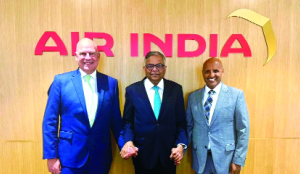
Air India must restore passenger confidence, strengthen safety standards and improve financial discipline as it enters a new phase under incoming Chief Executive Officer and Managing Director Tewolde Gebremariam, Tata Sons Chairman and Air India Chairman N Chandrasekaran said on Monday.
Addressing employees at a town hall, Chandrasekaran introduced Gebremariam, who will succeed Campbell Wilson as the airline’s chief executive. Chandrasekaran said rebuilding trust among passengers would be one of Air India’s most important priorities. He said the airline should aim to have a safety record that is “better than the best”.
He identified safety, customer confidence, operational performance and cost control as the key priorities for the airline’s next phase. He also called on employees to develop greater awareness of costs across the organisation.
The comments come as Air India faces significant operational and financial challenges. Chandrasekaran said the airline had experienced a particularly difficult period over the past 18 months because of geopolitical tensions, airspace restrictions, fluctuations in fuel prices and the fatal AI171 accident. The June 2025 crash of an Air India Boeing 787 shortly after take-off from Ahmedabad claimed 260 lives and resulted in extensive scrutiny of the airline’s safety practices. The carrier has also faced regulatory concerns related to operational and compliance procedures.
Air India’s financial performance has added to the pressure on the management. The Air India Group reported a loss of more than $2 billion in the financial year ended March 2026, compared with about $1.13 billion a year earlier, according to Singapore Airlines, which holds a 25.1 per cent stake in the enlarged group.
The airline has remained loss-making since the Tata Group took control of Air India in January 2022.
Chandrasekaran has said the transformation of Air India could take between five and 10 years. The Tata Group has undertaken extensive investment in aircraft, cabin upgrades, technology and the integration of Air India with Vistara.
The group also has more than 500 aircraft on order, creating substantial future expenditure while the airline works to improve its financial position. Air India has been considering measures to defer some aircraft deliveries as it seeks to manage costs.
Gebremariam, who previously headed Ethiopian Airlines Group, said Air India had a strong heritage and significant potential.
“If we do the right things at the right time, the sky is the limit,” he told employees.
In reference to US President Donald Trump’s “Make America Great Again” slogan, he also said, “We will Make Air India Great Again.”
Gebremariam said he had first encountered Air India while working in Mumbai in the 1990s and remembered it as one of the leading airlines in the industry. He said his objective would be to help restore the carrier’s position.
Safety, he said, would be the foundation of that effort.
“Safety-first culture has to be the number one priority,” Gebremariam said, while encouraging employees to raise concerns when they identify potential risks.
“If something is not right, it should be stopped,” he said. He also stressed the importance of improving day-to-day operational performance. According to Gebremariam, punctual flights, reliable baggage handling and clean aircraft would be essential to improving the customer experience.
“We need to minimise disruptions and when they do occur, handle them professionally and take care of our customers,” he said.
The new CEO said Air India had already undergone considerable groundwork but warned that further progress would depend on the workforce. “We cannot bring about meaningful change without the commitment of our people,” he said. Gebremariam was appointed to lead Air India on August 5 after a selection process overseen by a board committee. He becomes the second foreign chief executive to head Air India since its privatisation. He spent more than 36 years with Ethiopian Airlines, joining the carrier in 1985 and eventually becoming its group chief executive in 2011. He remained in the role for more than a decade, during which the airline expanded its fleet, network and cargo operations.
His tenure also included major crises. In 2019, Ethiopian Airlines Flight 302 crashed shortly after take-off from Addis Ababa, killing all 157 people aboard. Following the accident, Ethiopian Airlines grounded its Boeing 737 MAX aircraft before similar measures were adopted by regulators in major aviation markets.
Gebremariam now takes charge of an Air India that is considerably larger and more complex than the airline that existed before the Tata Group takeover. His immediate task will be to improve reliability and safety while addressing persistent losses and managing an ambitious fleet expansion. The airline is also facing fresh scrutiny following an incident involving an Air India A320 flying from Phuket to New Delhi on August 4, and in the past planes accident and Ahmedabad crash is also under investigation.
Outgoing CEO Campbell Wilson, who oversaw Air India’s transformation after the Tata Group takeover, told employees that the airline’s transformation would continue under the new leadership. Wilson said he would remain Air India’s “biggest cheerleader from the sidelines” and expressed confidence in Gebremariam’s ability to lead the airline.
During Wilson’s tenure, Air India completed the merger with Vistara and consolidated Tata Group’s airline operations. The carrier also began a major fleet renewal programme.Tata Group acquired Air India from the Indian government in January 2022.
Singapore Airlines later acquired a 25.1 per cent stake in the enlarged airline group, with Tata Sons retaining control. For Chandrasekaran, Air India’s revival remains a major project as he prepares to step down as Tata Sons chairman when his current term ends on February 20, 2027. For Gebremariam, the immediate challenge will be to turn years of investment and restructuring into improved safety, operational reliability, passenger confidence and sustainable finances.