
- HOME
- INDIA
- WORLD
- BUSINESS
- STATES
- LAW & JUSTICE
- ENTERTAINMENT
- SPORTS
- VIEWPOINT
- LIFESTYLE
- TECH
Hundreds of protesters from Left parties, the Congress and the Aam Aadmi Party (AAP), along with student and youth organisations, gathered at Delhi’s Jantar Mantar on Friday, defying police restrictions and barricades to demand the resignation of Chief Election Commissioner Gyanesh Kumar over alleged irregularities in the Special Intensive Revision (SIR) of electoral rolls and the mass deletion of voters.
The protest, held on Gandhi Jayanti, featured dramatic scenes as protesters crossed barricades and tried to move toward Jantar Mantar despite prohibitory orders and the denial of police permission. Several opposition leaders, including former Delhi Chief Minister Atishi, CPI(M) General Secretary MA Baby, AAP leaders Saurabh Bharadwaj and Sanjeev Jha, and activists from student and youth organisations, joined the demonstrations.
The Delhi Metro temporarily closed entry and exit at 12 stations in central Delhi, including Rajiv Chowk, Central Secretariat and Jantar Mantar, as part of security arrangements around the protest. Internet services were also suspended at the protest site and in surrounding areas. Despite the restrictions, protesters gathered in large numbers at Jantar Mantar. Several protesters crossed barricades as police personnel tried to stop them from proceeding towards the protest site.
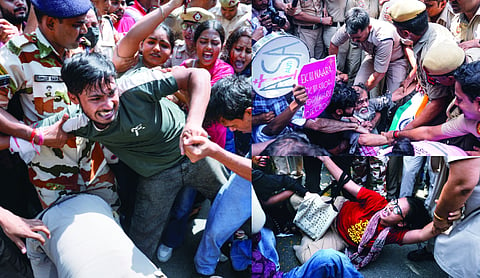
Slogans including “Ek kachori, do samosa, Gyanesh tumhara kya bharosa”, “Vote chor gaadi chor,” “Jai Bhim,” “Jab jab Modi darta hai police ko aage karta hai” and “Gali-gali mein shor hai, Modi-Gyanesh vote chor hai” were raised during the protest.
AISA president Neha Bora and other members of the organisation were seen running towards Jantar Mantar but were stopped midway by the Delhi Police. At several places like Firoz Shah Road and Ashoka Road, the protesters tried to go past barricades as police personnel prevented them from proceeding towards the designated protest site.
The area around Jantar Mantar and the roads leading to it witnessed chaotic scenes as the protesters attempted to make their way through the barricades. Police personnel repeatedly made public announcements, asking people not to assemble at Jantar Mantar and saying no gathering was allowed there.
Delhi Police sources said around 700 people were detained across Delhi during the day’s protests, though some were later released. Among those detained were AAP’s Saurabh Bhardwaj and Atishi, AISA national president Neha Bora, activist Yogendra Yadav, and CPI(ML) Liberation general secretary Dipankar Bhattacharya, along with activists from AISA, SFI, NSUI and other student bodies.
Footage and photographs from the scene showed security personnel physically carrying and dragging protesters into waiting buses, with police lined up outside the vehicles to manage the detentions.
The protesters were not allowed to enter the designated protest site. Instead, the roads around Jantar Mantar were turned into a heavily guarded zone. Delhi Police personnel, Rapid Action Force and Central Reserve Police Force personnel formed a human barricade. At the same time, DTC, government, and private buses stood ready to transport those detained away from the area.
The Youth Congress protesters marched from the IYC office on Raisina Road towards Jantar Mantar, wearing masks bearing the faces of Kumar and Prime Minister Narendra Modi and carrying posters and banners demanding accountability of the poll panel. AISA national president Neha Bora, reacting to her own detention, posted on social media, “Jantar Mantar 2.0 is on! Gyanesh will soon be gone!” Ghosh said, “Delhi Police is not able to stop crimes in the capital, but when it comes to protection of someone like Gyanesh Kumar, they get down on the streets.”
Section 163 of the Bharatiya Nagarik Suraksha Sanhita was in force across the New Delhi district, restricting gatherings of five or more people, processions, demonstrations, dharnas, slogans and speeches without permission. Police barricaded major roads leading to Jantar Mantar, including Sansad Marg, Tolstoy Marg and Jantar Mantar Road. Several protesters were seen trying to cross barricades at Firoz Shah Road as police attempted to stop them from reaching the protest site.
By around 3 pm, the character of the area had changed completely. Hundreds of security personnel had taken over the roads, while only scattered groups of protesters remained outside the barricades, holding placards and attempting to locate friends who had been detained.
For ordinary Delhi residents, Friday’s scenes at Jantar Mantar raise a pointed question: the venue itself has long functioned as the city’s designated space for public dissent, the one corner of the capital where citizens are meant to gather and be heard. The scale of Friday’s detentions, with hundreds physically removed within hours of the protest beginning, has reopened debate over how freely that right can actually be exercised when organisers and police disagree over permission.
Protesters at the site directly questioned why permission was required at all for a demonstration at what is meant to be a designated protest location, pointing to the contradiction between Jantar Mantar’s stated purpose and the police response they encountered on the ground.
The Delhi Metro has closed entry and exit at 12 stations, including Rajiv Chowk, Central Secretariat, and Jantar Mantar. Internet services have also been suspended around Jantar Mantar.
The demonstration was part of a broader, intensifying campaign by Opposition parties, student unions and civil society groups against the Election Commission’s handling of the SIR exercise, which has drawn criticism over alleged mass deletion of voters from electoral rolls. The protest coincided with Gandhi Jayanti, a detail organisers had specifically built their call for mobilisation around.
As buses carrying detained protesters left the area through the afternoon, the confrontation at Jantar Mantar left behind an unresolved tension for Delhi’s residents between the city’s formal provision of a space for peaceful assembly and the practical reality of what unfolds there once police determine a gathering lacks authorisation, a tension that, going by Friday’s scale of detentions, shows no sign of easing as the broader campaign over the SIR exercise continues to build.