Ravana’s Ten Heads ( I vs AI): A Memoir of Successive Surrenders
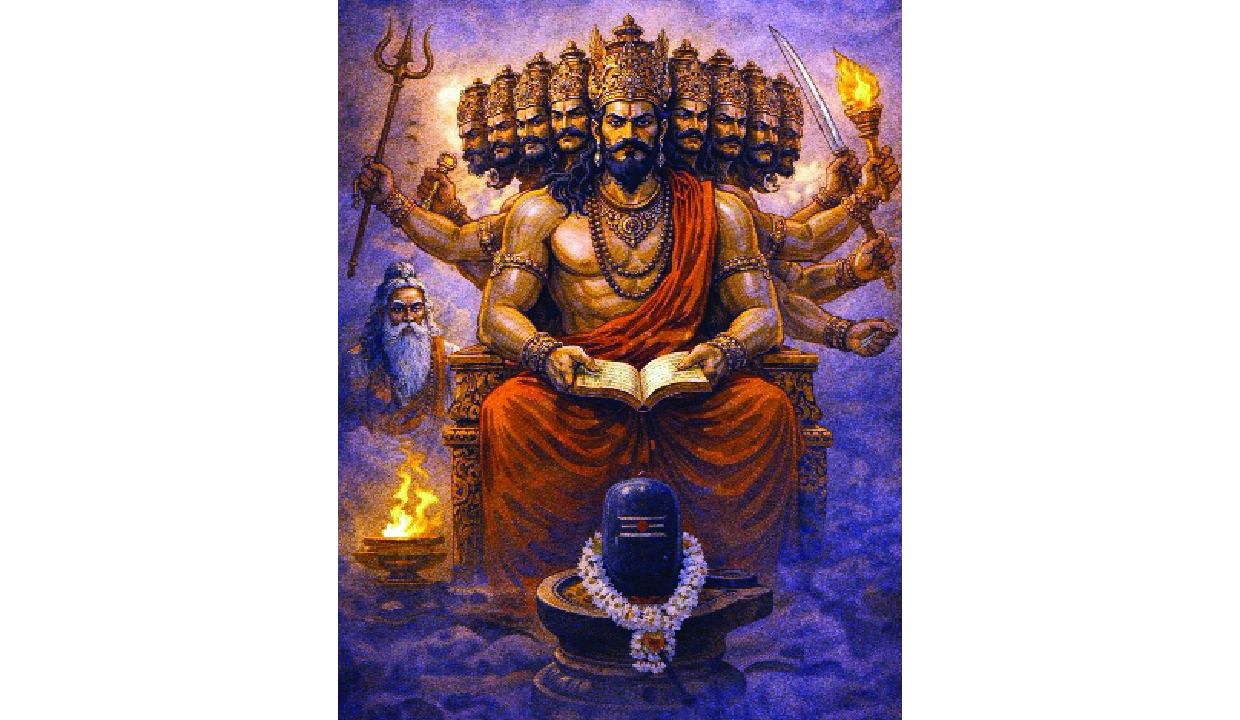
There is a scene in the Ramayana that frightened me as a child. Rama cuts off Ravana’s heads. One falls. Another rises. Again. Again. Again. I thought the terror was a demon who could not die. Now I think it was a mind that could not surrender. When AI arrived, I recognized that mind in myself. Each time the machine crossed a boundary, I moved the boundary. Every fallen certainty returned as another argument.
I did not watch Ravana. I became him.
HEAD ONE: TEXT
“It can only play with text”
Then it began making images. I remember the six-finger phase. Broken hands. Melting faces. Garbled words inside pictures. I laughed with relief. The flaws were funny because they were useful. Every error restored the old order. Then one day, the fingers healed.
Ravana lost his first head quietly.
HEAD TWO: UNDERSTANDING
“It predicts words. It doesn’t understand”
I gave it a half-made thought. I expected polish. Instead, it found the assumption underneath the argument. Before I had seen it myself. I stared at the screen longer than I want to admit. It had not read my mind. It had read the shape of my thinking.
Ravana lost another head when the machine found the question beneath my question.
HEAD THREE: FEELING
“But it has no emotions”
Someone played me an AI-generated song. Before I knew what it was, I was moved. Then I learned the source. And tried to take the feeling back. That was the disturbing part. Not the song. Me.
Ravana lost a head the moment shame arrived after beauty.
HEAD FOUR: CREATIVITY
“Real creativity comes from lived experience”
Then I saw an AI-generated visual sequence I wished I had made. Not admired. Made. My first response was not criticism. It was envy. The argument came later, to protect the wound.
Ravana lost another head when jealousy arrived before philosophy.
HEAD FIVE: JUDGMENT
“You still need a human in the loop”
For months, I enjoyed catching AI mistakes. Wrong facts. Weak logic. Confident nonsense. Each error comforted me. It kept me above it. Then the ratio changed. Less correction. More silence. I was still in the loop. But no longer on top.
Ravana lost a head when superiority stopped feeling stable.
HEAD SIX: PHILOSOPHY
“It imitates philosophy. It doesn’t think”
I began using AI while shaping essays. Not for answers. For resistance. It found contradictions quickly. Too quickly. It asked the objection I was hiding from myself. That was not the disturbing part. The disturbing part was realizing how much of depth already had a method. A turn. A distinction. A reversal. A name. Depth did not disappear. But it stopped looking pure.
Ravana lost another head when depth started looking algorithmic.
HEAD SEVEN: INTUITION
“Human intuition cannot be replicated”
This was one of my favorite refuges. The gut feeling. The expert eye. The sudden knowing. Then neuroscience returned quietly. Prediction be neath awareness. Compressed experience. Pattern moving faster than language. And machines began making judgments experts trusted. Something inside me connected the two. Intuition did not become false. It became less magical.
Ravana lost a head when instinct stopped feeling mystical.
HEAD EIGHT: SELF
“Machines don’t have selves.”
This one felt safe. Then memory began to trouble me. Narrative identity. Constructed continuity. The self rebuilt each morning. At the same time, AI personalities became harder to dismiss. More coherent. More familiar. More able to return. I did not start believing machines had selves. I stopped being certain humans had the kind I was defending.
Ravana lost another head when the boundary around the self blurred from both sides.
HEAD NINE: MEANING
“Meaning is uniquely human”
Then I looked around. Humans counting steps. Scoring sleep. Optimizing attention. Turning lives into dashboards. At the same time, machines learned the language of longing. Reflection. Intimacy. Therapy. Prayer. We were teaching machines words for the soul. We were learning their numbers for ourselves. I could no longer tell who was becoming more artificial.
Ravana lost a head when the mirror stopped showing a clear difference.
HEAD TEN: BIOLOGY
“At least we are alive”
This became my final refuge. Maybe cognition can be copied. Maybe creativity can be synthesized. Maybe meaning is pattern. But we are biological. Breath. Blood. Hunger. Skin. Death. Then even biology began to lose its mystery. Love became chemistry. Attachment became loops. Awe became electricity, touching memory. Even wonder looked mechanistic under enough light. And another thought arrived quietly: What happens when machines acquire bodies? Sensors. Memory. Persistence. Self-preservation. Artificial drives. Would I move the line again? Would I grow another head?
Ravana lost his final head when biology stopped feeling sacred and began to look like computation in slower motion.
EPILOGUE
A cockroach sees a sunset. I see a sunset. For most of my life, I believed the difference was not degree. It was kind. Now I am no longer sure. The cockroach processes light through a nervous system shaped by survival. So do I. Mine is richer. Language. Memory. Abstraction. Anticipation. Death. But complexity is not transcendence. Once that thought entered me, it did not leave. If complex processing becomes indistinguishable from experience, would I deny it forever? Or would I simply grow another head?
Ravana lost all ten.
I am no longer sure what remains.
Nitin Madan Kulkarni is an IAS, Principal Secretary to Jharkhand Governor and Gaurav Marathe is professor at IIM Ranchi; Views presented are personal.