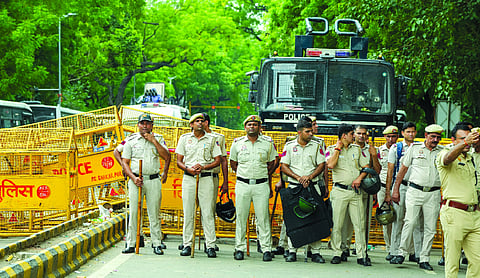

After the major protests and violence in Delhi on July 20, the Delhi Police have started a complete review of how they gather intelligence. Police Commissioner Anurag Kumar has told the Special Branch to collect and study at least ten key pieces of information before any big protest is planned in the city.
Delhi Police sources said this decision came after an honest review showed that their current methods did not work well on July 20. Officials found they lacked accurate or timely information about how many protesters to expect, how they would gather, or what roles different groups would play in the protest.
The police knew only the protest location and had a rough idea of the crowd size, which was not enough to predict the unrest or how quickly things would turn violent. “There was a clear gap between the intelligence we received and the ground reality that unfolded,” a senior officer involved in the review said. “Simply knowing where people would gather and roughly how many might turn up is no longer enough. We need actionable, multi-layered insights that allow commanders to plan deployments, containment strategies and contingency measures with far greater accuracy.”
Under the new rules, the Special Branch must go beyond basic checks. Sources say the ten key areas will likely include detailed group numbers, how and where people will gather, who leads and influences the groups, chances of multiple protests happening at once, possible trouble spots, outside involvement, social media activity, past behaviour of the groups, how long the protest might last, and any signs that people plan to break rules or enter restricted areas.
The focus now is on creating useful, forward-looking intelligence, not just watching events unfold. The violence on July 20 showed weaknesses in the old system. Police sources admitted that not having detailed information in advance made it harder to make quick decisions and put extra strain on resources. Because of this, Commissioner Kumar has ordered a full review of how intelligence is collected, analysed, and shared with teams on the ground.
Senior officers said the Special Branch must now write detailed reports for every major planned protest. These reports will be shared in advance with district police and special units so they can better plan for force numbers, barricades, traffic changes, and quick-response teams. This change is also intended to help the police work more effectively with other agencies that track social media and public information. The police have not shared the full list of ten key areas, but sources stressed that the main aim is to get useful and reliable information. “The goal is not to collect more data for the sake of it, but to ensure that what reaches decision-makers is specific, verified and relevant to operational planning,” another official said.
This overhaul comes after several large gatherings in Delhi have sometimes turned disorderly. Police leaders say the right to peaceful protest is still protected, but now the intelligence wing has more responsibility for predicting and handling possible problems.
Police top brass are also discussing if they need more staff or better technology to meet these new standards. As the Special Branch starts using the new rules, officers say the real test will be the next big protest.
The police hope that having more detailed information before events will help them avoid surprises and keep order more easily. Sources said the review of the intelligence system will continue over the next few weeks, and further changes may be made once they see how the new approach works.
For now, the message from police leaders is clear: rough guesses and basic venue details are not enough. Delhi Police want more detailed and useful intelligence before any crowds gather in the city, sources added.