Monsoon finally arrives in Delhi, ending weeks of heat and humidity

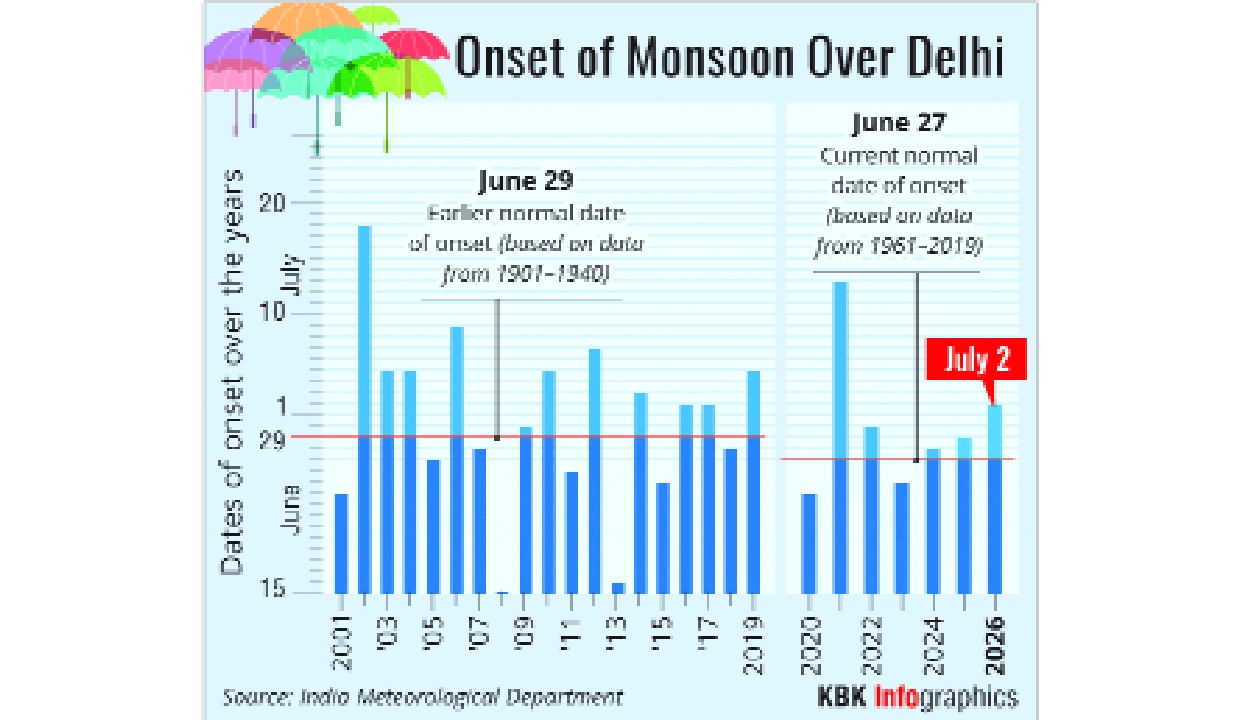
Ending the capital’s prolonged stretch of heat and sticky humidity, the India Meteorological Department (IMD) declared the onset of the southwest monsoon over Delhi and several parts of north India on Thursday, five days after its normal onset date of June 27, bringing widespread rain to several parts of the city. According to the IMD, it is the first time since 2021 that the monsoon has arrived in July. In 2021, the monsoon had set in on July 13.
The declaration followed several days of pre-monsoon conditions across Delhi and NCR. Thursday morning brought rains to parts of Delhi, Noida and Ghaziabad, and by the time the showers had rolled through, the IMD made it official. Historical IMD records show that such delays are not unusual. The monsoon reached Delhi on July 2 in 2016 and 2017. The fluctuating onset dates reflect year-to-year changes in the pace of the southwest monsoon’s advance, which depends on large-scale weather patterns over the Arabian Sea, the Bay of Bengal and northern India.
Between 1960 and 2025, the monsoon reached the capital 33 times in July and 33 times in June. During this period, the earliest arrival of the monsoon was on June 9 in 1961. The most delayed was when the winds reached Delhi on July 27 in 1987. In the last five years, the southwest monsoon had reached Delhi on June 29 in 2025, June 28 in 2024, June 25 in 2023 and June 30 in 2022. IMD data also shows that in the 15 years between 2011 and 2026, there were moderate showers either on the onset day or a day after (which is average rainfall logged in the past 24 hours).
According to data shared by the IMD, five weather stations in Delhi recorded low rainfall ranging from 2 mm to 5 mm over the last 24 hours. Chattarupur recorded 17.5mm of rainfall between 11:30 pm (Wednesday) and 8:30 am (Thursday), followed by Ayanagar (5mm), Safdarjung (4.6mm), Lodi Road (4.1mm), Mayur Vihar and Janakpuri (3.5mm), the Ridge (3mm), Palam (1.9mm), and Jafarpur (1mm).
IMD considers as ‘very light’ rainfall a precipitation measuring trace to 2.4mm in 24 hours. While ‘light’ rainfall measures between 2.5mm and 15.5mm, a downpour of 15.6- 64.4 mm is declared ‘moderate’. The rainfall is considered ‘heavy’ if it measures from 64.5mm to 115.5mm. If the rainfall logged is 115.6- 204.4 mm, it is categorised as ‘very heavy’.
The first spell of rain, accompanied by strong winds on Tuesday night, brought significant relief from the intense heat. Cooler conditions persisted through Wednesday and into Thursday, raising expectations that the monsoon could arrive in Delhi soon.
The weather department expects monsoon activity to stay active over Delhi and much of northwest India for the next several days. A favourable monsoon trough, the elongated low-pressure zone that draws moisture-laden winds inland, is in place, and a fresh low-pressure area is likely to form over the northwest Bay of Bengal around July 3. Together, these are expected to support widespread rainfall across northern India in the days ahead.
The IMD said the monsoon has now advanced across the national capital along with large parts of northwestern India, while extremely heavy rainfall is expected to continue over Maharashtra, Goa, Konkan, south Gujarat and parts of central India over the next several days. The weather department said the southwest monsoon advanced further on July 2 into the remaining parts of Uttar Pradesh, the entire National Capital Territory of Delhi, most parts of Madhya Pradesh, Haryana and Punjab, additional areas of Gujarat and parts of Rajasthan.