India and Jordan: A partnership that must not be missed
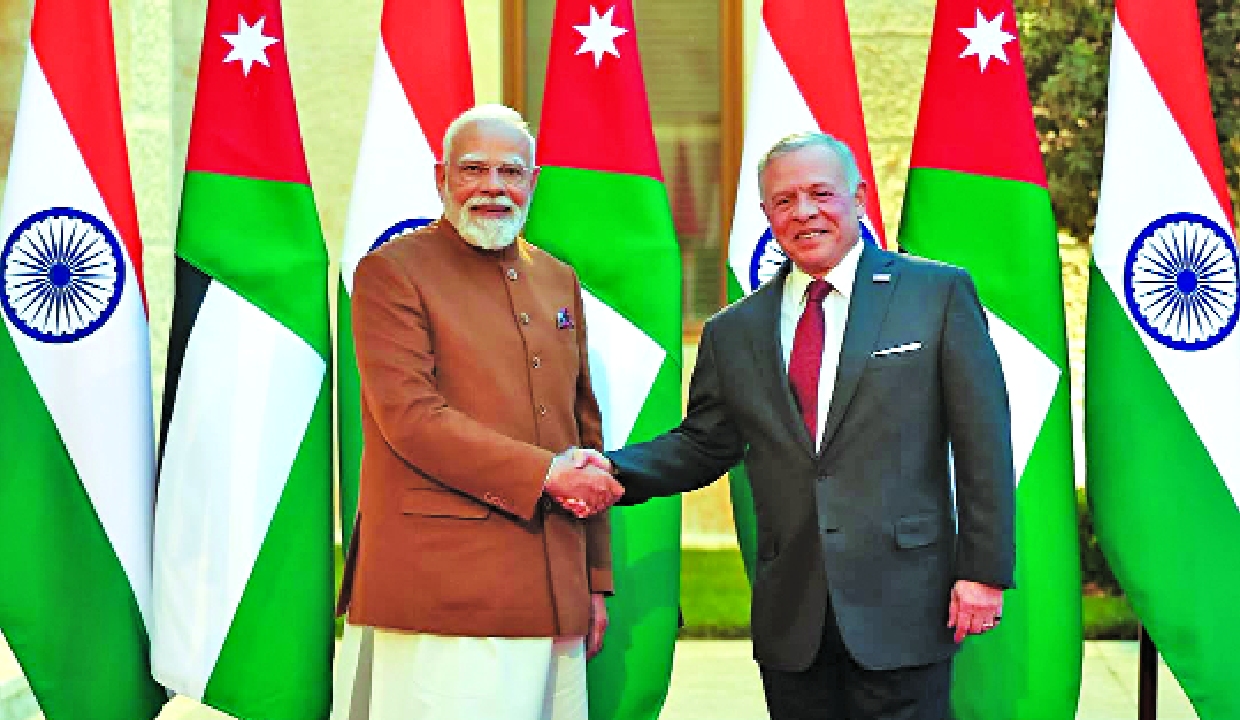
Prime Minister Narendra Modi’s December visit to Jordan marked a pivotal moment in India’s engagement with West Asia. It was significant not only because it coincided with the 75th anniversary of diplomatic relations between India and Jordan, but also because it represented the first full-fledged state visit by an Indian Prime Minister to the Hashemite Kingdom.
For decades, despite warm diplomatic ties and mutual goodwill, India has not fully leveraged its relationship with Jordan. The visit signalled a recognition that Jordan is far more than a friendly nation—it is a strategic gateway to West Asia and the broader Arab world. As both countries commemorate 75 years of diplomatic engagement, the relationship is now entering a phase of deeper commitment and greater ambition.
The Real Prize: Trade and Business
India is already among Jordan’s largest trading partners, yet bilateral trade remains well below its true potential. With both governments setting a target of $5 billion in bilateral trade over the next five years, the existing gap should not be viewed as a limitation but as an opportunity.
The complementarities are evident. India brings world-class expertise in information technology, renewable energy, pharmaceuticals, infrastructure development, and skilled workforce solutions. Jordan offers valuable phosphate and potash reserves, strategic geography, political stability, and access to regional markets. Together, these strengths form the basis of a natural economic partnership awaiting stronger execution.
The India–Jordan Business Forum held during the Prime Minister’s visit reflected this reality. It was not merely a ceremonial gathering but a practical platform where entrepreneurs and investors from both nations explored avenues for collaboration, investment, and growth. The central question was straightforward: how can both countries create value together? Jordan is already a critical supplier of phosphates and potash for India’s agricultural sector. However, the future of the relationship extends far beyond fertilizers.
Five Agreements, One Shared Vision
The signing of five Memorandums of Understanding covering renewable energy, water resource management, cultural exchange, digital solutions, and heritage-site cooperation offers a blueprint for the future of India–Jordan relations.
Renewable energy represents one of the most promising areas of cooperation. Jordan’s abundant solar potential and India’s leadership in cost-effective renewable technologies create opportunities for mutually beneficial projects that contribute to energy security and environmental sustainability.
Water management is equally critical. Water scarcity is emerging as one of the defining challenges of the twenty-first century. Jordan faces significant water constraints, while India has developed expertise in irrigation systems, water conservation, and resource management. Sharing knowledge and technology in this field addresses a pressing challenge while strengthening trust between the two nations.
Digital cooperation highlights another area where India can make a meaningful contribution. Indian technology companies have transformed industries worldwide through innovation and scalable digital solutions. Extending this expertise to Jordan can support economic modernization while creating opportunities for Indian businesses and professionals.
The cultural dimension should not be underestimated. The twinning of heritage sites such as Petra and Ellora may appear symbolic, but cultural diplomacy often produces tangible outcomes. It promotes tourism, encourages educational exchanges, and deepens people-to-people connections. Cultural understanding lays the foundation upon which stronger economic and strategic partnerships are built. These agreements are not isolated initiatives; they represent a coherent vision of what the India–Jordan partnership can become.
People-to-People Ties: The Unsung Bridge
One of the strongest pillars of the relationship is often overlooked: the people themselves. Approximately 17,500 Indian nationals live and work in Jordan across sectors including textiles, construction, healthcare, manufacturing, and services. These individuals contribute to Jordan’s economy while strengthening India’s presence abroad through remittances, professional excellence, and cultural engagement.
The recently renewed Cultural Exchange Programme for 2025–2029 provides an opportunity to deepen these ties through educational collaborations, artistic exchanges, yoga initiatives, academic partnerships, and cultural performances.
Such interactions create an emotional connection between societies. When Jordanians engage with Indian culture, they gain a deeper understanding of India’s values, diversity, and civilizational heritage. Likewise, Indians discover the rich history and traditions of Jordan. These exchanges generate trust, and trust remains the most valuable currency in international relations.
Standing Together Against Terrorism
India and Jordan share another important commonality: both have suffered from the consequences of terrorism and violent extremism.
This shared experience has created a strong foundation for cooperation on security issues. During the Prime Minister’s visit, counterterrorism featured prominently in bilateral discussions, with Jordan expressing firm support for India’s position on combating terrorism. Particularly significant is the alignment between India’s policy of zero tolerance toward terrorism and King Abdullah II’s promotion of the Amman Message, which rejects extremist interpretations of religion and condemns the use of faith to justify violence.
When two nations are united by common values and a shared understanding of security challenges, their partnership gains strategic depth. This alignment positions India and Jordan as credible partners in promoting regional stability and countering extremism.
Investing in Human Capital
Long-term partnerships are ultimately built through investments in people.
India’s decision to increase Indian Technical and Economic Cooperation (ITEC) training opportunities for Jordanian officials from 37 to 50 annually reflects this understanding. Such initiatives allow Jordanian professionals to gain exposure to Indian institutions, technologies, and development models while building enduring professional relationships.
Why Jordan Matters for India
In the twenty-first century, India’s global ambitions require a diversified approach to international partnerships. While engagement with major powers remains important, India must also strengthen relationships with strategically located and politically stable partners across regions.
Jordan may not be a major power by conventional metrics, but its importance lies in its strategic location, regional credibility, and stability in a complex neighbourhood. It serves as a gateway to the broader Arab world and offers India an important platform for expanding its engagement across West Asia.
India requires reliable access to critical minerals, energy partnerships, and new markets for its goods and services. Jordan can contribute to each of these priorities. A stronger Jordan also contributes to regional stability, which directly benefits India’s economic and security interests.
Furthermore, Jordan can amplify India’s voice in the Arab world, helping strengthen India’s diplomatic footprint across a region of increasing geopolitical importance.
The Road Ahead
Prime Minister Modi’s visit delivered a clear message: India is ready to invest in its partnership with Jordan. The challenge now is implementation.
Indian businesses must move beyond rhetoric and establish a stronger presence in Jordan, viewing the country not as a small market but as a strategic entry point into the wider region. The $5 billion trade target should serve as a roadmap around which concrete investment plans are built.
Educational and cultural exchanges must also expand beyond government-led initiatives. Universities, research institutions, think tanks, and private-sector organizations should become active participants in strengthening bilateral ties.
Most importantly, the agreements signed during the visit must translate into measurable outcomes. Renewable energy projects, water security initiatives, digital partnerships, and capacity-building programs should move swiftly from paper to practice.
Ultimately, the success of this relationship will depend not on official communiqués but on the strength of connections forged between entrepreneurs, students, professionals, investors, and communities. Real transformation occurs when businesses collaborate, ideas flow freely, and people build lasting relationships.
India and Jordan have spent 75 years building goodwill. The next decade must be about converting that goodwill into a strategic partnership that delivers tangible benefits for both nations. The opportunity is before us. It is one that neither country can afford to miss.
The writer is an Associate Editor (Foreign Affairs) at The Pioneer; Views presented are personal.