Football-theme sculpture at Salt Lake stadium razed
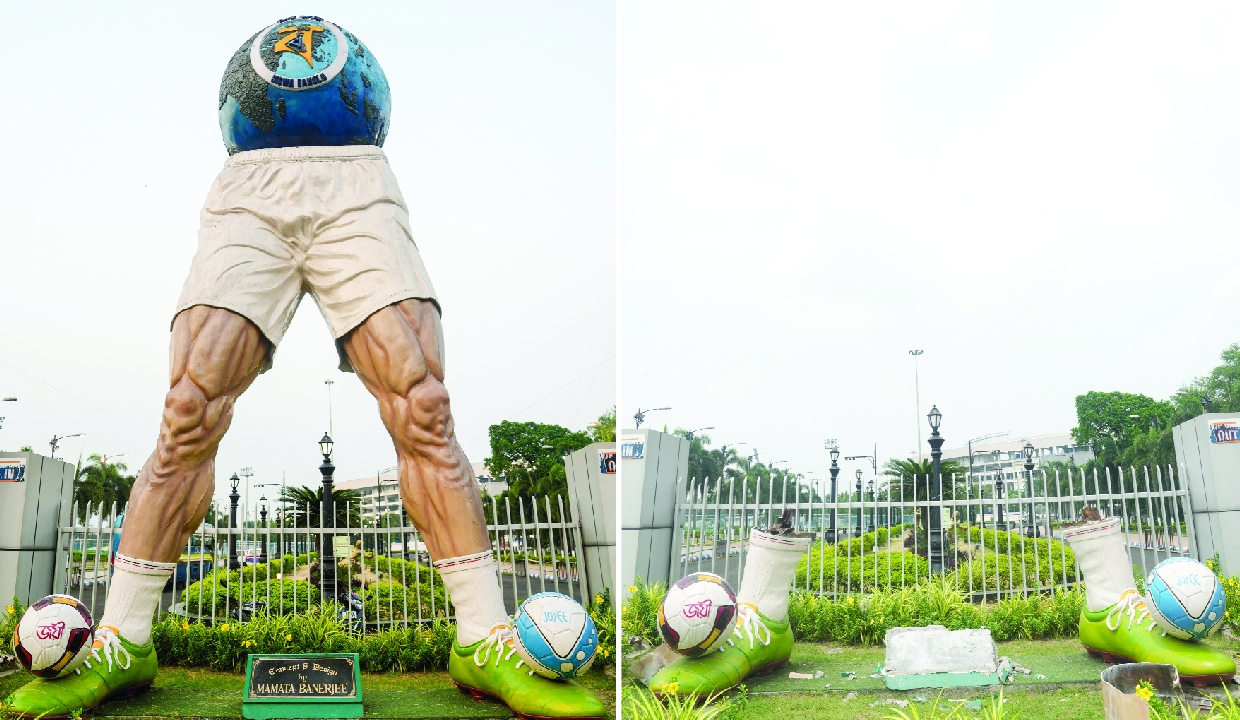
The West Bengal Government on Saturday morning demolished the football-themed sculpture located outside the VVIP gate of the Salt Lake Stadium, officially known as Vivekananda Yuba Bharati Krirangan (VYBK). Workers removed the Biswa Bangla logo parts first, then the rest of the structure. State Sports Minister Nisith Pramanik had announced the decision to demolish the sculpture earlier in the week.
The structure has faced sustained criticism from football fans since its installation nearly a decade ago, who called it “bizarre, meaningless, ugly and grotesque.” The demolition is part of the BJP-led Government’s effort to update the stadium’s look and facilities.
The sculpture was erected in 2017 before the FIFA U-17 World Cup, during Mamata Banerjee’s tenure as chief minister. It showed a footballer’s legs in shorts and socks with a football on top, often featuring the Biswa Bangla logo and the word “Joyi.” The design aimed to reflect Bengal’s football culture and Kolkata’s importance in the sport.
The sculpture stood near the stadium entrance, where fans, players, and visitors could see it. Some people saw it as a tribute to football in a state famous for clubs like Mohun Bagan Super Giant and East Bengal FC. However, many criticised its proportions and design, often calling it a “headless torso with legs and a ball on top.” From the start, the sculpture faced heavy criticism on social media.
Sports Minister Nisith Pramanik shared these opinions when he announced the removal. After an Indian Super League Kolkata derby, he said, “Such an ugly-looking statue, two legs cut at the torso and football above it does not make sense. It does not look aesthetically pleasing either, so we will not keep such a grotesque structure that has no meaning.” He added that the demolition was not only about appearance but also a necessary step to upgrade the stadium. The venue holds 85,000 people and has a long history of hosting major matches, famous derbies, and international games.
Because the sculpture was installed under the previous Trinamool Congress (TMC) Government, its removal sparked political conflict. TMC representatives called the action “vendetta politics” and see it as an attempt to erase symbols linked to Mamata Banerjee’s administration. Supporters of the BJP-led Government believe the removal was needed to fix what they consider a poorly planned public artwork.
This decision is one of several changes at the stadium. Other updates include replacing state emblems with national symbols such as the Ashoka Stambh and creating new fan areas, including a food court. Officials say these upgrades aim to improve the spectator experience and add more seats to the stadium.
Many football fans and social media users thought the quick removal was overdue. Some wanted the sculpture preserved rather than demolished, while others suggested erecting tributes to Bengal football figures like PK Banerjee. There were also concerns about the costs of installing and removing the artwork.
Salt Lake Stadium, also called VYBK, is in Bidhannagar (Salt Lake), Kolkata, and has played a major role in Indian football since 1984. It is the home ground for top clubs and has undergone numerous renovations, including major upgrades, ahead of the 2017 U-17 World Cup. With its large capacity and dedicated fans, the stadium is a cultural landmark in a city where football is more than a sport; it is a way of life.
Taking down the sculpture marks a symbolic new beginning for the stadium. It remains unclear whether this change will lead to better facilities. The removal has sparked debates about public art, political symbolism, and the management of shared cultural spaces in West Bengal. As redevelopment continues, the former sculpture has become a key topic in discussions about leadership, design, and legacy in Bengal football.