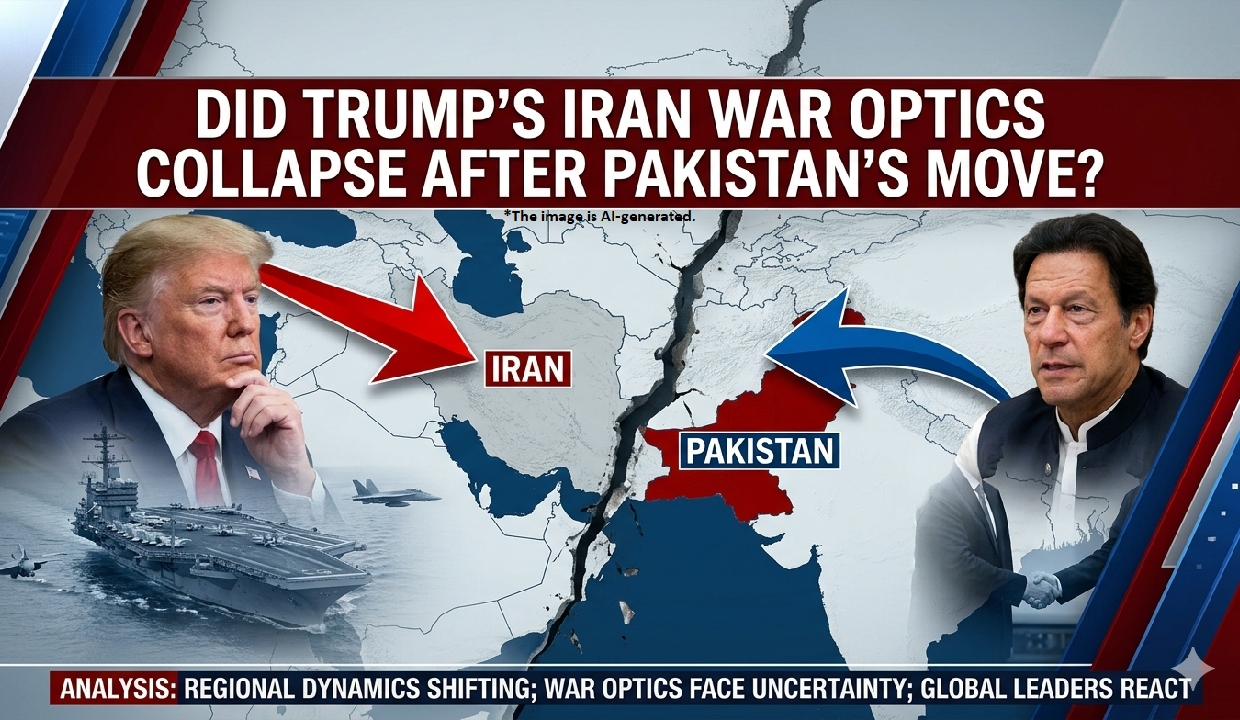
Did Trump’s Iran war optics collapse after Pakistan’s move?
Donald Trump built much of his public image on a single promise: he could issue hard threats, move fast, and still control how a crisis ended. The Iran episode weakened that claim. Five weeks into the campaign, he no longer looked like the figure setting the pace.
What made the moment more damaging was Pakistan’s place in it. During Operation Sindoor, Trump cast himself as the steady hand who stepped in and helped Pakistan avoid disaster. Now the picture looked reversed. Pakistan appeared to help create an exit from a clash that Trump could not shape on his own.
At its core, this was less about battlefield lines and more about who seemed forced to give way.
The argument turns on optics and bargaining power, not on any formal ruling over victory or defeat. Still, politics runs on what people can see, and by that measure, Trump’s Iran war no longer looked like a clear show of force.
His opening stance was blunt. Iran was expected to retreat, reopen the Strait of Hormuz on demand, and absorb pressure without setting conditions. That did not happen. Iran’s nuclear program was not broken in a way that Trump could present as final. The Strait stayed under Tehran’s effective control. Then the White House shifted from threats of destruction to a pause and talks.
That shift mattered because Trump had sold escalation as proof of command. A leader can change course and still come out ahead, but only when the new terms look chosen, not imposed. Here, they did not. Iran kept speaking as if it still had options, while Trump seemed more eager for a halt than he had at the start.
At first, Trump’s message was simple: open the Strait at once or face massive force. The point was to project dominance. It also left little room for doubt.
Iran did not accept that demand. Instead, Tehran tied safe passage to its own armed forces and to technical and security terms that it said it would manage. In plain terms, Iran did not act like a state surrendering under pressure. It acted like a state that still controlled the chokepoint.
That mattered because the Strait of Hormuz was not a side issue. It was the pressure point. If Iran could still shape the movement there, then Trump’s threats had not produced the clear compliance he wanted.
The next problem was both visual and political. Trump’s language began with destruction. Later, it gave way to a two-week pause in strikes and talks linked to an Iranian framework.
Iran presented that pause as a sign of confidence, not weakness. Its message stayed firm: attacks had to stop, Iran’s red lines would remain, and any talks would happen on terms it could accept. That framing helped Tehran look steady, while Trump looked as though he was stepping back from his own toughest line.
Even if the pause helped prevent a wider war, it still weakened the strongman image Trump likes to sell. He had promised pressure that would break resistance. What emerged instead looked like pressure that ended in bargaining.
A retreat is one thing. A retreat that runs through a country once treated as a dependent is far worse. That is why Pakistan’s role made the episode so uncomfortable for Trump.
During Operation Sindoor, Trump presented himself as the one adult in the room. He praised Pakistan’s leaders, spoke as though disaster had been avoided because they turned to him, and wrapped the moment in his favorite message: only he could make the right calls at the right time. In that story, Pakistan looked like the side that needed help. Now that image had flipped. Reports and public statements pointed to Pakistan as part of the channel that carried messages, bought time, and helped reduce the chance of a wider war. Trump publicly thanked Pakistan’s Prime Minister Shehbaz Sharif and Field Marshal Asim Munir. Iran, for its part, also suggested that Pakistan helped open space for de-escalation. That reversal hit Trump where he’s always been most exposed, his brand. He had cast himself as the man who stepped in during the India-Pakistan crisis around Operation Sindoor, praised Pakistan’s leaders, and claimed his involvement stopped a disaster. Yet the story flipped fast, and he no longer looked like the saviour of Islamabad. Instead, he looked like a president who needed Islamabad’s help to retreat.
The fine details mattered less than the image. Pakistan looked relieved to have Washington engage. Trump looked calm, decisive, and bigger than the crisis itself. He sounded like the only leader who could talk tough, make a few calls, and come out looking stronger than when he began. That story worked because it placed Pakistan beneath him in the chain of power. Trump was the fixer. Pakistan was the uneasy state that benefited from his reach. This time, Pakistan did not look like a client waiting for rescue. It looked like a broker. That is a very different image. Trump’s public thanks made that clear because they suggested dependence, not command.
At the same time, Iran’s side said Pakistan helped pass messages and reduce the risk of a broader war. The United States also seemed to make formal outreach. Islamabad then gained room to act as a go-between and, by some accounts, to host or support talks.
That is what made the reversal so awkward. Trump once used Pakistan to enlarge his own image. Now, Pakistan has enlarged its own relevance by helping manage Trump’s problem.
The Strait of Hormuz shaped the entire episode because oil markets and shipping react quickly to any threat there. A state that can still affect that chokepoint does not look cornered. It looks dangerous, controlled, and hard to force.
That gave Iran political space. Tehran could say it did not want a wider war while still warning that attacks would bring a response. In that frame, restraint looked like a choice, not surrender. Trump, by contrast, no longer looked like the side controlling the pace.
Pakistan’s role also revealed something familiar about its statecraft. Islamabad did not come out looking principled or consistent. It looked transactional, skilled at brokering in tense moments and quick to turn danger into diplomatic value. Iran’s public line was sharp but measured. It said it would defend its sovereignty, answer attacks, and keep the door open to talks if attacks stopped. That helped the Tehran project balance. In political terms, that was smart. Iran looked neither reckless nor submissive. It looked like a state willing to negotiate without first accepting humiliation. That cut into Trump’s core image as the leader who could escalate and still emerge stronger.
The biggest loss was not only military or diplomatic. It was personal and symbolic. Trump no longer looked like the leader who could threaten, escalate, and walk away taller.
Meanwhile, Pakistan looked like what it often looks like in regional crises, a state that survives by brokering between rivals. That may give it relevance, but it does not make it principled. In this case, it made Trump’s loss of face even harder to hide. Trump didn’t just fail to break Iran’s resistance on the terms he set. In the end, he also had to edge toward a way out shaped by pressure from allies, rivals, and events he couldn’t control. That mattered because his public image rested on force, command, and personal deal-making. Instead, he looked boxed in, with fewer choices than he claimed. That’s why the embarrassment hit so hard, it wasn’t only a failed threat but a very public loss of control.
The same Pakistan he once used to boost his image became part of the path out. That reversal damaged Trump’s central political story, the claim that every crisis bends to his will.
Pakistan, for its part, turned regional danger into fresh relevance once again. Trump lost the image battle, and Islamabad helped make that loss visible.
Surjit Singh Flora is a freelance writer and journalist who lives in Brampton, Canada. He is the author of the book “The Challenge and The Opportunity.”; Views presented are personal.