Delhi unveils INR 1.03 lakh crore budget
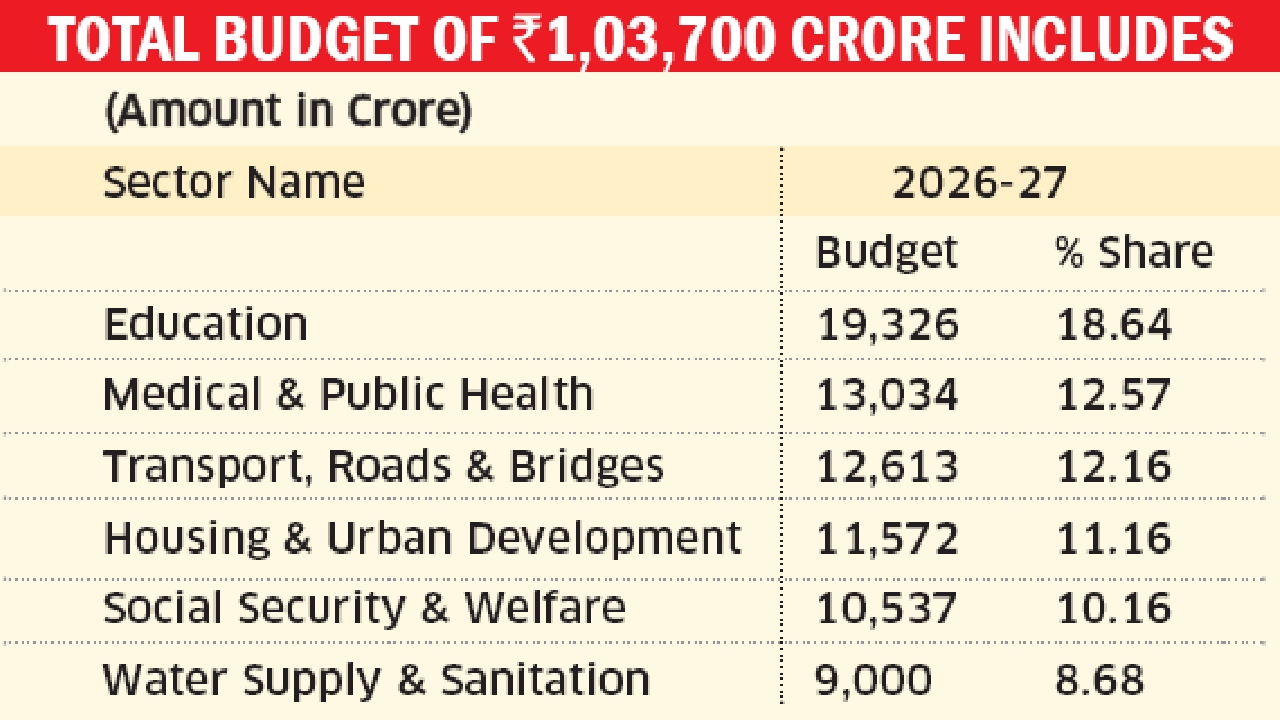
The Rekha Gupta Government on Tuesday unveiled a INR 1,03,700 crore budget for 2026-27, highlighting key priorities including education, health, transport, housing, urban development, water, and environmental sustainability. This is her second budget for the national capital.
Among the major announcements, the Government will offer free diagnostic tests for newborns under the new ANMOL (Advanced Newborn Monitoring and Optimal Lifecare) scheme, provide two free LPG cylinders during festivals, distribute bicycles to 1.3 lakh Class IX girls, and laptops to meritorious students. The ‘Mahila Samriddhi Yojna’ will be implemented with an outlay of INR 5,110 crore, giving eligible women INR 2,500 per month, with a registration portal to be launched soon. A new semiconductor policy and an ‘emergency operation centre’ for disaster management were also announced.
The total budget marks a 3.7 per cent increase over the INR 1,00,000 crore allocated in 2024-25. Delhi will generate INR 74,000 crore through its own tax revenue, raise INR 16,700 crore via market borrowing through the RBI, and receive INR 2,500 crore as an interest-free loan from the Centre under the SASCI scheme. This is the first time the Delhi Government will source funds through market borrowing.
Education continues to be the largest allocation, with INR 19,326 crore earmarked, representing 18 per cent of the budget. Health has been allocated INR 13,034 crore, transport INR 12,613 crore, urban development INR 11,572 crore, social welfare INR 10,537 crore, and water supply INR 9,000 crore. Infrastructure remains a central focus, with INR 5,921 crore for the Public Works Department, INR 1,352 crore for developing dust-free roads and resurfacing 750 km of city roads, and over INR 8,700 crore set aside for urban development.
To improve access to education, the Government will provide transportation for schoolchildren and INR 90 crore for bicycles for 1.3 lakh girls. Merit-based initiatives include laptops for high-performing Class 10 students, INR 150 crore for smart classrooms, and an Integrated Education Hub in Narela. INR 10 crore has been allocated for youth talent-hunt programmes, and a Sainik School will be established in Delhi.
Subsidies and welfare remain significant, with INR 3,500 crore for power subsidies and INR 450 crore for free bus travel for women. A new INR 260 crore provision will fund free LPG cylinders for ration card holders during festivals.
The budget, described by the CM as a “green budget,” allocates 21 per cent of total expenditure for environmentally sustainable initiatives. Power infrastructure will receive INR 3,942 crore, including INR 200 crore to shift overhead electricity wires underground.
For urban and regional development, INR 300 crore has been set aside for the trans-Yamuna area, while INR 787 crore is allocated to the Delhi Gram Vikas Board. Water and sewage management projects have been funded with INR 9,000 crore to the Delhi Jal Board.
Chief Minister Rekha Gupta highlighted that 70.3 per cent of the budget is for revenue expenditure and 29.7 per cent for capital expenditure, with a higher capital outlay than last year. She projected a tax-to-GSDP ratio of 5.09 per cent for 2026-27 and a revenue surplus of INR 9,092 crore. The CM emphasized Delhi’s resilience and economic progress, stating that the city is moving ahead at “triple-engine speed,” and underscored visible development in people’s lives.
The budget session began amid political tension, with AAP MLAs staging a protest with a ‘bier’ alleging a “murder” of democracy by the ruling BJP, while the Assembly received a bomb threat hours before the presentation. Police, however, reported no suspicious findings so far.