
- HOME
- INDIA
- WORLD
- BUSINESS
- STATES
- LAW & JUSTICE
- ENTERTAINMENT
- SPORTS
- VIEWPOINT
- LIFESTYLE
- TECH
There is a particular kind of protest that belongs to this generation alone. It happens on the street, yes, with the batons and the tear gas and the running and the shouting. But it also happens simultaneously on a phone screen, in a reel, in a meme drafted in real time, captioned with a punchline that lands before the tear gas has cleared.
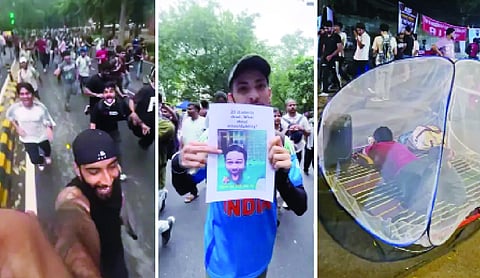
The Cockroach Janata Party’s Chalo Sansad march on July 20 was, by any conventional measure, a day of confrontation and chaos in the heart of Delhi. It was also, in the hours that followed, a masterclass in how Generation Z processes political trauma and turns it immediately, almost reflexively, into something that makes you laugh before it makes you think.
As thousands of protesters battled police batons near Parliament Street and teargas shells near Shastri Bhawan, another version of the same day was being assembled on Instagram and X in real time. Videos of protesters running from police set to the bouncing soundtrack of the mobile game Subway Surfer, in which the player sprints to escape a policeman, went viral within hours. Someone captioned it: “Thanks for the cardio, Delhi Police!”
Someone else posted a reel to the song Chak De India, with the caption: “Parliament ki doorbell baja ke bhag gaya!” The absurdity was the point. The laughter was the point. Both were also entirely serious.
YouTuber and rapper Garam Kalakar captured what the camera phones had seen and set it to verse. “Kal Jantar Mantar pe kya dekha? Chhatron me bhara tha junoon dekha, Delhi police pe sawar maine khoon dekha. Civil dress me gundo ki dhun dekha, aur vardi walon ki nameplate gum dekha. Chote baccho pe utha hua hath dekha, bade budhon ko mara tumne laat dekha.” The translation does not lose the sting: students full of resolve, police driven by something darker, plain-clothes men doing their work, officers with their nameplates conveniently absent, children having hands raised against them, the elderly being kicked. Wrapped in verse, the record becomes harder to unsee.
The demands driving the protest, the resignation of Union Education Minister Dharmendra Pradhan over the alleged NEET-UG 2026 paper leak, and accountability for students who died by suicide over examination irregularities were present in the humour too.
One Instagram user mocked the delay in Pradhan’s departure with the language of job hunting: “Employment opportunities are low in our country; that’s why Pradhan is not resigning.” Another translated the same frustration into corporate speak: the minister was probably waiting to receive his month’s salary before stepping down “to avoid the financial crunch during the full-and-final settlement.” On X, someone wrote: “Ho sakta hai Dharmendra Pradhan ke paas dusra offer na ho, isliye resign nahi kar raha.” Possibly he has no other job offer. That is why he is not resigning.
The protest also spread to Mumbai, Indore, Udaipur, and Hyderabad, and so did the content. Running protesters posted videos to Bhag Milkha, Bhag DK Bose, and Gangnam Style. The songs from Rang De Basanti and Swades played at protest sites. Someone pointedly noted on X that it was those songs, not those from the recently released film Dhurandhar, that the crowd had chosen. The allegation that the film carried a propaganda-driven narrative was folded neatly into the observation.
Superheroes turned up at protest sites in different cities. Protesters cosplayed as Batman, Spider-Man, Superman, and Iron Man. Mahatma Gandhi and B.R. Ambedkar were, in the language of the internet, “revived for the latest season.” The history and the meme lived in the same frame.