Bars shine, jewels lose sheen
There is something about gold in the recent past. Both its demand and prices have either fluctuated, or come down in both mysterious and logical ways. According to the World Gold Council’s index, there was a price peak in January 2026, followed by a fall, resurgence by early-March to a smaller peak, another fall during March, before a perk up since late-March. Much of this movement can be explained by
corrections, and the ongoing Iran-US-Israel war. Similarly, the overall quarterly demand, including OTC, went up, and came down over the past five quarters. In Q1-26 (January-March), which includes the war period, the demand was the lowest since Q2-25 (April-June).
What is equally perplexing about the demand is the wild gyrations between the various segments. This is evident in the tussle between the desire for the yellow metals as jewels, bars, coins, and ETFs (exchange-traded funds linked to gold) purchased for investment purposes.
There is the buying by the world’s central banks for safety and security. Bars and coins are up, ETFs are down; jewels are down, national reserves hover up and down, though seemingly within a consistent range. In effect, returns and investments score over vanity and personal needs, even as safety remains a priority among the central bankers.
Let us look at the various demand trends, and provide a future outlook, based on data and analysis by the World Gold Council. Overall demand, at 1,231 tonnes in Q1-26, is the lowest in four quarters, which
witnessed a high of 1,357 tonnes in Q3-25 (July-September). However, the figure in Q1-25 was 1,205 tonnes, which was dragged down by a fall of nearly 111 tonnes in the OTC market. On a year-on-year basis, Q1-26 demand was a modest two per cent higher. But when “combined with gold’s exceptional price rise,” it “generated a 74 per cent jump in the value of quarterly demand to a record $193 billion.”
According to the World Gold Council, “Geopolitical factors are expected to remain front and centre in driving gold demand for 2026 and beyond. This supports continued central bank net buying, broad global gold ETFs inflows, and bar and coin accumulation.” The analysis adds, “The geopolitical risk premium that has helped lift gold over the past few years is set to continue, and possibly expand as the year progresses.”
The outlook seems buoyant, although there will be fluctuations within the various segments. However, the price trends, and the ongoing conflict(s) will determine what will happen in the future. One of the interesting sub-trends is the demand for bars and coins, which are essentially for long-term investment purposes.
In Q1-26, the purchase of almost 475 tonnes was the “second-highest quarter on record,” even as “Asian investors led the charge, hoovering up gold investment products.” On a year-on-year basis, the rise was more than 40 per cent, and almost 11 per cent on a quarter-on-quarter basis. Bars constitute almost 85 per cent of the buying in this segment, which includes coins, imitation coins, and medallions. Since Q2-25, the sale of bars zoomed by 60 per cent, largely driven by the price attraction.
In the future, according to the Council, “Asian demand will likely remain a key source of strength in investment, as concerns over global geopolitics fuels demand for effective risk hedges.” High prices, a lack of alternatives, and inflation may attract savers and speculators. Unlike the investors in the West, the East-based buyers look at gold as something to be saved and preserved.
The latter’s holdings, which includes India and China, are over the longer term although, in the recent past, Indians have used gold as collateral to take loans to finance emergency, healthcare, and even consumption needs.
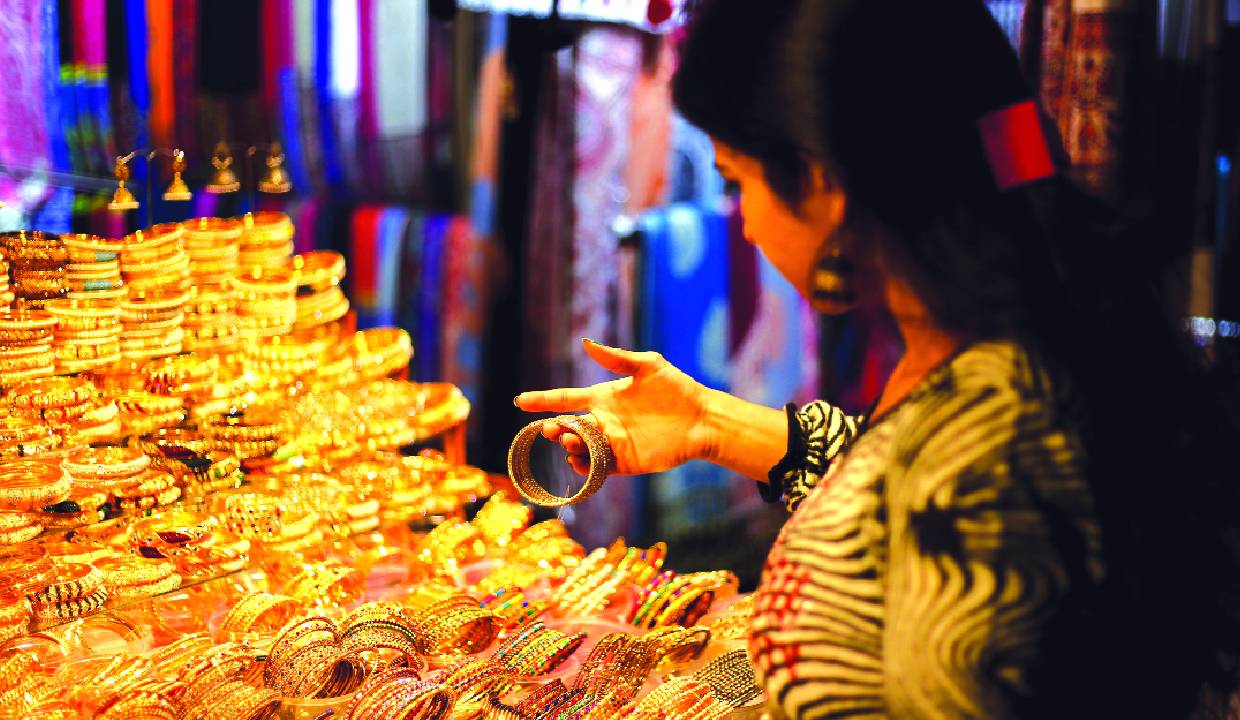
One is surprised that although the focus is on bars, gold jewels lost their sheen. This may indicate the smartness as investors feel that the returns from bars are higher because there are no cuts or discounts due to the making charges, as is the case with jewels, during sales.
This explains why only the necessary spending, which is requisite in Asian marriages, festivals, and occasions, may have pulled down demand in the segment by 23 per cent, year-on-year, in Q1-26. The figure, at 335 tonnes, is the lowest in the past five quarters.
One can blame the quarter-on-quarter decline of more than 100 tonnes due to the marriage and festival season in Q4-25 (October-December). But then the Q1-26 figure is the lowest for the first quarter in seven years, with the lowest of 331 tonnes in Q1-20 for obvious pandemic-related reasons. In Q1-25, the purchases were 435 tonnes, or 100 tonnes more, but this figure was more than 100 tonnes lower than in Q1-24.
There is something about the demand in the first quarters over the past several years, especially post-Covid, which follows the peak and highest demand in the fourth quarters of the previous year.
“Jewellery spend is likely to be resilient, absent economic shocks, but tonnage demand is expected to slip further as high prices, and regional tax policies, continue to bite,” states the World Gold Council. The fact remains that despite the lower volumes, the value of the quarterly spend in Q1-26 was up by 31 per cent, quarter-on-quarter, which indicates the continuance of “positive sentiment.” As mentioned earlier, people will buy jewels, but only what is required because of high purchase prices, and lower sale prices because of discounts.
ETFs and similar products were the quarterly laggards, with quarter-on-quarter sales dropping by more than 110 tonnes to 62 tonnes, with the highest at 230 tonnes in Q1-25. In Q1-22, the demand was 272 tonnes, followed by minimal or negligible purchases in Q1-23 and Q1-24. Hence, the first quarters are generally bad times for the ETFs.
But this time, the Iran war created a crisis and scare, which pushed the US investors to withdraw from such investments, and logically led to “sizable outflows from US funds in March (2026).” Hence, the future demand may be “positive but lower than in 2025.”
Which brings us to the central banks. They sold a lot of gold in the recent past, but bought more than 240 tonnes in the first quarter of this year, or the highest in the past five quarters.
However, apart from a noticeable dip in Q2-25, when demand slumped to nearly 180 tonnes, the quarterly buying was between 200 and 240 tonnes. “Central bank buying is expected to be solid at levels close to those in 2025,” states the Council. But it does not rule out “tactical rebalancing.”