Anti-pollution measures showing results: CM
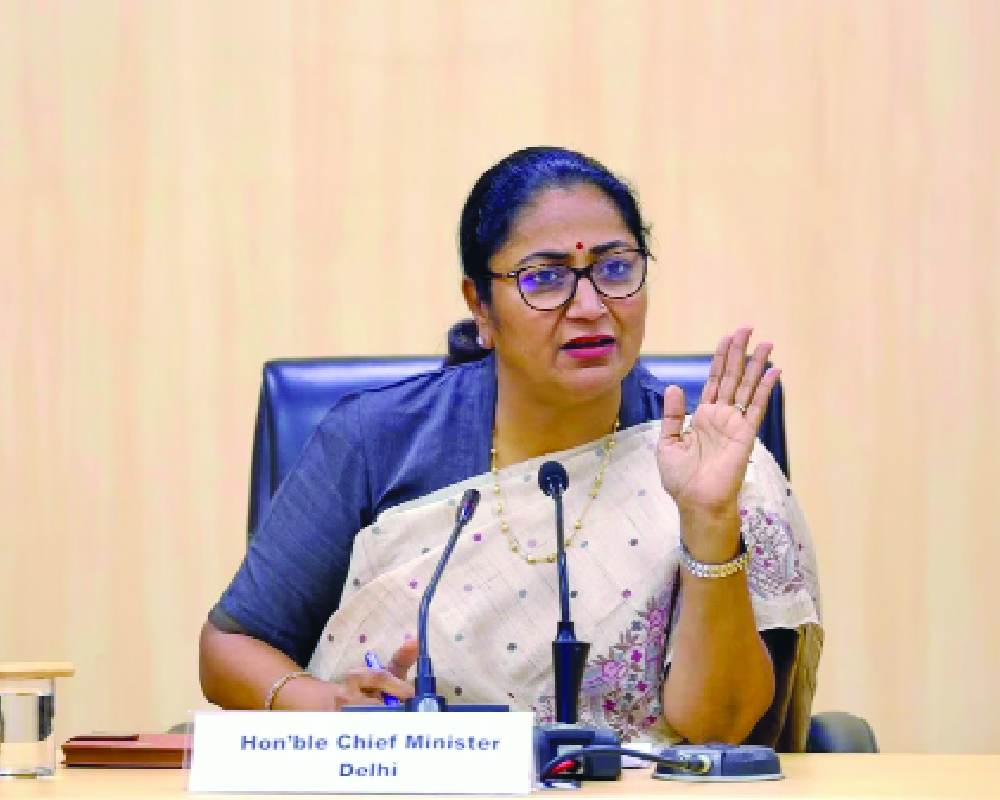
Delhi Chief Minister Rekha Gupta on Sunday said steps taken to control pollution are showing encouraging results, adding that in order to strengthen ground-level enforcement, thousands of teams are working round the clock to control dust, open burning, industrial pollution and vehicular emissions.
Joint teams comprising district magistrates, police officials and municipal corporation officers have intensified inspections, challans and penalty actions. Local authorities have been empowered to impose fines for open burning of garbage, dry leaves and plastic, she said.
To effectively tackle the challenge of air pollution, the Delhi Government is continuously implementing immediate, medium-term and long-term measures in a focused and systematic manner.
The Delhi Government has stated that it is taking all necessary steps to comprehensively control pollution, including dust control measures, expansion of public transport, strengthening metro connectivity and other related interventions.
According to the Environment Department of the Delhi Government and the Delhi Pollution Control Committee (DPCC), in compliance with the directions issued by the Supreme Court last month, a review meeting was held by the Ministry of Environment, Forest and Climate Change with the States/Union Territories of Delhi-NCR, the Commission for Air Quality Management (CAQM) and the Central Pollution Control Board (CPCB).
Based on the outcomes of this meeting, several measures are being implemented to control air pollution in the national capital, and the government has achieved encouraging results.
These measures include enhanced monitoring and enforcement, strengthening public transport, dust control, prevention of open burning, and strict action against industrial pollution.
According to the department, large-scale deployment of anti-smog guns, water sprinklers, mechanical road sweepers and mist spray systems has been undertaken to control dust on roads and open areas.
Across various localities, 388 anti-smog guns, 270 water sprinklers and 75 mechanical road sweepers are covering thousands of kilometres of roads on a daily basis. In addition, 326 mist spray systems have been installed at 13 major air pollution hotspots. For scientific management of construction and demolition (C&D) waste, new collection sites have been developed in addition to the existing sites of the MCD, NDMC and Delhi Cantonment.
Under the Graded Response Action Plan (GRAP), measures such as changes in office timings, work-from-home, hybrid classes in schools and temporary restrictions on physical activities are being implemented during severe and very severe pollution conditions.
Under the Graded Response Action Plan (GRAP), special emphasis has been placed on making public transport more accessible and attractive.
During GRAP Stage-II, 40 additional metro trips were operated by the Delhi Metro, while 60 additional trips were operated during GRAP Stage-III to reduce dependence on private vehicles and provide safe and clean transport options to commuters.
Additionally, the Delhi Metro Rail Corporation has deployed 1,823 e-autos at 44 metro stations. A further 476 e-autos are planned to be deployed by March 2026. Moreover, sites have been allocated at 18 locations for e-rickshaw services, of which services are currently operational at four stations through 100 e-rickshaws.
The Delhi Government has also taken concrete steps to promote public transport and electric vehicles. As of 30 November 2025, Delhi’s total bus fleet has reached 5,295, comprising 1,868 CNG buses and 3,427 electric buses.
By March 2026, 1,988 new electric buses are to be added, while an additional 510 electric buses are proposed to be inducted by December 2026. Under the Prime Minister’s e-Drive scheme, a total of 2,800 e-buses are proposed to be inducted. As a result, by December 2026, Delhi is expected to operate nearly 7,500 clean fuel buses.
Further steps have also been taken for the scientific management of construction and demolition (C&D) waste. The MCD, NDMC and DCB already have 132 collection sites, while the MCD has identified 14 new debris collection sites and has initiated their development.
To strengthen ground enforcement, thousands of teams have been deployed to control dust, open burning, industrial pollution and vehicular emissions.
In addition, cross-functional teams have been constituted at the district level to conduct regular inspections and enforcement actions. To control dust rising from roads and open areas, municipal bodies and concerned agencies have deployed machines on a large scale.
As of 4 December 2025, 388 anti-smog guns, 270 water sprinklers and 75 mechanical road sweepers are covering thousands of kilometres of road network daily. These measures aim to prevent dust from resuspending on roads and ensure rapid improvement in air quality.
Rekha Gupta made it clear that the Delhi Government does not view air pollution merely as a seasonal issue, but as a serious public health concern. She stated that the government’s priority is to simultaneously focus on prevention, enforcement and the promotion of alternative clean transport options.
The Chief Minister has directed all departments to work in coordination and ensure effective action at the ground level, and has emphasized that negligence at any level will not be tolerated.