All eyes on counting centres
From Bengal to Kerala, high voter turnout set the stage for a dramatic result day
All the political parties in the fray for the five Assembly elections are waiting with bated breath for the outcome on Monday. After a riveting high-voltage contest, the outcome is crucial for prominent ruling regional parties like the TMC, the DMK, as well as the BJP, the Congress, and the Left. Counting will begin at 8.00 am amid tight security in West Bengal, Tamil Nadu, Kerala, Assam and Puducherry. The results will determine the fate of 824 Assembly seats.
The Election Commission of India (ECI) stated that counting will be carried out simultaneously across all constituencies. Initial trends are expected to appear within the first one to two hours, with clearer trends emerging by morning and final results likely by evening. In a first, the ECI has introduced a QR code-based Photo Identity Card system through ECINET to prevent unauthorised entry into counting centres.
On paper, the 2026 Assembly elections are straightforward: five regions, 824 seats, and a familiar roster of parties battling for power. West Bengal (294 seats), Tamil Nadu (234), Kerala (140), Assam (126), and Puducherry (30) together form a significant, but not unprecedented, electoral exercise. Yet, this is not a routine election cycle.
As of May 3, 2026, the BJP-led NDA governs 21 out of 31 States and Union Territories. The regions that have just voted — particularly in the south and east — are among the last major spaces where the BJP has not fully consolidated power. That alone turns this into a test of geographic expansion.
Of course, the most keenly watched will be the results in West Bengal, which saw a frenzied campaign by two major contestants, including the incumbent TMC and the BJP.
The poll results in West Bengal wait with bated breath to see whether the TMC manages to hold on to power or the BJP makes a historic breakthrough and claims the State for the first time.
The State recorded turnout close to 91 per cent, among the highest ever. Chief Minister Mamata Banerjee-led TMC is hoping to win its fourth consecutive term by overcoming a spirited challenge from the main Opposition the BJP, while the CPI(M) and the Congress are trying to reclaim a foothold following their wipeout in the 2021 polls.
As the EVMs open at 8 am, the CPI(M) and the Congress will be watching with equal keenness, hoping to reclaim a foothold in the State’s electoral map after five years in the wilderness, following their wipeout in the 2021 polls. Counting of votes will take place across 77 centres in the state, with elaborate security arrangements and a charged political atmosphere setting the stage for the declaration of results in 293 of the 294-seat House.
The poll body countermanded polls in the entire Falta constituency in South 24 Parganas district, citing “severe electoral offences and subversion of the democratic process during polling in a large number of polling stations”. The fresh poll in that seat and the counting will take place on May 21 and May 24, respectively. Repolling in 15 booths in South 24 Parganas concluded on Saturday, with around 87 per cent turnout recorded.
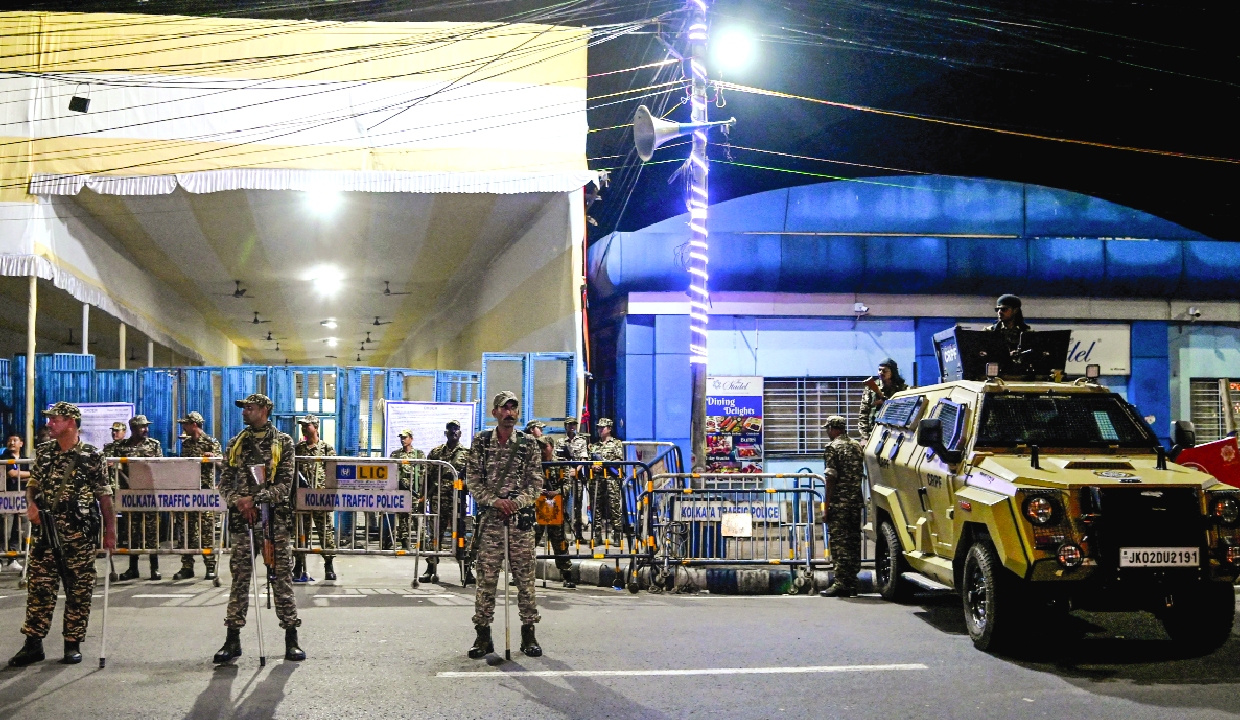
The State’s political climate bordered on the vicious, even after the conclusion of polls, leading to fervent anticipation ahead of the announcement of results, with both primary contenders, TMC and BJP, claiming they were dead certain about their victory prospects. Courtesy the tight security arrangements - with over 2.5 lakh central paramilitary personnel on the ground, besides the presence of a thoroughly reshuffled state police force - electoral violence remained at a minimum, and no deaths were reported for the first time in the state’s election history of recent decades. This was also the first election held in the state in 20 years, conducted after an extensive, albeit controversial, SIR exercise that revised the electoral rolls, removing over 9 million voters.
The campaigns recorded the BJP unleashing its full might, with top leaders like Prime Minister Narendra Modi, Union Home Minister Amit Shah and Defence Minister Rajnath Singh launching all-out attacks on the TMC over corruption, law and order, infiltration, women’s safety and unemployment, while promising welfare measures.
The TMC’s retaliation, with Chief Minister Mamata Banerjee and party MP Abhishek Banerjee leading the charge, focused on SIR harassment, Bengali persecution and ‘outsider’ plank, accusing the BJP of failing to deliver on its national commitments and upholding TMC’s development report card.
The poll body has scaled down the number of counting centres this year to 77 from 87 announced earlier, and 108 in 2021, while putting in place a multi-layered security grid. The run-up to counting, however, has been marked by high political drama, with TMC leaders, helmed by CM Mamata Banerjee, rushing to strongrooms in Kolkata, apprehending counting malpractice and alleging attempts to tamper with the sealed EVMs.
The EC rejected those allegations, maintaining that all electronic voting machines are kept under strict surveillance with round-the-clock security and CCTV monitoring. Closer to the counting date, security outside strongrooms has been further tightened, with the EC deploying 165 additional counting observers and 77 police observers to oversee the process and ensure adherence to norms. It has introduced stringent access control measures at the counting centres, including banning mobile phones except for returning officers and observers.
Tamil Nadu has seen turnout in the 85.1 per cent, a notable jump. Assam has recorded close to 86 per cent, Kerala has remained steady around 80 per cent, and Puducherry has touched roughly 90 per cent. These are not numbers that suggest voter fatigue. They point instead to a politically charged electorate, invested in the outcome. High turnout, however, remains an ambiguous signal. It can indicate anti-incumbency, but it can also reflect strong mobilisation by ruling parties.
The assembly polls in Assam will determine whether the BJP-led NDA gets a third term or the Congress wrests power after weeks of wrangling marked by identity politics, welfare delivery and regional aspirations. Among the high-profile candidates whose electoral fate will be decided on Monday are Chief Minister Himanta Biswa Sarma, the Congress’s state unit chief Gaurav Gogoi, assembly Speaker Biswajit Daimary, Leader of the Opposition Debabrata Saikia, AIUDF Chief Badruddin Ajmal, Raijor Dal Chief and MP Akhil Gogoi, and Assam Jatiya Parishad (AJP) chief Lurinjyoti Gogoi. Several cabinet ministers, including the AGP’s Atul Bora and Keshav Mahanta, and the BPF’s Charan Boro, are also in the fray.
In Tamil Nadu, the incumbent DMK regime has fought big to retain power, and its archrival AIADMK has slogged to win power after five years as the principal opposition party. Actor-politician Vijay-led TVK’s entry into the electoral arena has made predictions about the winning prospects tough and the Tamil nationalist Seeman’s NTK is another factor in the polls.
A number of exit polls have predicted a win for the DMK-led alliance, a pretty close fight and an impressive electoral debut for Vijay-led TVK. AIADMK chief Edappadi K Palaniswami, leader of opposition in the outgoing Assembly and former CM, has rejected the exit polls and expressed strong confidence of his party forming a Government with majority.
Kerala assembly results are crucial for the ruling LDF, the opposition UDF, and the BJP-led NDA as they seek to strengthen their position in the state’s evolving political landscape. With most exit polls predicting a close contest but giving an edge to the UDF, political parties and leaders will be closely watching the results.
For the Congress-led UDF, which has remained out of power since 2016, the election is being viewed as a do-or-die battle. The ruling LDF, however, citing forecasts of a close contest, remains hopeful of retaining power for a third consecutive term.
Though matching its 2021 tally of 99 seats appears unlikely, the front expects to secure around 75-80 seats, claiming that the Government’s development initiatives will translate into votes.
In Puducherry, six counting centres have been set up across the Union Territory.