
Guided by the principle of ‘Sarvajan Hitaya, Sarvajan Sukhaya’ (welfare for all, happiness for all), 88 countries and international organisations on Saturday adopted the New Delhi Declaration on AI Impact.
The Declaration, adopted at the conclusion of the AI Impact Summit 2026, lays out a shared vision for collaborative, trusted, resilient and efficient AI systems, with India leading the call for “AI for All” rooted in equity, access and global cooperation.
The list of endorsing countries includes the US, China, the UK, Russia, France, Australia, Belgium, Bhutan, Brazil, Canada, Denmark, Estonia, Ethiopia, Japan, Italy, Israel and Ireland. “Prime Minister Narendra Modi’s human-centric AI vision been accepted by the world.
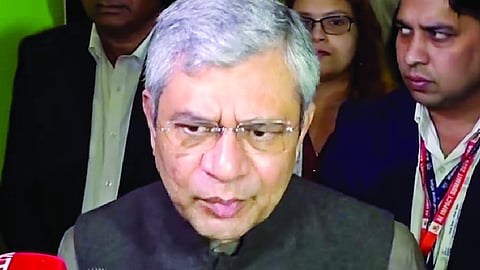
Democratising Artificial Intelligence resources so AI facilities, services and technology can reach everyone in society, which has been accepted by all,” IT Minister Ashwini Vaishnaw said, briefing the media.
At the AI Action Summit in Paris in February 2025, 61 nations, including India, China, France, Germany, and the African Union, were signatories to the declaration prioritising safe, ethical, open, and inclusive AI development.
The New Delhi Declaration document underscores that AI’s promise can be realised only when its benefits are shared across humanity. It calls for strengthened international cooperation, multi-stakeholder engagement and respect for national sovereignty while advancing accessible and trustworthy AI frameworks.
Structured around seven pillars — termed ‘Chakras’ — the Declaration outlines action areas, including democratising AI resources, economic growth and social good, secure and trusted AI, AI for science, access for social empowerment, human capital development, and resilient, efficient and innovative AI systems.
“The AI Impact Summit 2026... concluded with the adoption of the New Delhi Declaration on AI Impact, marking a significant milestone in global cooperation on artificial intelligence. The declaration has been endorsed by 88 countries and international organisations, reflecting a broad-based global consensus on leveraging AI for economic growth and social good,” an official release said.
Indonesia, Iran, Hungary, Greece, Germany, Finland, Mexico, Myanmar, Nepal, the Netherlands, New Zealand, Norway, Oman, The Philippines, Peru, Romania, Rwanda, Senegal, Singapore, South Korea, Spain, Sri Lanka, Sweden, Switzerland, Tanzania, the UAE, Ukraine, the EU, and IFAD are also on the list.
In all, about 118 countries participated in the India AI Impact Summit, which was held in New Delhi.
Among key outcomes is the Charter for the Democratic Diffusion of AI, a voluntary framework aimed at expanding affordable access to foundational AI resources and strengthening local innovation ecosystems.
The Declaration also emphasises energy-efficient AI systems and resilient infrastructure, recognising the rising demands of AI places on power and natural resources.
Voluntary Guiding Principles on Resilient, Innovative and Efficient AI, alongside a Playbook on AI Infrastructure Resilience, were acknowledged as reference frameworks.
As per the official release, participants reaffirmed their commitment to advancing shared global priorities in AI governance; promoting voluntary, non-binding frameworks; and translating vision into action through continued collaboration.
The broad-based endorsement — cutting across advanced economies, developing nations and multilateral bodies — signals growing convergence around responsible and inclusive AI governance, with the summit positioning India as a key convenor in shaping the global AI agenda.
While earlier global gatherings, including the UK’s AI Safety Summit at Bletchley Park (2023), the Seoul Summit (2024), and the Paris meet (2025) placed significant emphasis on frontier risks, safety guardrails and voluntary commitments, India widened the lens to foreground AI's developmental impact and real-world applications that can drive economic growth, social inclusion and sustainability. In essence, People, Planet and Progress.
The India AI Summit featured a blockbuster lineup of CEOs headlined by Google’s Sundar Pichai, OpenAI’s Sam Altman, Microsoft's Brad Smith and Anthropic’s Dario Amodei, as discussions spanned most intensely-debated global topics in the tech universe, from AI’s opportunities and risks, all the way to AGI, governance and the future of jobs.
The AI Impact Summit secured investment commitments of over USD 250 billion in infrastructure with Vaishnaw on Friday, terming it a “grand success”.