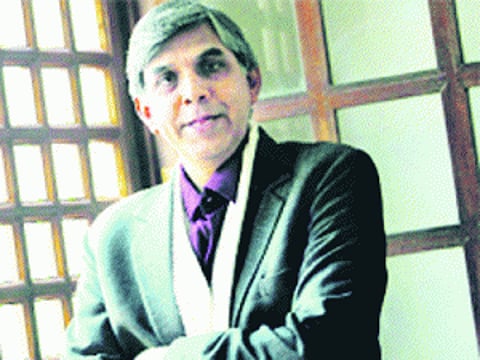

The stalwart of Delhi University and former Vice Chancellor Dinesh Singh has left deep footprints while carving the history by taking bold decisions in the last five years of his tenure. In a candid interview with The Pioneer, he said he did not think of becoming a Vice-Chancellor in his wildest dreams.
The silence that has taken over the prestigious university with his term’s end clearly defines the tall persona which kept the University buzzing with debates and discussions. Rahiba R Parveen interacts with the renowned mathematician at his bungalow in the North Campus, discovering his deep thoughts about the present and future of the University and the developing scene of higher education in the country.
How do you feel about your tenure as the DU VCIJ
* It’s been a great journey. I have no regrets. My father was also a Vice-Chancellor. My sister’s degree and wife’s degree bear my father’s signature. And my son’s degree bears my signature. So, I asked my son do you think your children’s degrees will have your signature. (laughs) He just smiled. I am glad that he did not say anything because one shouldn’t plan too much.
What are the things that you are taking with you as you leave Delhi UniversityIJ
* I think, I am not a wise man, but each day I am becoming a little wiser. And I am glad I am like that. I fear if I start feeling I am a wise man, then it shall be the end of me. However, each day, I get a little wiser. In the course of being the Vice Chancellor of the University of Delhi, I can with great satisfaction say that I began to understand India a little better and that is my biggest gain. I understand India better now than when I started my tenure.
And what part of your tenure was negativeIJ
* I have no negatives or regrets but I certainly have some concerns, which are pretty straight forward. Because I believe I understand India a little better, there are two or three things I believe are not happening the way I think they should have. I say this with full consciousness and responsibility. You know, for a country to do very well, it must have a knowledge-based economy. Unfortunately, India doesn’t have it. That is my biggest worry. And one of the reasons why we don’t have a knowledge-based economy is because our educational system, educational institutions, policies do not allow, or do not encourage, connecting education and knowledge with the needs of the nation. That is a big worry. It’s not happening. It hasn’t happened in a long time.
Google comes out of a university system. High Definition Television came from a team from MIT. The transistor came out of the University of Illinois. And they have given huge fillips to the economic systems of the world. Unfortunately, in modern times, Indian universities are not responding to the needs of the nation, at least not as much as they should.
What changes do you think DU needs at the momentIJ
* It’s nothing to do with DU. First you must change your pedagogical practices. You must start thinking on riding your systems on technology, both for the purposes of learning and for administration. That’s not happening much in India. As I said earlier, the numbers are so large that unless you use a technology platform, it’s not going to happen and DU can show the way because we have over four lakh students in open learning. Though we are better than what we used to be in terms of technology use, we still have a long way to go.
When we actually started reforming our distance learning platforms to enable them to use technology, we received interference from a senior civil servant, who was being guided by a close friend and a faculty member in our school of open learning. This happened a long time ago. How do I tell such people to just let us be so that the University could do what it should be doingIJ Five lakh students and they are largely sent notes by snail mail as hard copies.
You have closely worked with the HRD and UGC, what kind of approach should they have towards DU or other institutesIJ
* My thought is not directed to any particular regulatory body or institution. One of India’s problems is that we do not have that kind of maturity when it comes to handling institutions. I think our levels of maturity need to be higher whereby we realise that institutions need to be given a certain space and freedom. It’s very important. If you put good people there, then I think your job is done. Then give them freedom. I am not asking them to be given unbridled freedom. With freedom comes great responsibility.
Do you think in coming time FYUP or FYUP-like change will happen in DUIJ
* I do not want to make any comments on that. I only hope whatever happens must happen for the good of the nation. A lot of people ask me this question. You know, what we used to say about FYUPIJ It is written in stone that nothing is written in stone. I always said nothing about this programme is written in stone and let that be written in stone. Systems have to keep evolving. You have to keep changing for the better. That’s what evolution is about. What I worry about many of our educational institutions is that you put something in the system and it will stay there for 30-40 years. That’s bad.
But do you think the cut off system is fair enoughIJ
* No matter what system you device, there always will be something that will not be very healthy. The cut off system has been around for a long time in the University. It’s not a recent phenomenon. It’s just that the numbers are so large that you feel cut offs are high.
If you have an X number of seats Y number of applicants and if Y is much greater than X, then there will be a mad rush for admissions. There are millions of students passing Class XII. One crore students can’t study in DU. There is only one solution. We have to have a technology-based system. That is the only way you can handle India’s needs. There are enough studies to show that IT-based technological systems, if designed and implemented properly for learning purposes, can be as effective if not more than the traditional systems.
You have already said you are going to write a book on higher education at global level. Have you started researching on itIJ
* Yes, I am putting bits and pieces together. Somebody collected all my YouTube videos while somebody gave me a collection of all my speeches. I have been speaking all over the world. So, all of that is voluminous stuff. So, I propose to sift through all this material and use it and then I will use my experiences and insights. I have begun working on them.
How do you see your criticsIJ
* Nindak neearay rakhiyay — that’s what Kabir says. It’s good to have your critics nearby, they keep you grounded. My biggest critic is my wife. I am very grateful for that.
Do you think people opposed you just for the sake of opposing or they had a causeIJ What could you seeIJ
* I couldn’t see a cause. I couldn’t see a single academic argument in anybody’s opposition all through my term. It’s all on record.
lest, you get this impression that there was huge opposition. I have said this several times. What makes you think there was huge opposition. Is it because some newspapers put huge headlines saying so or you counted the numbersIJ May be some important people did not want it but that doesn’t mean that all the people were against it.
Your term has been defined as the most controversial tenure. How would you define your tenureIJ
* I think we should let history be the judge of that. Of course we had our share of controversies. However, if you stir waters that have been stagnant for a long time, what do you expectIJ However, for the record, civil society and teaching community have expressed themselves in many ways in appreciation particularly during the last few weeks. They say they found many creative and constructive things in the FYUP. Actually it also attracted the world’s attention and appreciation. Globally, it was appreciated. Within the country, I found so many States wanting to make this change. Chhattishgarh, Karnataka, Jammu & Kashmir, West Bengal, they all wanted to adapt from it.
I don’t know where the controversy has supposedly happened. I have no idea. Within the University, there are 10,000 teachers. Every time DUTA held a meeting, there used to be only 100 odd people which is supposed to represent major opposition. I read a newspaper headline that said a large large group had turned up to protest.
My friends and colleagues got me several photographs that showed only about 40 were present. When we were in the middle of the controversy, about 100 odd teachers turned up at a gate to protest while there were 300 odd teachers sitting on a hunger strike at another gate in support. The papers did not write about those who had turned up in support but reported prominently about the opponents.