
- HOME
- INDIA
- WORLD
- BUSINESS
- STATES
- LAW & JUSTICE
- ENTERTAINMENT
- SPORTS
- VIEWPOINT
- LIFESTYLE
- TECH
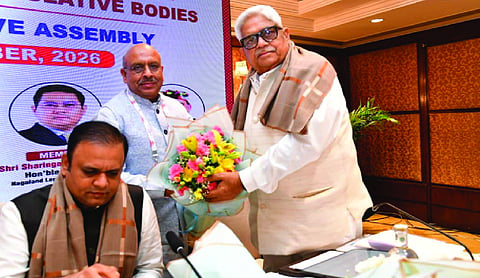
Uniform rules for India’s legislatures should not mean identical rules, Delhi Assembly Speaker Vijender Gupta said on Tuesday. He was presenting Delhi’s recommendations at a meeting of the Committee on Formulation of Model Rules for Uniformity in the Procedure and Conduct of Business in Legislative Bodies in India.
He called for gender-neutral rules, a minimum of 30 sittings a year and electronic notices, while asking that Delhi’s distinct constitutional position be protected. “Uniform Rules must not mean identical rules,” Gupta said. “Our endeavour should be to strengthen common democratic standards while preserving the constitutional autonomy and institutional distinctiveness of every Legislature.”
The meeting was chaired by Uttar Pradesh Assembly Speaker Satish Mahana. Maharashtra Speaker Rahul Narwekar, Himachal Pradesh Speaker Kuldeep Singh Pathania and Karnataka Speaker GS Patil attended, along with senior legislative officials. Gupta recalled that the Committee’s preliminary meeting was held in Mysore on May 12, 2026, after the 85th All India Presiding Officers’ Conference in Patna decided to develop a common procedural framework. He thanked the Uttar Pradesh Assembly Secretariat for preparing the draft report.
Gupta said masculine expressions retained under conventions derived from the General Clauses Act, 1897, must give way to language that reflects present-day democratic realities. Recognition of Nari Shakti, he said, must extend to the rules governing democratic institutions.
The meeting was held without paper. The Delhi Assembly Secretariat said digital circulation of 12 sets of documents, each of 1,521 pages, saved an estimated 18,252 sheets of paper. It put this at about 4.4 trees and 18,252 litres of water, along with a cut of about 182.5 kg of carbon dioxide-equivalent emissions.
Gupta said the Model Rules must recognise the legal frameworks of Delhi, Puducherry and Jammu and Kashmir. Their legislatures work under specific constitutional provisions and statutes, including the Government of National Capital Territory of Delhi Act, 1991. He sought provisions for bicameral legislatures, clarity on elections to presiding offices, the Panel of Chairpersons and delegation of the Speaker’s functions. He said quorum rules can be changed only through legislation, and opposed duplicating constitutional and statutory provisions.
Gupta backed three sessions a year, Budget, Monsoon and Winter, and at least 30 sittings for all State Legislatures, while protecting higher statutory requirements. With Digital Sansad, e-Vidhan and the National e-Vidhan Application in growing use, he asked for formal recognition of electronic notices, summons, petitions and other procedural communications. He welcomed the proposal to play Vande Mataram at the start of proceedings and Jana Gana Mana at the end of a session, noting that Delhi already follows both.
He asked for less duplication between Zero Hour and Special Mentions, a limit of one Adjournment Motion per sitting, and debate time left to the Speaker’s or House’s discretion. He questioned a proposed mandatory five-day gap before an adjourned House reconvenes.
Gupta urged that Bills carry financial, administrative and legal information, including Financial Memoranda and details of delegated powers. He backed advance electronic circulation of Bills and authorised translations, and referral to Select Committees or Standing Committees for expert views and public feedback.
To widen public participation, he proposed removing outdated colonial expressions from petition forms, recognising regional languages and allowing authenticated electronic submissions. On privileges, Gupta urged a rethink of the proposed 30-day suspension limit.