
- HOME
- INDIA
- WORLD
- BUSINESS
- STATES
- LAW & JUSTICE
- ENTERTAINMENT
- SPORTS
- VIEWPOINT
- LIFESTYLE
- TECH
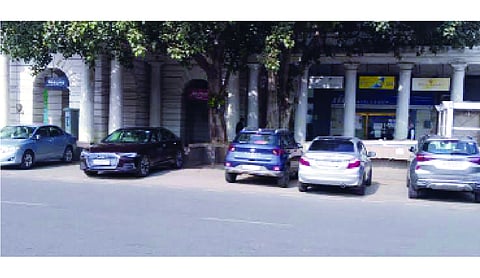
Motorists entering Lutyens' Delhi will likely pay higher parking fees, as the NDMC proposes a sweeping revision of its tariff structure and a penalty on cash payments to enforce digital transactions. Under the proposed revisions, four-wheeler off-street rates are expected to rise from Rs 20 to Rs 30 per hour, while on-street parking for cars will jump from Rs 50 to Rs 70 per hour, according to official documents.
The civic body said the monthly pass for four-wheelers at off-street sites will double from Rs 2,000 to Rs 4,000 per month, while passes for multi-level parking lots will see a steep revision from Rs 1,000 to Rs 3,300 per month.
Two-wheeler commuters will also feel the pinch, with off-street rates proposed to increase from Rs 10 to Rs 15 per hour and on-street charges moving from Rs 20 to Rs 30 per hour. Monthly passes for two-wheelers will rise from Rs 1,000 to Rs 2,000 for off-street sites and from Rs 500 to Rs 1,000 for multi-level facilities, it said.
The proposal also aims to upgrade 157 parking sites across Lutyens' Delhi, according to official documents. The new smart parking system in the New Delhi municipal area will flag vehicles parked for more than 24 hours and levy steep towing and storage charges. Under this system, the night parking fee will be doubled compared with the normal hourly rate.
Under the new framework for the civic council's Intelligent Integrated Parking Management System (IIPMS), drivers paying in cash will mandatorily pay a 100 per cent surcharge, effectively doubling their parking bill on the spot. To eliminate fractional decimal billing, all final fee amounts will be rounded to the nearest whole rupee, they said.
The private operators selected to run the three clusters under the Public-Private Partnership (PPP) model will be granted a three-to six-month transition period from site takeover to deploy FASTag readers, Automatic Number Plate Recognition (ANPR) cameras, handheld POS devices, and automated barriers, they said.
Once installed, the entire entry-to-exit chain will operate digitally without physical intervention.
Additionally, the proposal retains special pollution-control powers. During winter months, when the Commission for Air Quality Management (CAQM) invokes Stage II or III of the Graded Response Action Plan (GRAP) to combat severe air pollution, NDMC reserves the right to apply a double multiplier on top of standard rates for all users to deter non-essential private vehicle usage in the central hub.