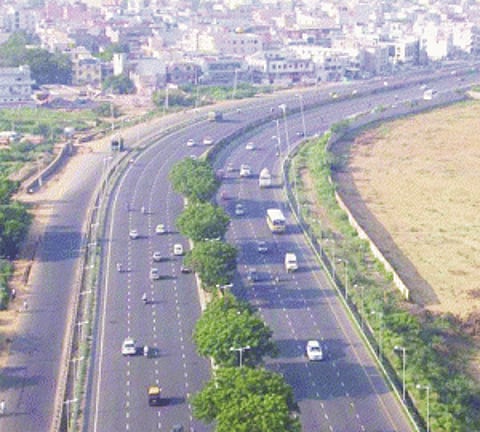

Excessive plantation on the Noida Expressway has been termed ‘hazardous’ during a safety audit of this arterial stretch. The expert agency — Central Road Research Institute (CRRI) — has observed that excessive plantation on the median as well as on the kerbside of the expressway was obstructing the view of the motorists.
At many locations on the stretch, safety barriers and road signs are camouflaged due to heavy plantations at critical locations, like road curves and bus stops.
According to CRRI, the placement of trees on the arterial stretch does not comply with the guidelines of the Indian Road Congress (IRC) and thus, poses hazards to motorists. According to IRC’s recommendations, the minimum vertical clearance of the trees on the kerbside should be 5 m in rural areas and 5.5 m in urban areas. The audit report states that only those plants should be trimmed whose ultimate height and breath exceeds the required measurement. Also, plants which are weak wooded or shed slippery foliage on road surface need to be eliminated for safety reasons.
It was also observed during the audit that being an expressway meant for driving at high speed, heavy plantation at the sharp curves drastically reduces the visibility for the motorists posing safety hazards. “At sharp curves, it is to be ensured that clear visibility is provided for drivers. It is more so for high speed corridors and expressways. However, during the audit, it was observed that due to heavy plantation provided at curves, visibility is drastically reduced causing safety concerns for the motorists. If it is not possible to remove the existing trees, measures shall be taken to trim the trees and also remove the dead trees if any causing safety hazards,” suggests the report.
Overgrown tress and lack of attention on trimming of the plantation has also resulted in obscuring the crucial road signs on the stretch, defeating the very purpose of these signs.
“During the audit, it was observed that undesirable plantation along the road and in the median obscured the road signs, depriving the provision of the required information to the road users. The visibility of bus stops was obscured by the heavy plantation provided in front of most of them. Hence, the very location of the bus stop is not visible to the commuters who intend to board the buses. This situation is equally hazardous for traffic using the highway,” added the report.
As a safety measure, the expert body has suggested the authorities to remove all the plantations provided near bus stands, so as to provide clear view of the bus stops to the commuters as well as to other vehicle users.
During the audit, it was also observed that the trees and bushes were hindering the pedestrian pathways, thus, forcing them to use the main carriageway. For the safety of the pedestrians, CRRI has recommended the authorities to ensure that the footpaths are not occupied by trees and bushes.
The entire length of the Noida-Greater Noida Expressway is 24.53 km long, built at a cost of `400 crore. This expressway provides a crucial link to the Yamuna Expressway and also plans on the anvil to connect it further to the expressway to Taj Economic Zone, International Airport and Aviation Hub.