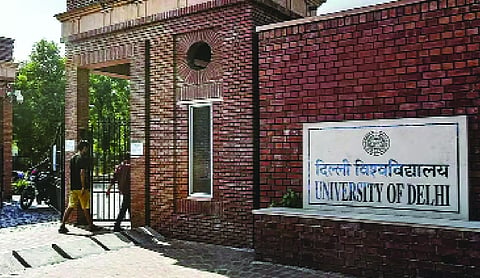

The University of Delhi’s Executive Council on Thursday passed its annual report for 2025-26 amid dissent from a member who raised concerns over the university’s reliance on loans from the Higher Education Financing Agency (HEFA), alleging that it could lead to commercialisation and undermine its public character.
In a dissent note submitted by Mithuraaj Dhusiya, an elected EC member, he flagged the university’s growing financial liabilities. He questioned its reliance on HEFA borrowing for infrastructure and other capital requirements. The dissent note said the university had an outstanding HEFA loan liability of about Rs 161.36 crore as of March 31, 2026.
It said the liability included an opening balance of Rs 46.93 crore, fresh loan releases of Rs 109.63 crore and accrued interest of Rs 4.80 crore during the financial year.
Dhusiya also objected to the university having to bear 10 per cent of the principal repayment, amounting to Rs 3.15 crore, from its internal receipts. In comparison, the Ministry of Education covers the remaining 90 per cent (Rs 28.35 crore). The note argued that the repayment obligation could push the university toward aggressive revenue generation through higher student fees, commercial exploitation of university resources, and a proliferation of self-financing courses. It also flagged an unutilised grant of Rs 221.50 crore from the Ministry of Minority Affairs, questioning the funding model under which the university relied on commercial borrowing despite having unspent government grants. “DU must demand that grants from the government finance all its expenditure,” the dissent note said.
Among the major developments highlighted in the report is the implementation of the Postgraduate Curriculum Framework 2025, aligned with the National Education Policy 2020. Under the framework, the university introduced two-year postgraduate programmes across 69 departments in its major faculties.
The university has described the move as an effort to bring greater academic flexibility and research integration into postgraduate education. 103rd Annual Report.
The report also records improvements in the university’s rankings. Delhi University moved up from 328th to 322nd position in the QS World University Rankings 2026. In the National Institutional Ranking Framework (NIRF) 2025-26, it improved its position in the universities category from sixth to fifth. Research output also registered growth during the year. Publications in Scopus-indexed journals increased by 12 per cent, from 4,120 to 4,618. The university’s H-index, a measure of research productivity and citation impact, rose from 286 to 309, the report said.
The report provides a snapshot of the university’s academic scale and student strength. It records enrolment across regular, distance, and non-collegiate programmes, along with details of admissions, examinations, research activities, and institutional infrastructure.
The university’s School of Open Learning, for instance, recorded 1,13,786 admissions during 2025-26, including 1,07,855 students in undergraduate programmes and 5,931 in postgraduate courses. It also inaugurated Swadhyay Bhawan, its East Regional Centre in Tahirpur, a seven-storey facility with smart classrooms, digital infrastructure, an auditorium, and studio spaces. The building can accommodate around 2,000 students.