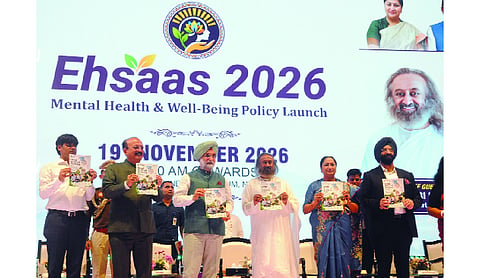

From examination pressure and anxiety to bullying and emotional distress, students in Delhi’s schools and colleges will now have a structured support system to turn to. The Delhi Government on Thursday launched its ‘Ehsaas 2026’ Mental Health and Well-Being Policy, providing for one counsellor for every 500 students, district-level specialist centres and a six-tier mechanism to handle serious mental health crises. Lieutenant Governor Taranjit Singh Sandhu, Chief Minister Rekha Gupta and Art of Living founder Sri Sri Ravi Shankar launched the policy at the Indira Gandhi Indoor Stadium. It will cover Government, Government-aided and recognised private schools, along with higher educational institutions under the Delhi Government.
The policy seeks to make emotional well-being part of the education system rather than limiting institutional intervention to academic performance and examination results. It also places responsibility on teachers, parents, school management and institutional heads to identify distress early and ensure students receive appropriate support.
Under the framework, every school will have counsellors, with larger institutions allowed to appoint additional personnel for different academic levels. Their responsibilities will include identifying emotional and psychosocial concerns, providing initial counselling and referring students for specialised assistance. Counsellors will be kept away from administrative and disciplinary duties.
Delhi Government schools currently have 540 Educational and Vocational Guidance Counsellors, including 348 regular and 192 guest counsellors. More than 500 teacher-counsellors are also involved in student guidance and awareness activities. The policy provides for District Well-Being Centres to offer psychological assessments, therapeutic interventions and psychiatric consultations. Schools will identify students requiring assistance and refer them to specialists for clinical assessment and treatment.
A six-tier escalation system has also been introduced for serious situations, including risks of self-harm and suicide. The process will involve the class teacher, school counsellor, school head or wellness team, District Well-Being Centre, hospital emergency services and relevant statutory agencies. Protocols will ensure immediate intervention and continued follow-up.
The policy will specifically address examination stress, anxiety, depression, interpersonal difficulties, bullying and cyberbullying. It also provides for confidential complaint mechanisms and protection against harassment for students reporting such incidents. To strengthen prevention, teachers, parents, principals, drivers, support staff and other school personnel will receive training to recognise behavioural changes and respond sensitively. Students will be encouraged to discuss their concerns and seek help when required.
The Government will use a digital monitoring portal to track counselling services, referrals, crisis preparedness and inclusive activities. Under the School Wellness Services Index, institutions will conduct quarterly self-assessments and submit reports. Monitoring will rely on aggregated information rather than students’ personally identifiable data. It also underlined mandatory reporting of suspected child sexual abuse under the Protection of Children from Sexual Offences (POCSO) Act, requiring school personnel to report such cases to the police or Special Juvenile Police Unit without delay or internal screening.
Speaking on the occasion, Sandhu said that making mental health and emotional well-being an integral part of education is the need of the hour. He said children must feel valued and understand that seeking help is a sign of strength. The Chief Minister said the initiative would help students develop emotional resilience and confidence. The Delhi Government has introduced the ‘Ehsaas’ Mental Health and Well-Being Policy with the mental health and overall welfare of students in mind. The policy will be implemented across schools and higher educational institutions in Delhi. Its objective is to provide students with continuous support and reassurance through different stages of their lives and changing mental and emotional needs.
Education Minister Ashish Sood urged students to learn from failure, express themselves freely and seek support when necessary. The policy is based on four pillars: a whole-institution approach, preventive care, institutional accountability and protection of students’ rights, privacy and dignity.
