
For more than a century, Venice has drawn the art world to its historic streets and exhibition spaces through a biennale that brings together artists and cultural voices from across the globe. Now, Delhi wants to create its own version of that city-wide cultural experience, turning its monuments, museums and public spaces into an international showcase for art, architecture and design.
The Bharat Biennale 2026, which the Delhi government is positioning along the lines of the renowned Venice Biennale, will run for 108 days from December 4 to March 21, 2027. The event, being organised by the Ministry of Culture, will be centred at Purana Qila and conclude on March 21 next year. The Venice Biennale is the world’s oldest, largest, and most prestigious international contemporary art and culture exhibition, often dubbed the “Olympics of the art world which draws hundreds of thousands of visitors—including top curators, museum directors, collectors, and critics—and has launched or cemented the careers of countless legendary artists.
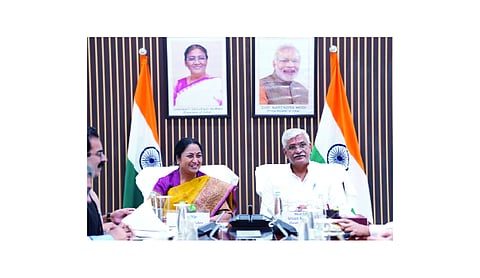
This is the second edition of the flagship event, but much bigger in scale and breadth than the inaugural edition held in 2023. Spanning 108 days, it will bring together contemporary art, architecture, design, and cultural exchange across the capital’s historic monuments, museums, galleries, public spaces, and cultural institutions. More than 22 heritage sites and cultural institutions across the capital are expected to participate. Chief Minister Rekha Gupta and Union Culture and Tourism Minister Gajendra Singh Shekhawat reviewed preparations on Monday and directed departments to put arrangements in place within fixed timelines.
The comparison with Venice is significant. First held in 1895, the Venice Biennale developed into one of the world’s prominent international art platforms, with a central exhibition, national pavilions and events at different locations across the city. Delhi’s proposed event will similarly bring together exhibitions, installations, performances and cultural programmes at multiple venues, though its own identity will be rooted in India’s artistic traditions and heritage. Purana Qila will be the main venue. The Red Fort, Qutub Minar, Humayun’s Tomb, Safdarjung Tomb, Lodhi Garden, Mehrauli, Hauz Khas and Agrasen ki Baoli will also host activities. The National Museum, National Gallery of Modern Art, Indira Gandhi National Centre for the Arts and Lalit Kala Akademi are among the participating institutions.
The theme, ‘Tat Tvam Asi’, explores the relationship between individuals, society and the world around them. The programme will be built around four ideas: Reflection, Rejuvenation, Renewal and Resilience. Exhibitions, art installations, heritage walks, workshops, cultural performances and interactive sessions are planned. The programme includes presentations by institutions such as Bihar Museum, Kiran Nadar Museum of Art, Nita Mukesh Ambani Cultural Centre, JSW Group, Serendipity Arts, Devi Art Foundation, Aditya Birla Group pavilion, Godrej Pavilion, Vedanta Pavilion, and the Public Arts Trust of India installations, alongside a wider network of other organisations and practitioners.
The preparations will also involve a major civic and transport exercise. The Traffic Police, Transport Department, DTC, Delhi Tourism and DMRC have been asked to draw up a traffic management plan for the venues, particularly during the inauguration and weekends. A hop-on, hop-off heritage bus service is proposed to connect locations. Metro signage will be installed, and the possibility of extending train operating hours on busy days will be examined. The MCD, NDMC and DDA have been directed to improve sanitation, waste collection, public toilets, street lighting, footpaths and parking facilities around the venues. Removal of encroachments, better green spaces and organised vending areas are also part of the proposed improvements.
A single-window system is being planned to speed up permissions for temporary structures, exhibition pavilions and installations. Advance approvals will be explored to prevent preparations from being disrupted by pollution-related restrictions under GRAP during December and January.
The event is being developed through a public-private partnership. More than 200 proposals have been received for exhibitions, performances and knowledge programmes, with around 40 exhibitions confirmed. Collaboration discussions are underway with 19 countries and international partners. A presentation by the Bihar Museum on the cultural traditions of Chhath Puja and Pind Daan is also planned.
Students will be brought into the programme through educational visits and volunteering opportunities. The Student Biennale will feature 108 young artists selected from across the country. The Chief Minister said the ambition was not limited to staging exhibitions. The government wants visitors and artists to experience Delhi’s heritage alongside better public amenities. The Urban Development Department Secretary will serve as nodal officer to coordinate preparations across departments.