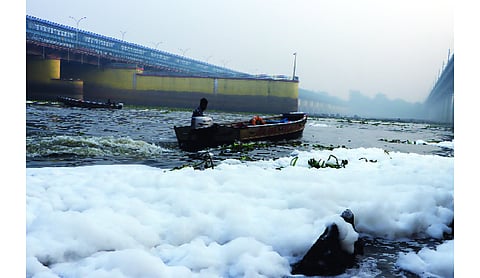

From restoring wetlands and planting native trees to improving water quality and reconnecting Delhi residents with the river, the Delhi Development Authority (DDA) is preparing a broader roadmap to revive the Yamuna. The authority will bring experts, Government agencies and civil society representatives together on November 20 to discuss the future of the river’s 52-km stretch through the capital.
Lieutenant Governor Taranjit Singh Sandhu will inaugurate the one-day event, titled ‘Yamuna Dialogues’, at Baansera, Birsa Munda Chowk. The discussions will focus on restoring, developing, and managing the Yamuna floodplains and ghats over the long term.
The exercise is intended to move beyond separate restoration projects and develop a coordinated approach that treats the river and its floodplains as one ecological system.
Participants will include national and international experts, senior Government officials, scientific institutions, urban planners, development and financing agencies, private organisations and civil society representatives.
The discussions will be organised around six themes: governance mechanisms; floodplain planning and ecological measures; water quality and drainage management; river-people connect and ghat development; sustainable financing; and emerging technology, research and innovation.
The recommendations from these sessions will be compiled into a proposed ‘Delhi Yamuna Report’. The document is expected to identify priority interventions, Government institutional responsibilities, potential partnerships, and the steps required to implement the recommendations.
The DDA has cited its ongoing restoration work across the floodplains as the foundation for the proposed exercise. According to the authority, more than 1,700 hectares are currently under active restoration. It has also revived 35 wetlands and planted over seven lakh native trees.
The authority said around 88,000 metric tonnes of construction and demolition waste have been removed from the floodplains.
At Asita, one of its major restoration sites, the number of recorded bird species has risen from 63 to around 200. The DDA has cited this increase as an indicator of ecological improvement following restoration efforts.
The event will also be held at a site that the authority presents as an example of landscape restoration. Baansera, once used for dumping construction waste, has been developed into a bamboo park and public green space. It now receives approximately five lakh visitors, according to the DDA.