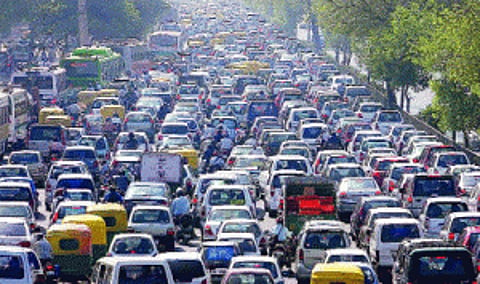

With around 100 days of festivities in a year, four months of monsoon with severe water-logging and two months of extreme winters with foggy conditions, traffic in Delhi hardly gets time to pick up its pace before it is slowed down again. Then there are large-scale events like India Africa Summit, India International Trade Fair, IPl matches, other sports fixtures, sessions of Parliament and other such events that add to the woes of the common commuter. Sometimes it's the VIP movement that stops the "common man" in his tracks, and at others it is dons like Chhota Rajan, whose transportation needs top-level security.
And in between, if there are any days that miss any of these events by any chance, then there is, of course, the regular affair that has permanently been termed as "peak hour traffic". In such a scenario, it's time to face the truth. These are not the reasons to blame for the traffic mess in the city. These are the realities of the Capital city which need to be factored in while planning to solve the city's traffic woes.
All across Delhi, it is common to find frustrated commuters — late for work, late for appointments, late for school — dejected at the state of affairs. As per estimates, a common commuter whose workplace is half an hour away (during normal traffic) from his home spends on an average around 200 extra hours stuck in traffic in a year just on his trip to work and back. The figure becomes staggering for those who live further away from their workplace, which is common in a big and ever-expanding city like Delhi.
The interesting thing is that Delhi has one of the best, if not the very best, road networks in the county. The vehicle density in Delhi is almost ten times lower than Chennai, the city with most vehicle density in India. And yet, Delhi sees the worst kind of traffic jams every other day. However, point needs to be made that while Delhi's road network is the best in India, and is better than most cities across the world, it still has a long way to go to reach the level of cities like New York, los Angeles and london.
Special Commissioner of Police (Traffic) Dr Muktesh Chander said the growth in the number of vehicles has far surpassed the amount of space available on the road. "Over 95 lakh vehicles have already been registered in the city and it will soon cross the 1 crore mark. And then, of course, there are vehicles coming from NCR cities like Noida, Gurgaon, Ghaziabad etc. that add to the traffic congestion in the city. But the space on the road for those vehicles is not increasing at the same pace. Drastic measures are needed to tackle this situation," he said.
However, transport officials claim that the length of the roads in Delhi is sufficient not only to withstand the current vehicle population, but also any increase in their numbers for the next many years.
"It is not the length or the width of the roads that is responsible for the traffic mess in the city. India has better road density and road length per vehicle than most of the cities in the world. It is the small things that are responsible for the traffic mess in the city like non-compliance of traffic rules, roadside parking, non-availability of stands for rickshaws, e-rickshaws and Gramin Sewa vehicles near the metro stations. Delhi needs all these small issues to be sorted out which will make a big difference. We have not yet reached the stage where drastic measures need to be taken to restrict the number of vehicles," said a senior transport official.
"Be it small measures or the drastic ones, what Delhi needs is this traffic mess to be sorted out," says Deepak Malhotra, who travels every day from Pitampura to Gurgaon.
And for this mess to be sorted out, a concerted effort by all stakeholders, including the citizens of Delhi, is needed.