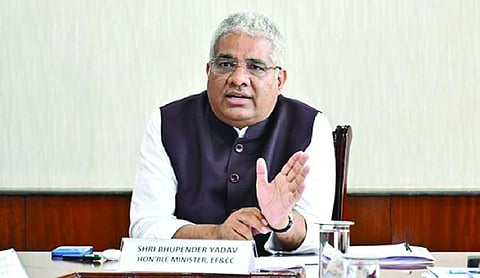

Union Environment Minister Bhupender Yadav has reviewed measures to intensify action against air pollution in Delhi-NCR, noting that NCR states need to move beyond planning and ensure strict, time-bound and coordinated ground-level enforcement. The Minister stressed on real-time monitoring through Integrated Command and Control Centres (ICCCs), directing states to nominate Secretary-level officials for direct accountability of implementation of anti-pollution curbs across cities in the National Capital Region (NCR).
These secretary-level officials will undertake field visits and report to the Commission for Air Quality Management (CAQM) in NCR and Adjoining Areas, and the ministry requested CAQM to “issue notices to non-performing officers”. The directions to hold officials responsible also comes in backdrop of suspension of an executive engineer of Municipal Corporation of Gurugram (MCG) for serious lapses in implementation of road sweeping and dust mitigation measures.
During the review meeting, the minister directed immediate action at the 233 identified congestion points across NCR and fresh assessments by respective States to ease traffic decongestion. He directed the Municipal Corporation of Delhi (MCD) to complete installation of Multi-Lane Free Flow systems at 154 Delhi border entry points by December 31, this year.
Yadav on Saturday chaired a meeting to assess measures undertaken in Delhi, Haryana, Uttar Pradesh and Rajasthan for mitigating air pollution in Delhi-NCR.
During the meeting, state governments were directed to nominate secretary-level officials for seven cities in Haryana, four cities in Uttar Pradesh, and four cities in Rajasthan for implementation of pollution control measures through field visits and submission of weekly reports to the Commission for Air Quality Management (CAQM). The CAQM was requested to issue notices to non-performing officers.
On vehicular pollution, Yadav called for expediting the PARIVARTAN Scheme for replacing pre-BS-VI trucks and buses with BS-VI, CNG and electric vehicles by 2028, particularly accelerating beneficiary registrations in Uttar Pradesh, Rajasthan and Haryana by organizing PARIVARTAN Melas at State level immediately.
The States were also asked to expedite installation of ANPR-based monitoring systems at fuel stations, integrated with VAHAN and PUCC databases, for intensified action against old and polluting vehicles.
The minister directed all agencies to ensure strict implementation of the Graded Response Action Plan (GRAP) and called upon NCR states to adopt Delhi’s hotspot-focused winter action plan, covering traffic management, work-from-home measures, construction restrictions and prevention of open burning. In accordance with CAQM’s order dated 30.10.2026, dust-generating Construction and Demolition (C&D) activities have been restricted across NCR from 5th to 20th November 2026.
GRAP is a set of emergency measures imposed to prevent further deterioration of air quality once it reaches a certain threshold.
Yadav reviewed road dust management and noted that only 3,221 km of the targeted 5,480 km of roads had been redeveloped. “He directed road-owning agencies to prioritise pothole repairs, damaged footpaths, central verges and end-to-end paving as per the CAQM framework, along with artificial intelligence-based videographic surveys,” Union environment ministry said in a statement.
On Industrial Emissions, the Minister noted that 2,298 of the 2,345 targeted industries (98%) had been connected to OCEMS, while the remaining 47 units had been closed or sealed. He called for strict enforcement of the 50 mg/Nm³ particulate matter emission norm, with non-compliant industries facing closure, electricity disconnection and sealing wherever required.
He emphasised that all NCR States must identify pollution hotspots in major cities and prepare focused Hotspot Action Plans, particularly covering markets, schools, hospitals, railway stations and bus terminals
Concluding the meeting, Yadav emphasised that coordinated efforts, field-level accountability, and visible action on the ground are essential to effectively address the challenge of air pollution in Delhi-NCR. Delhi Environment Ministers Manjinder Singh Sirsa (Delhi); Rao Narbir Singh (Haryana); Arun Kumar Saxena (Uttar Pradesh); Union Environment Secretary Narendra Bhooshan; Additional Secretary Dr Amandeep Garg; and CPCB Chairman took part in the meeting virtually.