
- HOME
- INDIA
- WORLD
- BUSINESS
- STATES
- LAW & JUSTICE
- ENTERTAINMENT
- SPORTS
- VIEWPOINT
- LIFESTYLE
- TECH
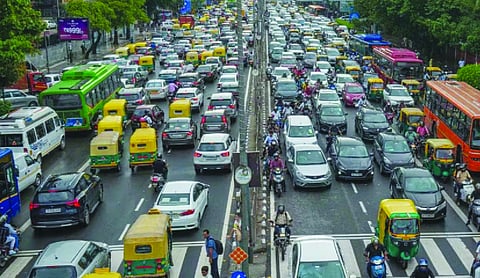
Every morning, fathers drive their children to school, and employees head to work in Delhi. Still, the daily rush is set to become a new source of anxiety as over 10 lakh vehicles from neighbouring NCR cities face restrictions from November 1, with commuters warning that the fight against air pollution could come at a high daily cost to them.
Delhi’s decision to prohibit the entry of vehicles below BS-VI emission standards from November 1 to January 31 will affect over 10 lakh vehicles from Gurugram, Faridabad, Noida, Greater Noida and Ghaziabad, according to Transport Department estimates.
For a man from Gurugram, the prospect of being unable to drive his children to school in Dwarka has raised questions about the restrictions and the alternatives available to families.
“I live in Gurugram and drive to Dwarka every day to drop my children at school. My vehicle is BS-IV-compliant and registered in Haryana. Why should I suffer for a problem that the Government has failed to control?” he asked, requesting anonymity.
The man said he chose to drop his children off at school himself because he was uncomfortable relying on school bus drivers, whom he accused of driving rashly.
“I don’t trust school bus drivers as they drive very rashly, so I personally decided to drop my children to school in my own vehicle. I have a valid pollution certificate, insurance, and I follow all the norms. I am a law-abiding citizen, so why should I suffer?” he said.
For others, the restrictions could mean not just a change in their daily routine but also additional expenses to reach their workplaces.
Sunil Kumar, who travels daily from Gurugram’s Sector 104 to the Dwarka Sector 21 Metro station before heading to his office, said he might have to depend on cabs if he could no longer drive his car to the station.
“My car is registered in Haryana. I drive to the Metro station every day to reach my office. “My vehicle has undergone pollution checks, and I follow the prescribed norms. Why is the Delhi Government trying to stop our vehicles?” he asked. Kumar said the alternative could cost him an additional Rs 500 to Rs 1,000 in cab fares every day.
“I may have to spend an additional Rs 500 to Rs 1,000 on cabs to reach my office. This is an extra burden on an ordinary household, especially when people are already spending money on maintaining their vehicles and complying with the rules,” he said.
The concerns extend beyond the immediate cost of commuting, with some residents questioning whether the restrictions will address the underlying causes of the city’s persistent pollution.
“Be it any Government in Delhi, they have failed to control pollution levels. They impose such rules on people who aren’t even violating any norms,” said Rajesh Sharma, another commuter.
“This order will add to household expenses without addressing the root cause of the problem,” said Rajesh Sharma, another commuter.
Anket Sharma, a Gurugram resident, said the restrictions could create difficulties for people who cross the Delhi-Haryana border for everyday needs and cannot afford to replace their vehicles at short notice.
“Thousands of people travel between Gurugram, Noida, Ghaziabad and Delhi every day. Many cannot afford to replace their vehicles overnight.
“The Government should consider practical alternatives and give people clarity on how they are expected to commute,” he said.
A senior Delhi Traffic Police officer said the force was prepared to enforce the restrictions, with more than 100 teams to be deployed at motorable border points across the national capital.
The officer said banners carrying messages about the restrictions would be displayed at entry points to inform motorists, while traffic personnel in different areas would maintain a strict vigil. Vehicles found violating the applicable directions would be challaned, he added.
The restrictions come as Delhi and its neighbouring NCR areas continue to grapple with persistent air pollution, with vehicular emissions remaining a major contributor to the capital’s pollution burden.
Transport and vehicular emissions account for nearly half of Delhi’s local PM2.5 pollution, according to a report by the Centre for Science and Environment released on December 31, 2025. During last year’s peak winter pollution period, vehicles contributed around 46 per cent to 53 per cent of the city’s local PM2.5 levels, the report said.
Even after their relative contribution fell by around 13 per cent following the stubble-burning phase, vehicular emissions continued to dominate Delhi’s pollution profile.
Adverse winter conditions, including shallow mixing heights and weak dispersion, trap pollutants near the ground, letting emissions from everyday urban activities accumulate and worsen air quality.