
- HOME
- INDIA
- WORLD
- BUSINESS
- STATES
- LAW & JUSTICE
- ENTERTAINMENT
- SPORTS
- VIEWPOINT
- LIFESTYLE
- TECH
· Indian enrolments of medical students reportedly crash from over 3,000 per year to around 200 amid regulatory turmoil in 2026.
· Conflicting claims and concerns over medical training leave thousands of aspiring doctors and their families seeking answers.
· Currently 1600 Indian medical students are studying in Uzbekistan.
Uzbekistan, once a preferred destination for thousands of Indian students seeking affordable MBBS degrees abroad, is facing a major admissions crisis, with the September 2026 intake reportedly recording a dramatic fall in Indian enrolments.
An investigation by The Pioneer, based on accounts from students and people associated with top medical universities in Uzbekistan, points to a sharp contraction in admissions. Figures cited by sources familiar with the process suggest that enrolments at major Uzbek medical institutions may have fallen to around 200 this year, compared with more than 3,000 in previous years. The precise figures, however, remain to be verified through official records.
The reported decline comes despite thousands of Indian aspirants waiting to secure admission, raising serious questions about what has changed in a country that had steadily emerged as an alternative to more expensive medical education destinations.
Admissions collapse raises serious questions
The scale of the reported decline becomes clearer from institution-level figures cited by sources. One major medical institution in Samarkand, which reportedly admitted more than 1,300 Indian students in September 2025, is said to have enrolled only around 15 this year.
Another major medical institution in Tashkent, which reportedly received approximately 450 Indian students last year, is alleged to have admitted none in the latest intake in 2026.
The above figures were confirmed through recent interactions with the students in Tashkent and Samarkand. Nevertheless, the accounts point to a serious disruption that warrants a formal explanation from the institutions and relevant authorities.
Contrary to rumours circulating on social media, there is no established evidence of a blanket nationwide ban on Indian students. The immediate concern appears to involve a combination of regulatory scrutiny, uncertainty over admission procedures and unresolved questions about compliance with Indian medical education requirements.
However, The Pioneer in Tashkent interacted with one of the medical college administrators regarding a lower intake of students in 2026. The person said, “The question should be asked to the Indian govt and embassy here in Tashkent.”
NMC advisory intensifies regulatory scrutiny
The controversy intensified following a National Medical Commission (NMC) advisory dated April 1, 2026, and a subsequent Haryana Medical Council communication dated June 9, later amended on July 21.
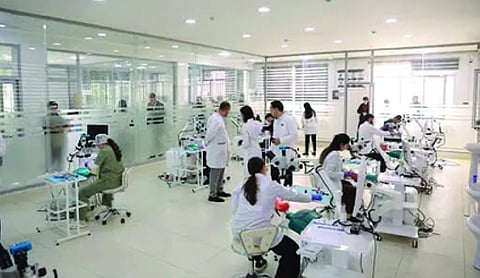
The NMC advisory named top medical universities in Uzbekistan, citing concerns communicated by the Embassy of India in Tashkent. Issues reportedly included admissions beyond institutional capacity, inadequate hands-on clinical training, language barriers and compliance with the Foreign Medical Graduate Licentiate Regulations, 2021.
These concerns carry significant consequences for Indian students, who must satisfy applicable Indian regulatory requirements before becoming eligible to practise medicine after returning home.
However, the basis and scope of the assessments have become contentious. According to stakeholders, a subsequent Right to Information (RTI) disclosure indicated that the complaints underlying the advisory originated from individual student grievances rather than documented technical inspections or formal professional evaluations. The precise scope of that disclosure and the underlying records require independent examination.
Uzbek stakeholders have reportedly questioned whether the concerns were supported by sufficiently detailed inspections and assessments. They have also sought greater clarity on the evidence behind the observations.
Neither these questions nor the reported admissions restrictions establish that the advisory was unfounded. They underline the need for transparent documentation, institutional dialogue and a clear explanation of the applicable requirements.
Students reconsider overseas medical education plans
On the ground, uncertainty is already influencing decisions. Two prospective students from Andhra Pradesh and Rajasthan told The Pioneer that their cousins had prepared to travel to Uzbekistan for medical studies but reconsidered after concerns emerged over admissions, seat availability and regulatory compliance.
For families investing substantial sums in overseas education, uncertainty over clinical training, degree recognition and future licensing eligibility can outweigh the attraction of lower tuition fees.
Education consultants are also facing mounting pressure as prospective applicants seek reliable answers rather than assurances based on informal communications or promotional claims.
Indian students’ presence has wider economic implications
People familiar with the sector estimate that approximately 16,000 Indian students are pursuing medical education in Uzbekistan, although this figure requires confirmation through official data.
Their presence supports not only educational institutions but also accommodation providers, transport operators, restaurants and other local businesses.
The reported admissions decline therefore has implications extending beyond individual campuses. Recruitment agencies and education-sector stakeholders are seeking clearer admission criteria, transparent information about institutional capacity and a predictable framework for Indian applicants.
Some stakeholders have proposed a joint working group involving Indian regulators, diplomatic representatives, Uzbek authorities and medical institutions to examine complaints, verify institutional standards and resolve outstanding issues.
Such a mechanism could help distinguish genuine deficiencies from misunderstandings while protecting students from misleading recruitment practices.
Reform assurances yet to resolve uncertainty
Presidential decrees reportedly introduced in Uzbekistan in September 2026 have added another dimension to the debate, with stakeholders pointing to reforms intended to strengthen medical education and improve alignment with international requirements. The precise provisions and their implications for Indian applicants require verification against the official decrees.
The continuing uncertainty over Indian admissions, despite these reported developments, raises questions about implementation, communication and coordination between the concerned institutions.
However, the fall in enrolments alone does not establish a diplomatic breakdown between India and Uzbekistan. Nor does the available evidence conclusively demonstrate that diplomatic disagreements were the sole cause of the decline.
What is evident is the need for timely clarification from both sides.
Clarity must replace speculation
For aspiring Indian doctors, the immediate questions remain straightforward: Are admissions open? What conditions must medical institutions satisfy? Which programmes meet applicable Indian requirements?
Educational institutions and regulators must address these questions through verifiable information rather than leave families dependent on rumours.
The reported collapse in Indian enrolments is a warning that uncertainty can undermine student confidence, institutional revenues and years of educational cooperation. A coordinated, time-bound response involving both countries could help restore confidence while ensuring that student welfare and academic standards remain paramount.
Until authoritative answers emerge, Uzbekistan’s medical education sector risks losing Indian aspirants to alternative destinations—not necessarily because a formal ban exists, but because families cannot afford to gamble with their children’s medical careers.
For students caught between regulatory warnings and uncertain admissions, clarity is no longer optional. It is the first requirement for restoring confidence.