
Author: Viplav Sharma
The proposed meeting of the leaders of the United States, Russia and China comes at a moment of profound geopolitical uncertainty. Its implications extend beyond the negotiating table—to the Iran conflict, the Russia–Ukraine war, global energy and fertiliser supplies, and India’s strategic interests
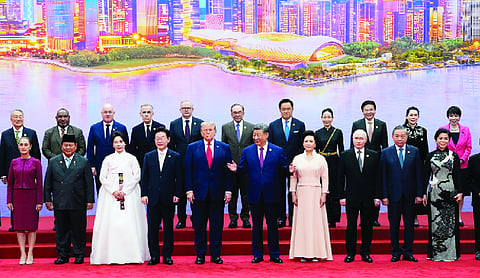
The world’s attention turns to Shenzhen on November 19, where Donald Trump, Vladimir Putin and Xi Jinping are scheduled to meet on the sidelines of the Asia-Pacific Economic Cooperation (APEC) summit. The proposed gathering brings together the leaders of three major powers at a time when the international order is under pressure from armed conflicts, energy insecurity and an increasingly contested balance of power.
The initiative originated with Moscow. The Washington Post, reporting on October 19, 2026, disclosed that Russia had proposed a Trump–Putin–Xi meeting in China the following month, well before the United States midterm elections. The Democratic victory in those elections therefore did not trigger the proposal, although it has altered the domestic political environment in which Trump approaches the summit.
The White House subsequently confirmed the meeting. In its November 14 report, Radio Free Europe/Radio Liberty stated that the discussions were expected to cover Iran and nuclear arms reduction. American officials described the gathering as an initial conversation, rather than a negotiation from which an agreement should be expected. They also indicated that the Russia–Ukraine war was not formally on the trilateral agenda.
That does not make Ukraine irrelevant to the calculations of the three leaders. For Putin, the meeting offers an opportunity to reinforce Russia’s standing as a power whose participation is indispensable to any discussion of global security. For Trump, it offers a high-profile diplomatic opportunity to demonstrate that Washington can engage both Moscow and Beijing. Xi, meanwhile, can position China as a central diplomatic interlocutor without necessarily endorsing either Russia’s or America’s strategic objectives. The three leaders may share an interest in preventing an uncontrolled escalation of international tensions, but their underlying objectives are seen far from identical. Russia seeks relief from strategic isolation and a settlement of the Ukraine conflict on terms favourable to Moscow. The United States wants to preserve its global leadership while avoiding the burden of prolonged military confrontation. China seeks stability for its economy and trade, while resisting any arrangement that compromises its strategic autonomy.
The nuclear question presents another difficulty. The United States and Russia possess the world’s largest nuclear arsenals, while China is expanding its own. Any serious arms-control discussion would therefore have to address not merely declarations of intent, but verification, strategic parity and the different stages of nuclear capability among the three countries.
Shenzhen is not a conference of victorious powers dividing territories or determining the political future of smaller nations. Nevertheless, the comparison carries a warning: whenever major powers discuss the security of other countries without their participation, the sovereignty and interests of those countries risk being reduced to bargaining considerations.
Ukraine cannot be treated as an object of negotiation rather than a sovereign participant in determining its own future.
Washington’s changed political arithmetic
The American political backdrop is particularly significant. According to the Associated Press’s November 18 election report, Democrats have won control of both chambers of Congress, gaining 42 seats in the House of Representatives and securing a 56–44 majority in the Senate.
There is, however, an important constitutional qualification: the newly elected Congress will take office in January 2027. Until then, the outgoing Congress remains in place. The election result is therefore a warning to the Trump administration about the political direction of the country, rather than an immediate transfer of congressional authority.
The consequences for the President’s foreign policy could nevertheless be substantial. A Congress controlled by the opposition can intensify scrutiny of military expenditure, demand explanations for the continuation of hostilities, investigate executive decisions and use its legislative and budgetary powers to exert pressure. It does not, simply by changing its political composition, assume command of the armed forces or acquire the President’s constitutional authority as Commander-in-Chief.
The distinction is particularly important in the context of Iran. The President’s authority to direct military operations is not equivalent to an unlimited power to commit the country to prolonged war without congressional accountability. A hostile Congress could make the political and financial costs of continuing the conflict increasingly difficult for the administration to ignore.
It would, however, be premature to assume that all Democrats will adopt an identical position on military funding or the precise terms of disengagement. Electoral unity does not necessarily translate into agreement on the conduct of foreign policy.
For Trump, the political challenge is now twofold: to demonstrate that the Iran operation has not become an open-ended military commitment, and to show that American diplomacy can produce a credible outcome. A meeting with Putin and Xi may help project diplomatic initiative, but it cannot by itself resolve the underlying conflict.
Iran: a conflict that refuses to end
The Iran conflict is central to the international significance of the Shenzhen meeting. The war began in February 2026 and caused a major disruption to energy flows through the Strait of Hormuz. In its November 17 analysis, Al Jazeera described the confrontation as having moved towards a dangerous, unresolved standoff following a temporary understanding and the subsequent breakdown of efforts to stabilise the situation.
The situation remains volatile. CBS News, reporting on November 17, covered the US strikes on an Iranian missile site on Qeshm Island, near the Strait of Hormuz, as well as reported Iranian drone activity concerning an American radar installation in Bahrain. US officials said the drones had been intercepted. These developments underline the fragility of the situation, notwithstanding statements from the Trump administration suggesting that Iran’s military capability has been substantially degraded.
The Strait of Hormuz is not merely a regional shipping passage. It is a strategic artery of the world economy. The International Energy Agency’s assessment of global energy security identifies the Strait as a critical route for international oil and liquefied natural gas shipments, with a substantial proportion of these supplies destined for Asian markets. The conflict has exposed the vulnerability of an international energy system dependent on a narrow maritime corridor. Even where alternative routes and other supply arrangements help restore exports, the threat of attacks on vessels, infrastructure and shipping lanes continues to affect freight costs, insurance premiums and energy prices.
Oil, gas and fertiliser: the economic consequences
The oil market has shown signs of adjustment, but that should not be mistaken for a return to normality. The International Energy Agency’s November 2026 Oil Market Report records a recovery in Gulf oil exports and signs of a better balance between global supply and demand. Yet the cumulative depletion of observed inventories since the conflict began, together with continuing shipping risks, leaves the market vulnerable. Diesel supplies remain a particular concern.
Natural gas faces a different challenge. The IEA’s Global Gas Security Review 2026 reports a sharp reduction in LNG supplies from Qatar and the United Arab Emirates following the disruption to shipping through Hormuz. Although additional production and supplies from other regions have offset part of the shortfall, the episode demonstrates how difficult it is to replace major LNG flows at short notice.
Russia’s position as a major energy producer may give it greater strategic leverage in this environment. But it would be simplistic to assume that Russian gas can immediately replace Gulf LNG. Pipeline capacity, export infrastructure, sanctions and the destination of existing supplies all constrain the possibility of rapid substitution.
The consequences extend beyond energy. In its July 10, 2026, analysis, the World Trade Organization documented the importance of the Gulf region in international nitrogenous and phosphatic fertiliser trade and the impact of the conflict on shipments. Its analysis also highlighted India’s substantial dependence on the region for nitrogenous fertiliser imports, based on 2024 trade data.
These are not peripheral commodities. Fertilisers are essential inputs into agricultural production. A prolonged disruption can translate into higher input costs, pressure on food prices and additional fiscal burdens for Governments. An energy crisis can therefore become an agricultural and food-security crisis.
Why India cannot afford to look away
For India, the developments in Shenzhen and the continuing instability in the Gulf are matters of direct national interest. India has substantial economic and strategic relationships with all three powers. Its engagement with the United States, its longstanding defence and energy relationship with Russia, and its extensive trade with China require a calibrated foreign policy rather than alignment with any one bloc.
The immediate concern is energy security. According to information released by the Ministry of Petroleum and Natural Gas on March 11, 2026, India imports approximately 60 per cent of its LPG consumption, and around 90 per cent of those LPG imports pass through the Strait of Hormuz. The distinction is important: the 90 per cent figure relates to imported LPG, not to India’s entire LPG consumption. The Government has also reported measures to increase domestic LPG production and diversify crude-oil supply routes.
Fertiliser security is another serious vulnerability. The WTO’s 2024 trade data indicates that India sourced almost two-thirds of its nitrogenous fertiliser imports from the Gulf region. This makes disruption to the region’s production and shipping routes particularly consequential for Indian agriculture.
There is also a human dimension. During his statement in the Rajya Sabha on March 24, 2026, the Prime Minister highlighted that nearly one crore Indians live and work in the Gulf region and drew attention to the safety of Indian nationals and seafarers affected by the regional conflict and disruption to maritime traffic. Their safety, livelihoods and remittances are integral to India’s economic and social interests.
India must therefore approach the emerging diplomatic equation with strategic clarity. It should support de-escalation, freedom of navigation and respect for the sovereignty of states, while maintaining constructive relations with Washington, Moscow and Beijing. Its interests are not served by a world in which access to energy, shipping routes and regional security becomes subject to the unilateral calculations of a few major powers. The Shenzhen meeting may not produce a treaty, a ceasefire or a breakthrough in nuclear arms control. It may, however, reveal the extent to which the three leaders are prepared to accommodate one another’s interests—and where their strategic differences remain irreconcilable. Its real significance will be measured not by the photographs taken at the summit, but by whether the conversation contributes to reducing the risk of conflict.
The world does not need another arrangement in which powerful nations negotiate over the security of others. It needs a framework in which diplomacy restrains military escalation, international law protects sovereign equality, and economic interdependence is not held hostage to geopolitical confrontation. For India, the lesson is clear: engage all, depend on none, and preserve the strategic autonomy necessary to protect national interests in an increasingly uncertain world.
The author is a Advocate, Supreme Court of India and International Legal Consultant; Views presented are personal.