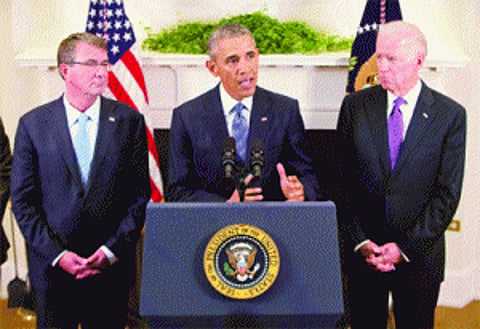

In a major reversal triggered by a sharp spike in Taliban resurgence, US President Barack Obama has ordered a halt to the pullout of American forces from Afghanistan, thereby effectively retaining the current deployment of 9,800 troops for much of 2016.
In the revised scheme of things, which may have put paid to Obama’s plans for a complete Afghan pullout by the end of his White House tenure in January 2017, there will be a drawdown to 5,500 troops sometime in 2017, at a pace to be determined by US commanders.
“As commander in chief, I will not allow Afghanistan to be used as a safe haven for terrorists to attack our nation again,” Obama said, even while conceding that there will be no change in the non-combat role assigned to the residual US forces. As such, they will continue to train Afghan forces and go after Al Qaeda elements.
Explaining his course correction, Obama, who was first elected to the White House in 2008 on a pledge to end America’s war in Afghanistan, commented that “Afghan forces are still not as strong as they need to be.” The decisions followed discussions with Afghan leaders, US lawmakers and international partners, apart from detailed consultations with Pentagon.
Obama conceded the Afghanistan situation is “still very fragile, and in some places there a risk of deterioration”, against the backdrop of renewed Taliban aggression, efforts by ISIS to move into the country and Al Qaeda remnants trickling in from neighbouring Pakistan.
“While America’s combat mission in Afghanistan may be over, our commitment to Afghanistan and its people endures,” Obama said, adding: “It’s the right thing to do.”
Stating that he does not support the idea of endless war, Obama calling this new mission modest yet meaningful felt it can make a real difference.
The Obama policy shift, in the works for some weeks now, was apparently reinforced by the Taliban wresting Kunduz, said to be the first major city to come under their control since 2001. In the ensuing operation against Taliban, a mistaken US airstrike hit a hospital, killing 10 patients and 12 staff members of Doctors Without Borders.
The new plan of action contrasts with Obama’s concerted moves earlier on to complete withdrawal of American troops from Afghanistan by the end of next year, coinciding with the end of his White House tenure.
Obama’s decision follows the presentation of a range of options by Gen. John Campbell, the top US commander in Afghanistan. Afghan President Ashraf Ghani also made a strong pitch for the deployment of more American troops.
Noting that Afghan forces continued to hold most urban areas, Obama said they, backed by coalition support, have been able to push the Taliban back. But this effort has come at a heavy price, he said, pointing out that this year alone, thousands of Afghan troops and police have lost their lives as have many Afghan civilians.
Obama felt that pressure from Pakistan has resulted in more Al Qaeda coming into Afghanistan. “We have seen the emergence of an ISIl presence,” he noted, adding: “In key areas of the country, the security situation is still very fragile. In some places there is risk of deterioration.”