
- HOME
- INDIA
- WORLD
- BUSINESS
- STATES
- LAW & JUSTICE
- ENTERTAINMENT
- SPORTS
- VIEWPOINT
- LIFESTYLE
- TECH
Preliminary results leave Netanyahu’s right-wing
bloc short of a majority, while Opposition parties struggle to establish a clear path to forming Israel’s next Government.
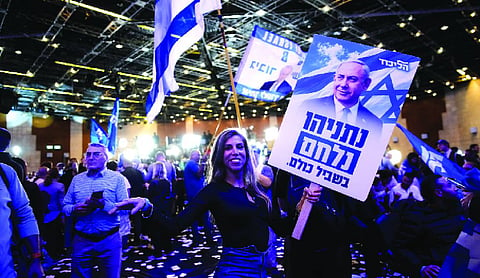
Israel’s parliamentary election has left Prime Minister Benjamin Netanyahu facing an uncertain political future, with preliminary results showing his right-wing bloc falling short of the majority required to form a Government. However, opposition parties have also failed to secure a clear route to power, setting the stage for potentially difficult coalition negotiations.
The election marks a significant political test for Netanyahu following the Hamas-led attack on October 7, 2023, which exposed serious weaknesses in Israel’s security system and triggered the war in Gaza.
The results reflect a divided electorate weighing the Government’s security record against economic pressures, domestic political disputes and concerns about the country’s future direction.
According to preliminary figures from Israel’s Central Elections Committee, 93 per cent of ballot boxes had been counted .
The partial results projected 53 seats for Netanyahu’s bloc, 48 for an Opposition grouping led by former military chief Gadi Eisenkot, and 19 for Arab-led parties. A majority in Israel’s 120-member Knesset requires at least 61 seats.
Although Netanyahu’s Likud party remained the largest individual party in the preliminary count, his alliance appeared short of the numbers needed to govern without additional support.
The opposition faces its own challenge in assembling a parliamentary majority. Disagreements over cooperation with Arab-led parties could complicate efforts to form an alternative Government, leaving the final outcome dependent on negotiations among smaller political groups.
October 7 attack shapes election debate
The attack on October 7 remains a central issue in the debate over Netanyahu’s leadership. The assault killed approximately 1,200 people in Israel and resulted in 251 people being taken hostage, according to the figures cited in the supplied report.
Critics have accused Netanyahu’s Government of failing to prevent the attack and have called for greater political accountability.
They argue that the security failures raised serious questions about the Government’s preparedness and its ability to protect Israeli citizens. Netanyahu’s supporters, however, have highlighted his Government’s subsequent military operations against Hamas, Hezbollah and Iran.
They argue that his experience and hard-line security policies remain important at a time of continued regional instability.
The preliminary results suggest that the attack has not produced a uniform political rejection of the prime minister. Instead, voters appear divided over whether his Government’s military response outweighs criticism of the failures that preceded the conflict.
Domestic issues add pressure on Netanyahu
Security concerns were not the only factors influencing voters. The cost of living, military conscription, judicial reform and relations between religion and the state also featured prominently in the campaign.
An Israel Democracy Institute survey conducted from August 31 to September 3 found that 39 per cent of Jewish respondents identified foreign affairs and security as one of their two leading priorities. The economy and cost of living followed closely, at 38 per cent.
The question of military service has become particularly contentious. Many ultra-Orthodox men receive exemptions from compulsory military service, a policy that has drawn criticism as Israel continues to rely on reserve forces during periods of conflict.
Netanyahu’s dependence on ultra-Orthodox parties has complicated efforts to reform the conscription system. Changing the exemptions could create tensions within his
political alliance, while maintaining the existing arrangements risks further public dissatisfaction.
Judicial reform has also contributed to political divisions, with disagreements over executive authority and institutional checks remaining important concerns for sections of the electorate.
Coalition talks will determine the next Government
Israel’s proportional representation system makes coalition-building essential because no single party has ever secured an outright majority in the Knesset. Smaller parties can therefore exercise considerable influence when larger political blocs fail to win enough seats.
President Isaac Herzog is expected to consult party representatives before assigning a member of the Knesset the task of forming a Government.
The designated candidate generally has 28 days to secure sufficient parliamentary support, with a possible extension of 14 days.
Netanyahu will remain caretaker prime minister while negotiations continue. If neither political camp can assemble a viable coalition, the country could face a prolonged political deadlock or another election.
The results also carry implications for Israel’s international relationships, particularly its ties with the United States and
its policies towards Iran and Gaza.
However, any major policy changes will depend on the composition of the next Government and its ability to maintain parliamentary support. For now, the election has delivered neither a decisive endorsement of Netanyahu’s leadership nor a clear mandate for his removal.
The coming coalition negotiations will determine whether the veteran prime minister can retain power or whether Opposition parties can unite behind an alternative Government.