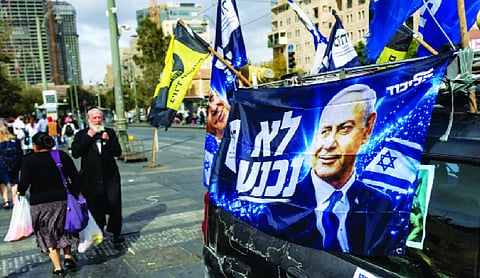

Israel has an election result and still has no government. The final count leaves Prime Minister Benjamin Netanyahu's bloc on 53 seats, the opposition bloc on 48 and the two Arab-led parties on a record 19 in a 120-member Knesset, with 61 needed to govern. Netanyahu stays on as caretaker prime minister, with a caretaker's limits, until a coalition is sworn in — a process that could run into next year.
THE WEEK AHEAD
The Central Elections Committee hands the official results to President Isaac Herzog on Wednesday. Consultations at the President's Residence begin the same day and are expected to run into Thursday and Friday. The law gives Herzog seven days from the official publication to place the mandate, which sets a deadline of November 11, though he can act sooner.
THE RECOMMENDATION TALLY
Herzog asks each faction whom it recommends for prime minister. Gadi Eisenkot, the former army chief whose Yashar party won 21 seats, is expected to lead. Naftali Bennett's B'Yachad has announced it will recommend him; the Joint List and Ra'am are expected to as well. United Torah Judaism and Avigdor Liberman's Yisrael Beytenu have not committed. On published counts that gives Eisenkot about 60 recommendations without Liberman and 67 with him, against roughly 46 for Netanyahu from Likud, Otzma Yehudit, Shas and Religious Zionism. Herzog is not bound to pick the candidate with the most recommendations, but the law and the courts point him to the one with the best chance of building a government.
THE CLOCK
Whoever gets the mandate has 28 days, extendable by 14, so 42 days in all. If that fails, Herzog can hand the task to another Knesset member for 28 days with no extension. After that, 61 lawmakers can petition him to give the job to a third candidate, who gets 14 days. If none of it produces a government that wins a confidence vote, the Knesset dissolves and Israel returns to the polls within 90 days.
SCENARIO ONE: EISENKOT, BACKED FROM OUTSIDE
The arithmetic works only if the Arab parties help. Veteran MK Ahmad Tibi has offered the Joint List's support from outside the coalition: "We won't be part of the government. I don't want a ministerial post. I don't want to be in the cabinet," he said, adding that "without the Arab parties there won't be change". His conditions are a diplomatic process towards a Palestinian state, a funded plan against crime in Arab municipalities and a halt to home demolitions. Ra'am's Mansour Abbas, who sat in a coalition in 2021, is more open, and his party's number two is a former senior police officer, a deliberate signal.
The obstacle is on the other side. Eisenkot, Bennett and Liberman campaigned on not sitting with the Arab parties. Eisenkot has set tests for any Arab partner — acceptance of Israel as a Jewish and democratic state, the values of the Declaration of Independence, service for all, and recognising Hamas as a terrorist organisation to be destroyed — and has said neither list meets them.
SCENARIO TWO: A UNITY GOVERNMENT
Herzog has pushed for a national unity arrangement since before the vote. It would require Netanyahu to break his promise to keep his bloc intact, and require Eisenkot, Bennett and Liberman to serve under a prime minister they have described as unfit. A variant is Netanyahu luring defectors from Yashar, which is why Likud is reported to have set up a unit to work on exactly that. Shas has left itself room: a senior party figure said this week there is "no reason to rule out" negotiations with Eisenkot.
SCENARIO THREE: ANOTHER ELECTION
If the mandates run out, the country votes again. Herzog has warned against it repeatedly, saying leaders must find "creative solutions".
NOVEMBER 10 MATTERS WHATEVER HAPPENS
The new Knesset is sworn in on November 10, coalition or no coalition. The opposition bloc intends to use its 67 votes that day to replace Speaker Amir Ohana of Likud — a 2020 Supreme Court ruling obliges a speaker to bring such a vote if 61 members demand it. Once in office a speaker is very hard to remove, needing 90 votes, which is why the post matters more than the numbers suggest. The bloc's declared next steps are a state commission of inquiry into the October 7, 2023 attack, repeal of the judicial overhaul laws and a conscription law. Likud's counter is to question the legitimacy of any majority resting on Arab support and to find members who will abstain.
WHAT ALL OF IT TURNS ON
Ultra-Orthodox conscription. The Eisenkot bloc is committed to enlisting Haredi men; Shas and United Torah Judaism want the exemption written into law; Religious Zionism wants a negotiated draft. No coalition of any colour settles without answering that question.
WHY IT MATTERS BEYOND ISRAEL
A caretaker government cannot take the decisions a new one could — on Gaza, on Iran, on the Saudi normalisation track. For New Delhi, the shape of the next coalition governs the pace of defence and technology cooperation and how far Israel goes in the West Asia endgame now under negotiation in Washington. Until a government is sworn in, expect continuity and little movement.
(With inputs from PTI and media reports)