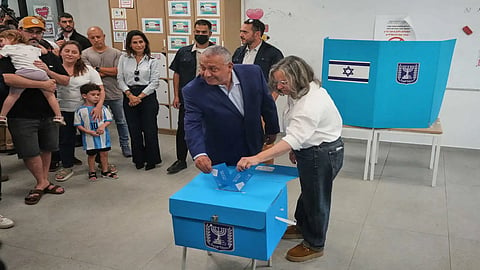
With 5,114,634 votes counted, or 89.8 per cent, the Netanyahu bloc stands at 53 seats and the Eisenkot-led bloc at 48, Ynet reported. The Arab parties hold 19 seats.
The Central Elections Committee figures, reported by The Jerusalem Post, put Likud at 26 seats, Eisenkot's Yashar at 21, the Joint List at 12, B'Yachad at 12, the Democrats at 8, Yisrael Beytenu at 7, Shas at 7, United Torah Judaism at 7, Otzma Yehudit at 7, Ra'am at 7 and Religious Zionism-Zehut at 6.
Israel's Central Elections Committee has begun counting double-envelope votes, cast largely by soldiers, along with ballots from prisoners, medical personnel, voters with medical conditions and Israeli representatives posted abroad, the Indian Express reported.
Regular votes have been processed from 11,712 of 12,018 polling stations. These ballots are counted last because they arrive sealed and separately, and they can move a seat or push a party across the 3.25 per cent threshold.
A government needs the support of 61 of the Knesset's 120 members. On the committee's figures, the Netanyahu bloc is eight short and the opposition bloc 13 short.
The outgoing government held 68 seats at its height, the Jewish Telegraphic Agency reported. Likud itself won 32 seats in the 2022 election and is projected at 26 this time.
President Isaac Herzog said he would receive the official results next week and then begin consultations with each party that won seats, the Jewish Telegraphic Agency reported.
"We must do everything we can, certainly after yesterday, to avoid another round of elections," Herzog said. "So I expect everyone who comes here to come with an open mind."
Netanyahu said the right-wing bloc had "a clear, decisive majority among the Zionist public, among the Jewish public and all those who support the Jewish state", the Jewish Telegraphic Agency reported. He warned against a government that "rests on anti-Zionist Arab parties".
He also called for a "national right-wing government", the Indian Express reported. On X, Netanyahu posted a short message thanking supporters.
Gadi Eisenkot told supporters that "the public wants change", the Indian Express reported. He warned Netanyahu not to use his powers as caretaker prime minister to shape the talks on a new government.
Eisenkot has also raised the option of a minority government. Some of his allies differ on working with Arab parties, which would complicate that route.
The Joint List is projected at 12 seats and Ra'am at 7, taking Arab parties to 19, their strongest showing. The two are separate parties, not a single bloc.
Joint List chairman Yousef Jabareen said on X that "the change comes through Jewish-Arab partnership, a true and equal partnership", according to JFeed. Joint List faction chairman Ahmad Tibi told Army Radio the opposition could form a government "if it has the courage".
Once the committee certifies the results, the president consults the parties and asks one Knesset member to try to form a government. Netanyahu remains caretaker prime minister until a new government is sworn in.
Analysts are also discussing a unity government between Netanyahu and Eisenkot, with the premiership the main sticking point, the Indian Express reported.
Three of five exit polls put the anti-Netanyahu bloc ahead and two put the Netanyahu-led bloc ahead, the Indian Express reported. Likud was the largest party in all five.
Exit polls are projections, not results, and their seat counts differ by broadcaster. The count has since put the Netanyahu bloc ahead.
The Central Elections Committee said 98.6 per cent of ballots had been counted, excluding double envelopes, Ynet reported on Thursday. It put the count at 5,168,955 valid votes and 22,957 invalid votes. The committee reported no change in the bloc map.
Counting of double envelopes is under way. The committee has processed 29,253 of more than 400,000 such ballots, Ynet reported. Likud leads among them with 18.5 per cent, followed by Yachad on 15.6 per cent and Yashar on 14.8 per cent.
Double envelopes arrive sealed from soldiers, prisoners, hospital patients and Israeli staff posted abroad. They are counted after the regular ballots and can still move a seat between lists. Official results are due by November 4, the committee has said.
India's Ministry of External Affairs said on Wednesday that New Delhi would wait for the outcome of Israel's election before drawing conclusions. "As for Israel's election results, let's wait and see what conclusions emerge," MEA spokesperson Randhir Jaiswal told a media briefing in New Delhi, IANS reported.
Jaiswal said India has "a good relationship with Israel" and would strengthen it "in the coming days". He spoke while votes were still being counted.
Justice Noam Sohlberg, who chairs the Central Elections Committee, asked Shin Bet chief David Zini to examine claims of foreign funding in the election, the Indian Express reported. Sohlberg wrote that he could not confirm the suspicions but that they involve foreign entities and must be investigated thoroughly. He asked for findings within a week to protect public trust in the vote and did not name the countries or groups suspected, the Indian Express reported. Israel Police said there was no investigative or intelligence evidence for Likud's claim that Arab parties stole the election, The Jerusalem Post reported.
Yisrael Beytenu chairman Avigdor Liberman said he would not sit in a government led by Benjamin Netanyahu or by the Joint List's Ahmad Tibi, The Times of Israel reported. "We will not sit with Bibi or with Tibi," Liberman said on Thursday. He said there had been too many developments and that he would wait for the dust to settle before deciding his next step, The Times of Israel reported. His party is projected at seven seats. N12 reported that Liberman had cut contact with opposition leaders Naftali Bennett and Gadi Eisenkot, The Jerusalem Post reported.
President Isaac Herzog said the evidence and suspicions around foreign funding in the election must be investigated thoroughly and offenders punished to the fullest extent of the law, Ynet reported.
Herzog said he had spoken that morning with Central Elections Committee chairman Justice Noam Sohlberg and the head of the Shin Bet, and was following the developments closely.
Addressing party representatives ahead of the coalition consultations, he said the only question before them should be what is in the best interest of the state, Ynet reported.
Yashar leader Gadi Eisenkot said every complaint about foreign interference in the election should be examined thoroughly. He said Israel must safeguard the integrity of the vote against "any attempt at interference, spin and manipulation".
He also said political actors must not exploit the situation and affect the date on which the 26th Knesset is sworn in, the Indian Express reported, quoting Ynet.
The Central Elections Committee has counted 196,618 double-envelope ballots, nearly half of the more than 400,000 it expects, Ynet reported. Likud takes 18.5 per cent of those votes, Yashar 15.1 per cent and Yachad 13.9 per cent.
Ynet reported that the figures of seven seats for Shas and eight for Ra'am are wavering as counting continues. Israeli media have projected Ra'am at eight seats and the Joint List at 11, from seven and 12. Media houses reported earlier on Thursday that the committee's figures still gave the 19th seat to the Joint List under the two parties' surplus-vote agreement. Ra'am was about 1,200 votes short of claiming it, according to media organisations.
Sami Abu Shehadeh chairs Balad, which is part of the Joint List. He accused Benjamin Netanyahu and his allies of laying the groundwork to reject "the clearest election results Israel has seen in decades", The Guardian reported.
He said the claims of foreign interference were part of a "racist blood libel" against Arab parties and that the losing side was manufacturing it. "You lost. Get out," he said.
President Isaac Herzog said the fraud and foreign-funding claims around the election must not be used to tarnish an entire community. “We must avoid tarnishing an entire community that sought to exercise its right to vote and take an active part in democracy,” he said.
Herzog said he was following the investigation into the suspicions reported that morning closely. He said he would meet representatives of all political groups once the official results are in, and urged them to keep “an open mind, an open heart and broaden your perspective” ahead of next week's consultations.
Ynet reported on Thursday that the count now covers 96.1 per cent of all votes, with 233,815 double envelopes counted so far. The 96.1 per cent figure includes the double envelopes, which are added to the national tally. The committee said earlier that 98.6 per cent of regular ballots had been counted.
Likud leads the double-envelope vote with 18.62 per cent, Ynet reported. Yashar has 14.92 per cent, Yachad 13.57 per cent, Religious Zionism 10.37 per cent and Otzma Yehudit 8.11 per cent.
HaMiluimnikim, the reservists' party, has 3.95 per cent of the double-envelope vote and has not crossed the 3.25 per cent threshold. Ynet reported that about 200,000 votes remain to be counted, and that the party would need roughly 20 per cent of them to win a seat.
Ynet did not report a change in the projected seat totals. The count is not final.
Attorney Livne, the Central Elections Committee's acting director-general, said election integrity had been maintained, Ynet reported. He said there was no basis for claims of systematic harm to election integrity.
He was responding to a request from Yesh Atid MK Vladimir Beliak to convene the committee's presidency, Ynet reported. Livne said the many reports in the media had no foundation.
He said classified and sensitive information had raised suspicions that required examination to establish whether evidence existed.
Ynet reported at 6:50 pm IST that 97.3 per cent of all votes had been counted, including double envelopes. Likud had 27 seats, up from 26, and Shas had six, down from seven. Ynet described it as Likud gaining a seat at Shas' expense.
The Times of Israel reported the same shift and said the bloc map was unchanged. Benjamin Netanyahu's bloc held 53 seats, the opposition bloc led by Gadi Eisenkot held 48, and the Arab parties held 19.
Yashar had 21 seats, Yachad 12, the Joint List 11, the Democrats eight and Ra'am eight, Ynet reported. Yisrael Beytenu, Otzma Yehudit and United Torah Judaism had seven each, and Religious Zionism had six.
The Times of Israel reported that 295,607 double envelopes had been counted, of an estimated 430,000 to 480,000. No bloc reaches the 61 seats needed to govern.
The Central Elections Committee said on Thursday that counting of double-envelope ballots had been completed, Ynet reported. It said final results would be provided later.
The committee said 99 per cent of votes had been counted, Ynet reported. It said results from 12,644 polling stations had been entered, covering 5,589,836 votes.
Of those, 5,564,764 were valid votes and 25,072 were invalid, the committee said.
Ynet reported no change in the number of seats held by any party. The balance between the blocs was also unchanged, it said.
Former prime minister Yair Lapid said on Thursday that there was no risk to the election results and no obstacle to swearing in the new Knesset, The Jerusalem Post reported. He spoke after meeting Shin Bet chief David Zini at the agency's headquarters, and said he had also spoken with representatives of Central Elections Committee chairman Justice Noam Sohlberg. Lapid said the assessment rested on his own familiarity with the material and on the agreement of the authorities handling the matter. He said there was "no risk to or challenge to the election results", according to the report.
The Shin Bet said on Thursday that its inquiry into suspected foreign interference in the election was still under way, and that its findings would go to the Central Elections Committee chairman when it ends. In a statement, the agency said the intelligence at the centre of the inquiry had been collected independently under its statutory remit to identify foreign influence. It said the information did not come from any political party or political figure, regardless of affiliation. No one outside the Shin Bet apart from Justice Noam Sohlberg had access to the material before voting ended, the agency said, according to The Jerusalem Post.
Yashar chairman Gadi Eisenkot said he would work to form a new government, in a recorded phone message he released on Thursday, Ynet reported.
"I will work to fulfill the will of the people and form a new and good government for Israel," Eisenkot said in the message. "There is hope. We will do it and succeed. I commit."
He thanked voters for their support and said he would work to be worthy of their trust. The message did not name any potential coalition partner, and the Central Elections Committee has not published final results.
Yashar chairman Gadi Eisenkot and B'Yachad chairman Naftali Bennett met at Bennett's home in Ra'anana, the two parties said in a statement reported by Ynet on Thursday.
The parties said the two discussed ways to act "to form a good government in Israel as quickly as possible." The statement named no other party and set no timetable.
The Central Elections Committee had counted about 99.7 per cent of votes when the statement was reported, and no party's seat total had changed, Ynet reported. The committee has not published final results.
Israel's Central Elections Committee has projected Benjamin Netanyahu's bloc at 53 seats and the opposition bloc led by Gadi Eisenkot at 48, with Arab parties at 19, after counting ballots from almost five million voters. No bloc reaches the 61 seats needed to govern in the 120-member Knesset.
Counting of double-envelope ballots, cast by soldiers, prisoners, medical staff and officials posted abroad, is still under way. Follow this page for the count, the party-by-party numbers and the coalition talks that follow.