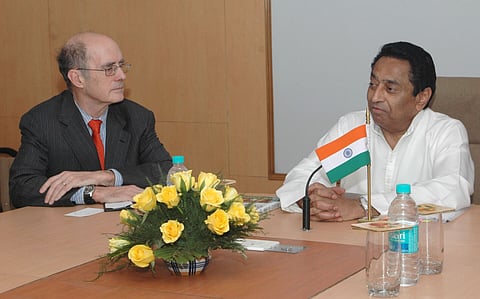


WASHINGTON: Strobe Talbott, the former United States deputy secretary of state who led Washington’s sustained diplomatic dialogue with India following the 1998 Pokhran nuclear tests, died on November 26 at his home in East Hampton, New York, at the age of 80. His son Devin confirmed that he passed away after a prolonged illness.
Talbott, who served as deputy secretary of state from February 1994 until January 2001 under President Bill Clinton, played a central role in rebuilding US-India relations after the 1998 nuclear tests.
Between June 1998 and September 2000, he held 14 rounds of talks with then Indian External Affairs Minister Jaswant Singh across seven countries on three continents, a process he later chronicled in his 2004 book, Engaging India: Diplomacy, Democracy, and the Bomb.
The talks extended beyond nuclear security and nonproliferation to cover economic and strategic ties, paving the way for Clinton’s landmark visit to India in March 2000, the first by a US president since Jimmy Carter’s trip in January 1978.
At a Washington event in November 2006, Jaswant Singh credited the dialogue and Clinton’s visit with laying the groundwork for the 2004 Next Steps in Strategic Partnership and the July 2005 civil nuclear initiative, telling Talbott: "You led us across the bridge."
Talbott remained critical of the 2005 civil nuclear deal, telling the Council on Foreign Relations in March 2006: "I have some profound and persistent concerns about the deal."
He argued that granting India exceptional treatment could weaken international nonproliferation norms, while also describing the US Senate’s 1999 rejection of the Comprehensive Nuclear-Test-Ban Treaty as "a black day for the cause of nonproliferation" that had hindered Washington’s efforts to bring India into the treaty.
Born in Dayton, Ohio, in 1946 and educated at Yale and Oxford where he was a roommate of Clinton, Talbott spent 21 years at Time magazine, Eastern Europe and State Department correspondent, Washington bureau chief, and foreign affairs columnist, and also translated and edited two volumes of Nikita Khrushchev’s memoirs.
Entering government in 1993 as ambassador-at-large for the former Soviet states before becoming deputy secretary of state, he later served as founding director of the Yale Centre for the Study of Globalisation, president of the Brookings Institution from July 2002 to October 2017, and chair of the State Department’s Foreign Affairs Policy Board under Secretaries Hillary Clinton and John Kerry.
"Strobe was a good and brilliant man who made our world more peaceful and secure," Clinton said in a statement, adding that he and Hillary Clinton were deeply saddened by the loss.
Talbott is survived by his wife, author Barbara Lazear Ascher, his sons Devin and Adrian, and six grandchildren.
(With inputs from agencies)