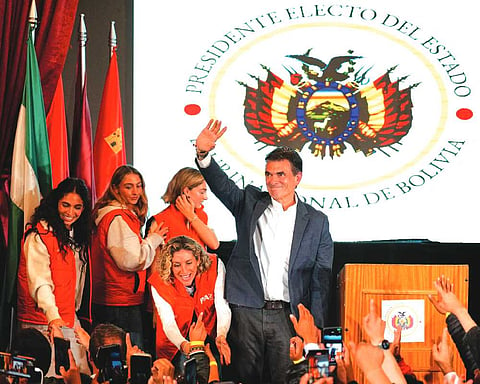

Bolivia’s first conservative president-elect in 20 years, Rodrigo Paz, injected a sharp note of realism into his plans to tackle Bolivia’s economic crisis on Monday, a day after his surprise electoral victory signalled the end of decades of leftist rule in the South American nation. After years of Government antipathy toward the US under the Movement Toward Socialism party, Paz pledged to rebuild relations with Washington and attract foreign investment to a country long locked out of international markets.
US Secretary of State Marco Rubio said in a statement that Paz’s victory Sunday “marks a transformative opportunity for both nations” to work on investment, immigration, security and other matters. “The message from Mr Trump’s administration itself is a very clear and open signal,” Paz said at a news conference. “We will have a fluid relationship and commitments to cooperation and joint work between both nations.”
In another sign of the dramatic regional shift, Paz on Monday held a video call with Venezuelan opposition leader María Corina Machado, who was awarded the Nobel Peace Prize this month. After years of Bolivia aligning itself with Venezuela’s increasingly repressive President Nicolás Maduro, Paz told Machado that his country was “here to join in the fight for Venezuela and for Latin American democracies.” “These are very difficult times; here we have achieved a great step,” he said of Bolivia’s break with socialism. Paz won 54.5 per cent of the vote, according to preliminary results.
Paz defeated right-wing former President Jorge “Tuto” Quiroga in Sunday’s presidential election runoff after a campaign in which both candidates reached out to Washington, though Quiroga was seen as having warmer ties with the Trump administration. Quiroga pitched having the International Monetary Fund impose a fiscal shock package to right the economy, an unpopular move with many voters. Sensitive to the country’s deep-seated resentment of such international organisations under leftist rule, Paz rejected an IMF bailout.
He did reveal on Monday that he was talking to the Trump administration -- among “other friendly countries” — to ensure Bolivia would have fuel imports after he takes office on November 8. “The process is underway. We are coordinating in the best way possible so that the much-needed fuel -- gasoline and diesel — can arrive, and from that, we can bring calm to the population,” Paz said, without elaborating.