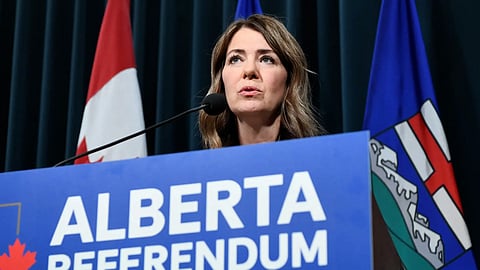

Edmonton: Voters in Canada's oil-rich Alberta province have overwhelmingly rejected a proposal to begin the legal process that could eventually lead to a referendum on separation from Canada, delivering a major victory for Prime Minister Mark Carney and supporters of national unity.
Unofficial results from Elections Alberta showed about 76% of voters chose for Alberta to remain a province of Canada, while nearly 24% backed starting the constitutional process for a future binding referendum on separation. More than 1.5 million votes had been counted by Tuesday. The official results are due on October 29.
The October 19 vote was not itself a referendum on independence. Under the question approved for the ballot, Albertans were asked whether the province should remain in Canada or whether the Alberta government should begin the legal process required under the Canadian Constitution to hold a future binding referendum on separation. The result of the question was non-binding.
The decisive result gives Carney a political boost as he seeks to strengthen Canadian unity amid an ongoing trade dispute with the United States and President Donald Trump's repeated rhetoric about Canada, including his suggestion that it could become the 51st US state.
“Albertans made a clear choice. They chose unity, to build together, and to take care of each other,” Carney said after the results emerged. He had urged Albertans to reject the separation proposal during a campaign stop in Edmonton, warning that breaking away would bring years of uncertainty.
The result also gives Alberta Premier Danielle Smith a political mandate to argue for greater provincial powers while keeping the province within Canada. Smith, who opposes Alberta independence, had called the referendum after facing growing pressure from separatists within her governing United Conservative Party.
“I’m very pleased to see the initial results from Elections Alberta show widespread support for remaining in Canada,” Smith said, adding that Albertans had voted for “a stronger Alberta in a united Canada.”
Alberta has long had a complicated relationship with Ottawa. The province is a major oil and gas producer and home to some of the world's largest proven oil reserves. Frustration over federal energy policies, environmental regulations, equalisation payments and Ottawa's role in provincial affairs has periodically fuelled calls for greater autonomy.
Separatist sentiment gained additional momentum following the COVID-19 pandemic, as opposition to federal restrictions helped mobilise activists who later became involved in the independence movement.
But the separatist campaign fell well short of its hopes on Monday. The result was significantly below the 30% and 40% support levels some campaigners had identified as important benchmarks for demonstrating that the movement had become a major political force.
Supporters of separation argued that Alberta's economic strength, particularly its energy resources, would allow it to prosper outside Canada.
Dustin Degenhardt, a voter in Wainwright, said Albertans had long been mistreated by Ottawa.
“Alberta has essentially been treated as, you know, a colony,” he said after voting.
Taylor MacIsaac, another Wainwright voter who supported separation, said she believed Alberta would benefit from becoming independent.
Others argued that the separation debate was taking place at the wrong time, particularly as Canada faces pressure from Washington.
Dave Malka, 59, of Edmonton, criticised the cost of what he described as a “referendum on a referendum”, arguing that money could instead have been spent on health care.
“With Trump threatening Canada, it seems to be happening at the absolute worst time when we should be united; instead we're fighting among ourselves,” he said.
Jake Graham, 35, of Calgary, attended a Carney rally wearing maple leaf pants and a Canada hockey jacket. He said he hoped the result would put the issue to rest.
“I hope this squashes this for a long time to come and that it's clear and decisive, that these grumblings disappear for a while and we can be a united Canada,” he said.
The vote was held against the backdrop of Trump's trade war with Canada and his repeated comments about annexing the country. The issue allowed Carney, who grew up in Edmonton, to frame the Alberta vote as part of a wider debate about Canada's place in North America.
The referendum also included nine other non-binding questions dealing with issues including immigration, eligibility for provincially funded services, voting requirements and constitutional powers. Those questions were separate from the separation issue and their results were still being counted.
Despite the defeat, Alberta's separatist movement is unlikely to disappear immediately. Separatist leaders have argued that the campaign itself succeeded in bringing the issue into mainstream political debate, while continuing to point to grievances over federal energy policy and the distribution of Canada's economic resources.
For now, however, the result is clear: Albertans have rejected the first step towards a future separation referendum and voted overwhelmingly to remain part of Canada.
The outcome represents a significant victory for Carney's unity campaign and leaves Smith facing the challenge of balancing demands for greater provincial autonomy with the clear preference expressed by voters to remain within Confederation.