
Six artists put up their experiences with women in an informal art show. Iknoor Kaur read their minds
As they first met in February, an idea sparked in their minds. Six months later, they were at The Attic, CP, with a multi-faceted art exhibition called HERS. The six artists — Alka Mathur, Akshay Mahajan, Bathsheba Okwenje, Nupur Mathur, Samia Singh and Samira Gupta — have presented their ideas of being a woman in India. The venue was divided into different sections showing motley audios, photographs, illustrations, etchings and books.
Our attention was captured by Samira Gupta’s book One Bedroom, Hall and Kitchen. “It’s about complexity of a mother-daughter relationship, how a young woman discovers her friendship with an older woman. The book is a narrative which is unconventional and non linear,” says the author.
Sections like Dincharya by Alka, Untitled by Akshay, Reminiscence and Adda-Baazi by Bathsheba and Nupur, Etchings and Woodcuts by Samia were named by the artists themselves. While Alka’s collage Dincharya was a collection of her daily visual diary that she described as a “spontaneous outpouring,” Sheba and Nupur’s Reminiscence was an audio booth that made one understand what it meant to be a male or a female in urban middle-class of Delhi. Nupur feels it is a way of giving people the chance to share their personal experiences with gender. She said, “We interviewed a lot of people and asked them to recollect stories and personal experiences. So it can be subtle things which don’t need to be dramatic, though some are dramatic as well. It is like curating your thoughts and what you end up with is this huge collection of anonymous voices who are sharing experiences.”
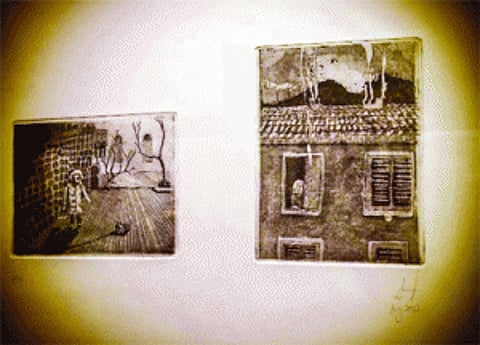
When Samia left Delhi and went to Florence, Italy to pursue print making, it took her time to accept that there were places ‘safe’ for women. Her etchings are all about her rediscovery in a new country. She recollected, “It was suddenly so safe. I could go and cycle at 3 am and nobody would say anything. I hung out with like five to six girls and enjoyed the entire city and I saw different stories unfold.”
Contrast to it was Sheba and Nupur’s Adda-Baazi. Sheba explained, “Delhi has a very male public face. So, men are sort of given permission and allowed to socialise on the streets while women are seen doing that very rarely. So, what we wanted to do was essentially give women that male dominated space. We photographed a few women and pasted the pictures on walls at public places.”
The exhibition concluded on Sunday with a musical performance by Abhishek Mathur and Sajid Akbar of Sajid and The lost Boys. Samira said that they all tried to keep the exhibition informal in order to initiate conversation.