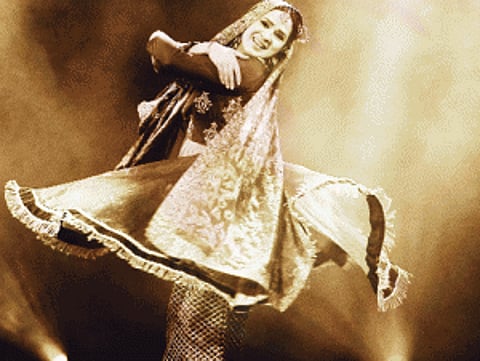

Kathak exponent Manjari Chaturvedi's recent enthralling performance on the compositions of Sufi saint Baba Bulleh Shah proved to be an undeniable entertainment for the soul. She toldIla Sankrityayan about this fakir, his wisdom and what makes him relevant today
Sufi Kathak and sufi poetry are synonymous with each other and Manjari Chaturvedi is a name that complements both. Her performance is always like a visual representation of the poetry sung; they seamlessly merge into one another and transform the dance into live piece of well researched documentary. The danseuse once again was at her best in capturing the devotional and spiritual contours of the compositions of Baba Bulleh Shah as part of 22 Khwaja Project in her recent production O’ Bullayah at The Kila. She had a wonderful flair for expression and chose not to leave even a minute detail in delineation about the saint in her repertoire. In addition to her magnificent and mystic presentation what made it more enticing was inclusion of voice overs, visuals of musicians and dancers from the shrine of Baba Bulleh Shah at Kasur, Punjab in Pakistan
Chaturvedi commented, “The production O’Bullayah is a one of its kind. Nothing on Bulleh Shah has been done in classical dance, and yet the most popular song till date remains Tere ishq nachaya, which is what we also performed and explored in this concert. The world knows Rumi who wrote great poetry on love. It is the time to take the poetry of the great Sufi poets from Punjab to the world, to familiarise the world with their expression of love, surrender, ecstasy, separation, a range of emotions articulated in words, music and dance. Bulleh Shah was one poet who wrote in complete surrender of love — at times singing, at times dancing and at times dressed as a woman. He became the voice of the woman in Punjab. This production finds its relevance especially in recent times when humanity is divided in so many divisions, each human separated from the other. The voice of Bulleh Shah becomes the uniting force and an expression of love.”
A number of Bulleh Shah’skafis have been sung by present day qawwals and even Bollywood has adapted many of his compositions into melodious songs like Chaiyyaa chaiyaa from Dil Se, Ranjha ranjha from Raavan and so on. But what makes Bulleh Shah so appealing even after 700 yearsIJ She replied, “While till date I remain wonder-struck at our immense poetic wealth I am saddened by how Punjab has squandered away its cultural traditions. Today the only music emanating from Punjab is a certain dhink chak chak with random words thrown into it. There should also be something more than that. Shouldn’t someone take the couplets of Baba Bulleh Shah or Baba Farid and set it to musicIJ It is remarkable with what calm serenity Bulleh Shah attacks the orthodox in both Hindusim and Islam. In a country where society is divided rigidly into these two main sects, it is unusual to meet a man who is above the trappings of sects, and who can criticise both religions with equal impartiality. It was said that Bulleh Shah knew the text of scriptures by heart. And yet again, he discarded all rituals and ceremonials.”
She went on to talk the intricacies in his creations like Tere Ishq nachaiyaan, Ghungat chuk o sajna and Kisi ne teri zaat puchni. “Bulleh Shah spent his whole life in the search of true self-realisation and spiritual awakening. In his poetry he talks about his understandings of the world around him and his divine experience. It was astonishing to see during the period of Emperor Aurangzeb, when music and dance were almost debarred, he used to roam dancing and singing on the streets of Punjab. He preached to the masses to leave their egos and not to worry about social conventions; if they wish to meet the divine power. Very interesting story was associated with his poetry Tere ishq nachaiyaan which shows his love and devotion for his master Inayat Shah who was angry with him. Just to please his master, he learnt dance from a tawaif (court dancer) for months and then dressed up as a female to perform in front of him. Inayat Shah was so delighted to see his level of adoration that he hugged him with warmth. Bulleh Shah was a saviour of human race and an instrument of peace in Punjab.”
As for Manjari, the main motive was to take all the incredible knowledge of this Sufi saint to audience and present a dance piece not just to soothe their eyes but mind as well. “I take these messages of the Sufi saints to audiences across India and the world. Nothing blurs the divide better than our tradition of music, dance and poetry. Today when we are getting belligerent about creating rather than obliterating the divide and to these misguided sections I say that threaten this composite heritage otherwise nothing will remain. I am determined to be the link and the light, swathe in colours of Sufi saint poets, as I introduce audience to many layers of our culture and traditions,” concluded Chaturvedi who created out-of-body experience in an intriguing concept embraced by Sufism.