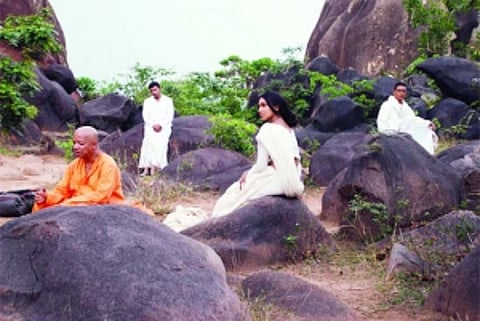

Chaturanga by Suman Mukhopadhyay is a film based on Tagore’s play, set in colonial Bengal. The director tells Utpal K Banerjee that the story is about love caught between a conflicting world of ideas
Chaturanga (Four Chapters) was penned and serialised in a journal from 1914 by Tagore soon after he became Nobel laureate and published in 1916 as a trend-setting novel. Set in the turn of the 20th century, the work interweaves its human bondings in the colonial society of Bengal. Tagore creates the complex social matrix with seven major characters, each resonating like a musical note — self-sufficient, in a complex web of relationship with each other and, together, leading to a harmonious octave.
The base is Sachish, similar to sajda: an honest believer in atheism. He is closest to his Jethamashai (father’s elder brother), like Rishav — where many ragas rest their oars — steadfast in rational philosophy. On another pole is Sachish’s father, living next to him, comparable to gandhar: a staunch puritan, involved in orthodox rituals. To complete the lower octave of a close-knit family arrives Sribilas, madhyam, soulfully-attached friend of Sachish. In the upper octave is guru Neelanada as dhaibat — the other sheet-anchor of ragas who, in his high spirituality, is the alter-ego of Jethamashai. The women characters come as Nanibala, the “left-over” of Sachish’s elder brother who enjoyed her, impregnated her and then threw her away.
She is nishad, the shadowy one nearest to the upper sadja, which again is Sachish, who seeks to marry the “fallen woman” to “save” her. The strongest note is pancham — the saucy, invariant one without a semi-tone — embodied by the belligerent and beautiful widow Damini, as untamable as her pets, the hawk and the mongoose. Chaturanga, the film recently presented by the Presidency College Alumni Association at IHC, created the above seven characters, playing out their actions and reactions.
In a compelling cinematic canvas, the adroit director Suman Mukhopadhyay conducted a musical orchestration using, incidentally, a bouquet of 16 songs, comprising keertan, baul, sufi, Rabindra Sangeet and lalan fakir songs.
The film begins in a perfectly catholic atmosphere, with Jethamashai feeding, with own hands, lower-castes and Muslims, counter-poised by his younger brother chanting endless hymns. The two inevitably fall apart, the ancestral mansion is divided and Sachish, again inevitably, comes over to Jethamashai’s side. The thrown-out Nanibala is protected and the grand gesture of marriage from Sachish ends in fiasco because Nanibala would rather commit suicide than be “saved.” Sudden demise of Jethamashai throws Sachish out of gear, driving him and, eventually, friend-scholar Sribilas — to the other extreme, namely, the folds of spirituality under the wings of the benign Neelanada. There, Damini is fatally attracted to Sachish who would rather not respond to carnal desires. How Sribilas is drawn to Damini, gets married to her and how, against the backdrop of an idealist Sachish drifting away, an apparently happy Damini dies of stomach ulcer, is the rest of the story. Excerpts of an interview with the director:
What is the message of the filmIJ
Perhaps it is that we all are “ideology boxes” and live in our own splendid isolation. Damini, the eternally-rebel woman, is battering against these civilisation boxes but she can’t break them. This is the tragedy of Tagore’s time and continues to be in our time as well.
What is your personal statement in ChaturangaIJ
It’s frailty of human existence. It’s been so long since this novel was written and yet the fundamental questions regarding the position of women in the society remain unanswered. Damini epitomises the struggle of women in a male-dominated society.
But Damini has to die in the end, is that an escapeIJ
In a sense, it is. In Tagore’s time, he could not possibly suggest a social solution but indicate a pointer to the endemic problem.
Tagore etched a particularly intimate cave-scene…
There’s an underlying sexual tension running throughout the film. Yes, there’s the cave-scene where Damini falls over Sachish and urges him to make love to her. But Sachish rejects her move. I have kept it very subtle. I haven’t dealt with physical sexuality.
The film has been screened in scores of international festivals, where you’ve earned many laurels, but in India, none. Are we less sensitive viewersIJ
Many of Tagore’s novels are made of ideas and much nearer our time than, say, Saratchandra Chattopadhyay’s. Perhaps the time to appreciate them has not come yet.