
Uma Shankar Shah and Seema Shah’s printmaking describes the cultural exchange between India and Nepal through subjects like mythology. The artists’ next series will present interesting facts on the rail link between the two countries. By Divya Kaushik
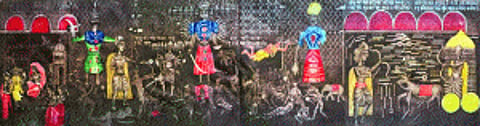
This is no ordinary picture of lord Ganesha. He sits on the lotus flower in the same posture as Goddess lakshmi. His head is turned towards the right, giving an impression that he is fondly watching his pet mouse. limited colours, like shades of red and grey, are used in the background. This is a printmaking work by Uma Shankar Shah. like this, most of his works from his recent series that will be displayed at Shridharani Gallery, Triveni Kala Sangam, are based on mythology. Titled Sacred Spaces, most of the works depict scenes from Ramayana and some are based on Buddhist scriptures and beliefs.
The artist’s work documents the birth of Sita, the garland ceremony and the mighty bow, her trip to Ayodhya, her subsequent exile into the forest with lord Rama, her abduction, the search launched for her and the ensuing battle in which the demon Ravana is defeated. Since Shankar hails from Janakpur in Nepal, his narrative and imagery are deeply rooted in Mithila tradition and folklore. Shankar reinterprets the classical Mithila silhouette — with doe-like eyes — to depict his characters. Though the hallmark of Shankar’s prints have been dark and nocturnal, this series marks a departure as the artist uses a red palette with earthy tones to recreate the colours of ancient frescoes where red earth and mud served as natural pigments. In some prints, the earth tones are evocative of the dust that is generated in the battle in which these epic characters clashed. Shankar portrays Ravan as the traditional firework puppet that is set alight in Dussehra to celebrate the victory of good over evil. Arrows dart across the canvas, the great beasts of war — elephants, horses and chariots — are featured amongst the dead and the wounded. The artist uses ancient shlokas from Maithali, Awadhi, Bhojpuri and Sanskrit to reverentially evoke the mood of this great epic. “Through my Ramayana series and by depicting the scenes from the battlefield on my canvas I wanted to give a message that characters like Ram, who stands as a metaphor for goodness, and Ravan, who is a metaphor of evil, are present within us. The responsibility to kill the evil within and bring out the goodness lies on each one of us. This exhibition will also include some works from the Shanti Yagna series. I did the series as a response to the bloodshed in Nepal. The country was facing turbulent times and to spread the message of peace I did the series that used the imagery of the prayer wheel to make an appeal for peace. The iconic Tibetan prayer wheel is reworked with Mithila folk characters to portray a tragic reality — the land where the Buddha was born is in a state of unrest,” explains Shankar, who has been in the art of printmaking for the past 20 years. He completed his masters in printmaking from Varanasi. He and his wife, Seema Shah, moved to Nepal in 1995 and since then their printmaking works and paintings reflect the culture and traditions of both India and Nepal.
Prior to this series, it was cityscapes that formed the subject of the artist’s works. The exhibition will also include 15 prints by Seema that showcase deities from the Hindu and Buddhist pantheon. Seema is adept at creating a landscape in which, a pantheon of heavenly beings, are surreptitiously caught in a mysterious twilight zone. In this series, Seema takes heed of the fact that Nepal has been regarded as a great tantric shakti sthal or power centre, where the cult of the Goddess has led to the worship of her many manifestations — from Virgin Goddess to the wrathful Kali. Hence, we find the portrayal of the Kumari and the Nava Durgas (nine manifestations of the self same Goddess). The 10 avatars of Vishnu are also depicted in tune with the belief that Vishnu’s reincarnations are taken to eradicate evil. The stories of Krishna leela, the sublime power of the Pancha and Dipankar Buddha are also portrayed in her prints.
“Our art practice was quite different before we met each other. While I used to paint cityscapes and landscapes inspired by the Pagodas of Nepal, Seema was into painting the daily scenes of Indian life. When she came to Kathmandu, she was inspired by the religious pulse of this city where Hindu and Buddhist cultures co-exist,” says Shankar.
Printmaking is an extensive technique and is a laborious process. Shankar informs that one frame takes him almost two months to complete. “It is a highly technical process that involves a lot of science. One needs a sheet of metal on which initially a drawing is made. later the sheet is treated with chemicals. It takes many trials to bring a different effect on the frame. The cost of completing one piece is pretty high. The size of frames that I usually do requires four metal sheet and only that costs around Rs16,000. Add to that other expenses and the final cost that I have to bear for each piece is around Rs35,000. This is one reason why not many artists try printmaking,” says Shankar.
The artist has started work on his next series as well. It will present how trains served as an important link for cultural exchange between India and Nepal. Shankar says, “The rail link was built by the Britishers for trade purposes. Initially the train used to carry woods from the jungles of Nepal to India, which was industrially developed then as compared to Nepal. Apart from wood, raw material for major industrial produce came from Nepal. It was I think in the year 1912. later, when people also started travelling between the two places, an extra bogey was added to ferry passengers. This was how the rail link started and contributed to the cultural exchange between India and Nepal. I came across these old engines near Jainagar in Bihar. Almost four kilometers away from Jainagar there is a place which is like a dumping ground of old engines. They are in ruined state right now. I visited the place several times to draw images of various parts of the engine. Interestingly, each is names on the gods of Nepal. like Pashupati, Sita, Chandra, Mahavir and Krishna. Each had a story behind it. For example, the train between Raxaul and Amlekhganj in Nepal was usually boarded by the devotees to Pashupatinath shrine in Nepal and therefore the engine was called Pashupati.” The exhibition which will present train as a metaphor of cultural harmony will follow Sacred Spaces.